
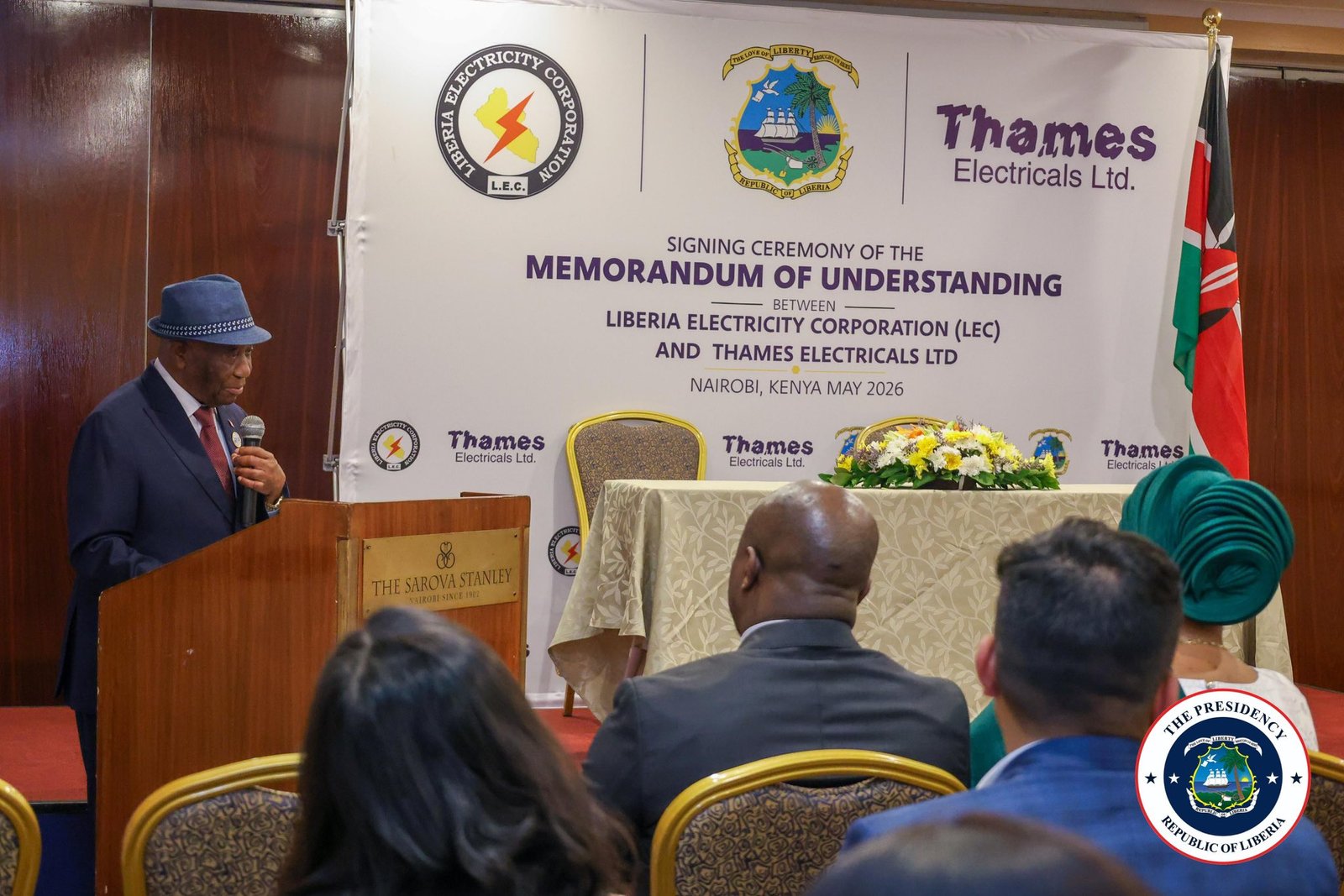

The Liberia Electricity Corporation (LEC) signed a $26 million agreement with Kenyan firm Thames Electricals Limited on Tuesday to establish Liberia’s first electrical manufacturing plant, a deal President Joseph Boakai described as a turning point in the country’s industrial development.
The memorandum of understanding was signed on the margins of the inaugural Africa Forward Summit in Nairobi, Kenya, a two-day gathering co-hosted by Kenya and France that brought together more than 30 heads of state, the African Union, and over 1,500 business leaders, entrepreneurs and investors to accelerate partnerships across energy, industrialization, finance and digital technology.
The proposed facility will manufacture transformers, conductors, switchgears and smart meters locally, reducing Liberia’s dependence on imported electrical equipment.
“This represents the beginning of the end of Liberia’s dependence on imported electrical materials,” Boakai said.
“By producing these materials locally, we will drastically reduce procurement and delivery timelines while creating opportunities for industrial growth and job creation.”
Thames Electricals, which has distributed electrical products across Kenya and East Africa since 1982 and represents global brands including ABB and Osram, marks its first manufacturing venture outside Kenya with the Liberia project.
The company’s CEO said the investment was designed to serve as a model for broader Kenyan business engagement across the continent.
“We will do our best to make Kenya proud in Liberia and ensure that Liberia feels that our countries are not just on the same continent, but are like family,” he said.
The agreement follows high-level discussions between Boakai and Kenyan President William Ruto, during which electrical manufacturing was identified as a priority area for bilateral cooperation.
LEC Managing Director Mohammed Sheriff said the investment would significantly shorten procurement timelines, a long-standing bottleneck in Liberia’s energy sector.
Momo Tamba Tulay, a financial management analyst, called the deal overdue. “This is the kind of strategic investment Liberia has needed for years,” Tulay said. Beyond energy, he argued, the plant opens a wider industrial logic.
“It is about reducing dependence on imports, creating skilled jobs, strengthening energy infrastructure, and positioning Liberia as an emerging industrial hub in West Africa,” Tulay added.
He said successful execution would deliver cascading benefits. Shorter procurement timelines, lower operational costs for LEC, and technology transfer for Liberian engineers and technicians all depend on the quality of implementation.
“Strong infrastructure and industrialization are key pillars of sustainable economic growth,” he said, “and partnerships like this can help move Liberia from consumption to production,” he stated.
Boakai said Liberia’s existing regional energy interconnections with Sierra Leone, Guinea and Côte d’Ivoire position the country as a potential supply hub for electrical equipment across West Africa.