

Bantu Gazette

Bantu Gazette
  • Energy & Trade
  • Finance
  • Health
  • Politics & Economy
  • Technology
  • Environment
  • Feature
  • Opinion
  • Changemakers
  • Tourism & Culture
  • Sports
  • Magazine
Menu
  • Black Frame Studio
  • Magazine

‘Never Miss an Opportunity to Tell Your Story’

Togolese author and Pan-Africanist Farouk Mintoiba uses literature, language and community leadership to reshape narratives about Africa

‘Never Miss an Opportunity to Tell Your Story’

Farouk Mintoiba

Bukelwa Maphangaby Bukelwa Maphanga
May 16, 2026
Reading Time: 5 mins read

‘Never Miss an Opportunity to Tell Your Story’

Togolese author and Pan-Africanist Farouk Mintoiba uses literature, language and community leadership to reshape narratives about Africa

‘Never Miss an Opportunity to Tell Your Story’

Farouk Mintoiba

‘Never Miss an Opportunity to Tell Your Story’

Farouk Mintoiba

Bukelwa Maphangaby Bukelwa Maphanga
May 16, 2026
Reading Time: 5 mins read

Farouk Mintoiba had heard the questions so many times he could anticipate them before they arrived. People wanted to know about poverty, about conflict, about animals. Rarely did they ask about his family back home, his grandfather’s farm, or the political debates shaping Togo’s public life. Those questions told him everything he needed to know about where Africa’s story was being written, and by whom.

The encounters set the intellectual direction for the 30-year-old Togolese writer and youth advocate, whose work now spans two published books, a diaspora advocacy platform, and a professional role in youth development at a major multilateral institution. Each of these efforts is driven by the conviction that Africans must tell their own stories, wherever they find an audience willing to listen.

Mintoiba arrived in Türkiye in 2018 on a scholarship to pursue a master’s degree in African studies and international relations. The program was conducted in English, making Turkish optional.

He enrolled in Turkish language courses anyway and practiced beyond the classroom, attending conferences, workshops, and public gatherings where Turkish shaped every exchange, deliberately placing himself in situations where the language was the only currency that worked.

“Anytime, anywhere, particularly when we are actually blessed with such an advantage as learning a new language, please use it,” he said.

Those same interactions revealed a pattern that would eventually become a book. People he met, curious and well-meaning, asked him questions about Africa that stopped him cold. Were there animals roaming freely? Was the continent really as desperate as television suggested?

The questions reflected assumptions accumulated over decades of skewed media coverage. His first instinct was to withdraw, to disengage from conversations that seemed to lead nowhere productive.

He later decided to walk toward the ignorance rather than away from it, trying to understand where it came from.

Many of the people asking those questions told him they had no resources about Africa available in Turkish, and that the resources available in English were produced mainly by Western countries.

The problem was a structural absence of African-authored knowledge in a language spoken by millions, and Mintoiba resolved to address it directly through his own writing.
Farouk Mintoiba

Writing Africa From an African Perspective

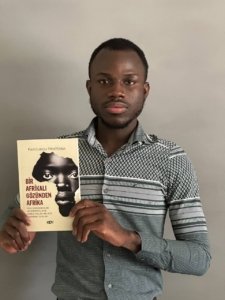
The book that became Bir Afrikalı Gözünden Afrika, Africa Through the Eyes of an African, had a complicated birth.

Mintoiba first attempted a novel, imagining a love story between an African man and a Turkish woman to draw readers in before teaching them something.

He drafted it, examined it honestly, and walked away. He contacted the publisher to withdraw the manuscript and started again, this time writing in the form of a direct personal essay addressed to the reader without narrative distance.

The essay challenges some of the most durable myths that follow Africa wherever its image travels, insisting on context and specificity in place of sweeping generalizations.

A continent of 54 countries, each with distinct political histories, cultures and economic realities, deserves to be understood through the full complexity of its parts rather than through the crisis of any single one.

“It is not because people in Syria once faced war that Türkiye caught fire,” he writes. “The same logic applies to Africa.”

His challenge to conventional poverty measurements draws directly from his family’s experience in Togo.

He describes his grandfather growing food, sustaining a household and living with minimal monetary dependence, spending perhaps a single dollar a week when a trip to the market was necessary.

International development indices register that existence as poverty, while Mintoiba reads it as dignity, stability and a form of sufficiency that urban life in Ankara or Istanbul rarely produces.

“There are people living better lives in those situations than we are here, stressed about rent, bills and transport,” he said. “They are just living. And they are happy.”

Readers responded to the book’s emotional charge. One told him she could feel his anger in certain passages confronting misrepresentation.

He received the observation as confirmation that the writing had carried what he intended.

Readers who told him the book felt autobiographical confirmed something he had already sensed, that an African writing honestly about Africa from inside a foreign country was never really writing only about himself.

“The story of any African in Türkiye is my own story,” he said.

The book was published in early 2023. Working on ideas that had been forming since his student years in Benin, Mintoiba drafted Les Drames Psychologiques de la Jeune Génération Noire, The Psychological Drama of the Black Youth Generation, beginning in 2016.

The French-language work examines the internal pressures shaping young Black people navigating identity, expectation and inheritance, and was published just last year. Together the two books form a diptych, one looking inward at the African self, the other looking outward at how that self is perceived and reduced by forces external to the continent.
Farouk Mintoiba

Building Platforms for African Voices

Mintoiba had understood early that writing alone would carry only part of the weight. Back in Togo, before leaving for graduate study, he founded Savannah Youth Revealed, a youth association committed to bringing the Sustainable Development Goals into local communities.

The organization struggled after his departure, and the experience clarified something essential about the relationship between leadership and institutional durability.

“Leadership means making sure what you created can live even when you are not there,” he said.

That lesson informed his co-founding of Bizim Afrika, which translates from Turkish as Our Africa, a platform established in 2024 alongside other Africans based in Türkiye.

The platform grew from a straightforward observation that accomplished Africans were present across Türkiye in significant numbers, contributing across professional, academic and entrepreneurial sectors, while the broader public conversation remained anchored to a much narrower image of who Africans in the country were.

“When Turkish people talk about Africans here, they think of those in Aksaray [a neighborhood in Istanbul known for its migrant business community] selling watches,” Mintoiba said. “They overlook those who are educated and achieving.”

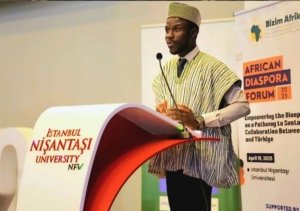
Bizim Afrika provides a structured space for those professionals, as the platform hosts the African Diaspora Forum, now in its third edition. The forum brings together African entrepreneurs, students, diplomats, and civil society representatives to share their work, showcase their businesses, and build professional networks.

Workshops on leadership, entrepreneurship and advocacy run alongside panel discussions. Business owners receive exhibition space at no cost. TRT Afrika [a Turkish public broadcaster with a dedicated Africa-focused channel] has covered the program, extending its reach beyond the immediate diaspora community.

Professionally, Mintoiba works as a youth capacity-building officer at the Islamic Cooperation Youth Forum, the youth institution of the Organization of Islamic Cooperation, where he leads programs that support young people across member states in developing skills in leadership, diplomacy, and entrepreneurship.
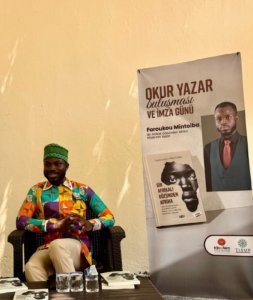
Farouk MintoibaA Commitment to Telling the Story

Throughout his writing and advocacy, Mintoiba returns to the warning Nigerian author Chimamanda Ngozi Adichie gave the world about the danger of a single story. He applies it as practical guidance rather than theoretical reference, directing it at both the audiences he addresses and the Africans he hopes to mobilize.

“Develop the ability to question whatever comes in front of you,” he said. “Most of the negative storytelling about Africa is the result of the way Western countries have seen our continent for a very long time.”

His message to Africans in the diaspora carries particular force. A community that learns the language of its host country and then uses that language to reframe how the host country understands Africa is doing something no foreign correspondent can replicate.

Learning Turkish and then writing an entire book in Turkish was, for Mintoiba, a deliberate act with a clear purpose. “You came to Türkiye and you learned Turkish,” he said. “What is the point of learning Turkish if you are not able to use it to make people better understand you?”

Mintoiba resists ideological labels and expresses impatience with Pan-Africanism that remains at the level of declaration.

Sustained, visible effort communicates more than any political branding can sustain over time, and he measures his own contribution by what the work produces rather than what it proclaims.

“If you check, you will not see anywhere that I wrote that I am a Pan-Africanist,” he said. “It’s about doing. If whatever I’m doing shows that I am, that’s perfect.”

He hopes to eventually return to Africa, to work in Togo or elsewhere on the continent.

“Even if I’m not in Africa right now, at least I’m working for Africa,” he said.
Get the inside Story

Stay informed on the stories shaping Africa’s future. Get breaking news, in-depth analysis, opinions and exclusive insights from across the continent delivered to your inbox, free and unfiltered.


Get in touch for more:
Felix Tih
Editorial Director, Bantu Gazette
WhatsApp
LinkedIn
X (Twitter)
Instagram

Related Posts

Rwanda Highlights Skills Development in Creative Economy Strategy
Tourism & Culture

Rwanda Highlights Skills Development in Creative Economy Strategy

May 16, 2026
Ethiopia Receives Emperor Tewodros II Relics as African Heritage Repatriations Gather Pace
Tourism & Culture

Ethiopia Receives Emperor Tewodros II Relics as African Heritage Repatriations Gather Pace

May 13, 2026
African Creators Gather at Adwa Memorial to Reclaim the Continent’s Story
Tourism & Culture

African Creators Gather at Adwa Memorial to Reclaim the Continent’s Story

May 8, 2026
The Father of Ethio-Jazz Takes His Farewell Bow
Feature

The Father of Ethio-Jazz Takes His Farewell Bow

May 7, 2026
Ethiopia Overhauls Visa Framework to Attract Long-Term Investors
Tourism & Culture

Ethiopia Overhauls Visa Framework to Attract Long-Term Investors

April 8, 2026
Uganda Returns Rhinos to Kidepo Valley After Four Decades
Tourism & Culture

Uganda Returns Rhinos to Kidepo Valley After Four Decades

March 22, 2026

Most Recent

‘Never Miss an Opportunity to Tell Your Story’
Tourism & Culture

‘Never Miss an Opportunity to Tell Your Story’

by Bukelwa Maphanga
May 16, 2026
0

Farouk Mintoiba had heard the questions so many times he could anticipate them before they arrived. People wanted to know...

Read moreDetails
Rwanda Highlights Skills Development in Creative Economy Strategy

Rwanda Highlights Skills Development in Creative Economy Strategy

May 16, 2026
Ethiopia Export Earnings Surge to $8.7 Billion in Ten Months

Ethiopia Export Earnings Surge to $8.7 Billion in Ten Months

May 16, 2026
Liberia to Build its 1st Electrical Manufacturing Plant in $26M Deal with Kenyan Firm

Liberia to Build its 1st Electrical Manufacturing Plant in $26M Deal with Kenyan Firm

May 14, 2026
South Africa Allocates $1.7 Billion to Road Agency for Network Expansion

South Africa Allocates $1.7 Billion to Road Agency for Network Expansion

May 13, 2026
Ethiopia Receives Emperor Tewodros II Relics as African Heritage Repatriations Gather Pace

Ethiopia Receives Emperor Tewodros II Relics as African Heritage Repatriations Gather Pace

May 13, 2026
Rwanda Secures €45M to Expand Climate-Resilient Irrigation in Drought-Prone East

Rwanda Secures €45M to Expand Climate-Resilient Irrigation in Drought-Prone East

May 12, 2026
‘Never Miss an Opportunity to Tell Your Story’
Tourism & Culture

‘Never Miss an Opportunity to Tell Your Story’

by Bukelwa Maphanga
Reading Time: 5 mins read
May 16, 2026
0

Farouk Mintoiba had heard the questions so many times he could anticipate them before they arrived. People wanted to know...

Read moreDetails
Rwanda Highlights Skills Development in Creative Economy Strategy
Tourism & Culture

Rwanda Highlights Skills Development in Creative Economy Strategy

by Jane Mukami
Reading Time: 2 mins read
May 16, 2026
0

KIGALI Rwanda is investing in skills development as part of its strategy to expand the creative economy, with officials calling...

Read moreDetails
Ethiopia Export Earnings Surge to $8.7 Billion in Ten Months
Politics & Economy

Ethiopia Export Earnings Surge to $8.7 Billion in Ten Months

by Kalkidan Negash
Reading Time: 1 min read
May 16, 2026
0

Ethiopia’s export revenues rose 43% to $8.71 billion in the first ten months of the current fiscal year, beating the...

Read moreDetails

‘Never Miss an Opportunity to Tell Your Story’

Togolese author and Pan-Africanist Farouk Mintoiba uses literature, language and community leadership to reshape narratives about Africa

‘Never Miss an Opportunity to Tell Your Story’

Farouk Mintoiba

Farouk Mintoiba had heard the questions so many times he could anticipate them before they arrived. People wanted to know about poverty, about conflict, about animals. Rarely did they ask about his family back home, his grandfather’s farm, or the political debates shaping Togo’s public life. Those questions told him everything he needed to know about where Africa’s story was being written, and by whom.

The encounters set the intellectual direction for the 30-year-old Togolese writer and youth advocate, whose work now spans two published books, a diaspora advocacy platform, and a professional role in youth development at a major multilateral institution. Each of these efforts is driven by the conviction that Africans must tell their own stories, wherever they find an audience willing to listen.

Mintoiba arrived in Türkiye in 2018 on a scholarship to pursue a master’s degree in African studies and international relations. The program was conducted in English, making Turkish optional.

He enrolled in Turkish language courses anyway and practiced beyond the classroom, attending conferences, workshops, and public gatherings where Turkish shaped every exchange, deliberately placing himself in situations where the language was the only currency that worked.

“Anytime, anywhere, particularly when we are actually blessed with such an advantage as learning a new language, please use it,” he said.

Those same interactions revealed a pattern that would eventually become a book. People he met, curious and well-meaning, asked him questions about Africa that stopped him cold. Were there animals roaming freely? Was the continent really as desperate as television suggested?

The questions reflected assumptions accumulated over decades of skewed media coverage. His first instinct was to withdraw, to disengage from conversations that seemed to lead nowhere productive.

He later decided to walk toward the ignorance rather than away from it, trying to understand where it came from.

Many of the people asking those questions told him they had no resources about Africa available in Turkish, and that the resources available in English were produced mainly by Western countries.

The problem was a structural absence of African-authored knowledge in a language spoken by millions, and Mintoiba resolved to address it directly through his own writing.

Farouk Mintoiba

Writing Africa From an African Perspective

The book that became Bir Afrikalı Gözünden Afrika, Africa Through the Eyes of an African, had a complicated birth.

Mintoiba first attempted a novel, imagining a love story between an African man and a Turkish woman to draw readers in before teaching them something.

He drafted it, examined it honestly, and walked away. He contacted the publisher to withdraw the manuscript and started again, this time writing in the form of a direct personal essay addressed to the reader without narrative distance.

The essay challenges some of the most durable myths that follow Africa wherever its image travels, insisting on context and specificity in place of sweeping generalizations.

A continent of 54 countries, each with distinct political histories, cultures and economic realities, deserves to be understood through the full complexity of its parts rather than through the crisis of any single one.

“It is not because people in Syria once faced war that Türkiye caught fire,” he writes. “The same logic applies to Africa.”

His challenge to conventional poverty measurements draws directly from his family’s experience in Togo.

He describes his grandfather growing food, sustaining a household and living with minimal monetary dependence, spending perhaps a single dollar a week when a trip to the market was necessary.

International development indices register that existence as poverty, while Mintoiba reads it as dignity, stability and a form of sufficiency that urban life in Ankara or Istanbul rarely produces.

“There are people living better lives in those situations than we are here, stressed about rent, bills and transport,” he said. “They are just living. And they are happy.”

Readers responded to the book’s emotional charge. One told him she could feel his anger in certain passages confronting misrepresentation.

He received the observation as confirmation that the writing had carried what he intended.

Readers who told him the book felt autobiographical confirmed something he had already sensed, that an African writing honestly about Africa from inside a foreign country was never really writing only about himself.

“The story of any African in Türkiye is my own story,” he said.

The book was published in early 2023. Working on ideas that had been forming since his student years in Benin, Mintoiba drafted Les Drames Psychologiques de la Jeune Génération Noire, The Psychological Drama of the Black Youth Generation, beginning in 2016.

The French-language work examines the internal pressures shaping young Black people navigating identity, expectation and inheritance, and was published just last year. Together the two books form a diptych, one looking inward at the African self, the other looking outward at how that self is perceived and reduced by forces external to the continent.

Farouk Mintoiba

Building Platforms for African Voices

Mintoiba had understood early that writing alone would carry only part of the weight. Back in Togo, before leaving for graduate study, he founded Savannah Youth Revealed, a youth association committed to bringing the Sustainable Development Goals into local communities.

The organization struggled after his departure, and the experience clarified something essential about the relationship between leadership and institutional durability.

“Leadership means making sure what you created can live even when you are not there,” he said.

That lesson informed his co-founding of Bizim Afrika, which translates from Turkish as Our Africa, a platform established in 2024 alongside other Africans based in Türkiye.

The platform grew from a straightforward observation that accomplished Africans were present across Türkiye in significant numbers, contributing across professional, academic and entrepreneurial sectors, while the broader public conversation remained anchored to a much narrower image of who Africans in the country were.

“When Turkish people talk about Africans here, they think of those in Aksaray [a neighborhood in Istanbul known for its migrant business community] selling watches,” Mintoiba said. “They overlook those who are educated and achieving.”

Bizim Afrika provides a structured space for those professionals, as the platform hosts the African Diaspora Forum, now in its third edition. The forum brings together African entrepreneurs, students, diplomats, and civil society representatives to share their work, showcase their businesses, and build professional networks.

Workshops on leadership, entrepreneurship and advocacy run alongside panel discussions. Business owners receive exhibition space at no cost. TRT Afrika [a Turkish public broadcaster with a dedicated Africa-focused channel] has covered the program, extending its reach beyond the immediate diaspora community.

Professionally, Mintoiba works as a youth capacity-building officer at the Islamic Cooperation Youth Forum, the youth institution of the Organization of Islamic Cooperation, where he leads programs that support young people across member states in developing skills in leadership, diplomacy, and entrepreneurship.

Farouk MintoibaA Commitment to Telling the Story

Throughout his writing and advocacy, Mintoiba returns to the warning Nigerian author Chimamanda Ngozi Adichie gave the world about the danger of a single story. He applies it as practical guidance rather than theoretical reference, directing it at both the audiences he addresses and the Africans he hopes to mobilize.

“Develop the ability to question whatever comes in front of you,” he said. “Most of the negative storytelling about Africa is the result of the way Western countries have seen our continent for a very long time.”

His message to Africans in the diaspora carries particular force. A community that learns the language of its host country and then uses that language to reframe how the host country understands Africa is doing something no foreign correspondent can replicate.

Learning Turkish and then writing an entire book in Turkish was, for Mintoiba, a deliberate act with a clear purpose. “You came to Türkiye and you learned Turkish,” he said. “What is the point of learning Turkish if you are not able to use it to make people better understand you?”

Mintoiba resists ideological labels and expresses impatience with Pan-Africanism that remains at the level of declaration.

Sustained, visible effort communicates more than any political branding can sustain over time, and he measures his own contribution by what the work produces rather than what it proclaims.

“If you check, you will not see anywhere that I wrote that I am a Pan-Africanist,” he said. “It’s about doing. If whatever I’m doing shows that I am, that’s perfect.”

He hopes to eventually return to Africa, to work in Togo or elsewhere on the continent.

“Even if I’m not in Africa right now, at least I’m working for Africa,” he said.

‘Never Miss an Opportunity to Tell Your Story’

Togolese author and Pan-Africanist Farouk Mintoiba uses literature, language and community leadership to reshape narratives about Africa

‘Never Miss an Opportunity to Tell Your Story’

Farouk Mintoiba

Bukelwa Maphangaby Bukelwa Maphanga
May 16, 2026

Farouk Mintoiba had heard the questions so many times he could anticipate them before they arrived. People wanted to know about poverty, about conflict, about animals. Rarely did they ask about his family back home, his grandfather’s farm, or the political debates shaping Togo’s public life. Those questions told him everything he needed to know about where Africa’s story was being written, and by whom.

The encounters set the intellectual direction for the 30-year-old Togolese writer and youth advocate, whose work now spans two published books, a diaspora advocacy platform, and a professional role in youth development at a major multilateral institution. Each of these efforts is driven by the conviction that Africans must tell their own stories, wherever they find an audience willing to listen.

Mintoiba arrived in Türkiye in 2018 on a scholarship to pursue a master’s degree in African studies and international relations. The program was conducted in English, making Turkish optional.

He enrolled in Turkish language courses anyway and practiced beyond the classroom, attending conferences, workshops, and public gatherings where Turkish shaped every exchange, deliberately placing himself in situations where the language was the only currency that worked.

“Anytime, anywhere, particularly when we are actually blessed with such an advantage as learning a new language, please use it,” he said.

Those same interactions revealed a pattern that would eventually become a book. People he met, curious and well-meaning, asked him questions about Africa that stopped him cold. Were there animals roaming freely? Was the continent really as desperate as television suggested?

The questions reflected assumptions accumulated over decades of skewed media coverage. His first instinct was to withdraw, to disengage from conversations that seemed to lead nowhere productive.

He later decided to walk toward the ignorance rather than away from it, trying to understand where it came from.

Many of the people asking those questions told him they had no resources about Africa available in Turkish, and that the resources available in English were produced mainly by Western countries.

The problem was a structural absence of African-authored knowledge in a language spoken by millions, and Mintoiba resolved to address it directly through his own writing.

Farouk Mintoiba

Writing Africa From an African Perspective

The book that became Bir Afrikalı Gözünden Afrika, Africa Through the Eyes of an African, had a complicated birth.

Mintoiba first attempted a novel, imagining a love story between an African man and a Turkish woman to draw readers in before teaching them something.

He drafted it, examined it honestly, and walked away. He contacted the publisher to withdraw the manuscript and started again, this time writing in the form of a direct personal essay addressed to the reader without narrative distance.

The essay challenges some of the most durable myths that follow Africa wherever its image travels, insisting on context and specificity in place of sweeping generalizations.

A continent of 54 countries, each with distinct political histories, cultures and economic realities, deserves to be understood through the full complexity of its parts rather than through the crisis of any single one.

“It is not because people in Syria once faced war that Türkiye caught fire,” he writes. “The same logic applies to Africa.”

His challenge to conventional poverty measurements draws directly from his family’s experience in Togo.

He describes his grandfather growing food, sustaining a household and living with minimal monetary dependence, spending perhaps a single dollar a week when a trip to the market was necessary.

International development indices register that existence as poverty, while Mintoiba reads it as dignity, stability and a form of sufficiency that urban life in Ankara or Istanbul rarely produces.

“There are people living better lives in those situations than we are here, stressed about rent, bills and transport,” he said. “They are just living. And they are happy.”

Readers responded to the book’s emotional charge. One told him she could feel his anger in certain passages confronting misrepresentation.

He received the observation as confirmation that the writing had carried what he intended.

Readers who told him the book felt autobiographical confirmed something he had already sensed, that an African writing honestly about Africa from inside a foreign country was never really writing only about himself.

“The story of any African in Türkiye is my own story,” he said.

The book was published in early 2023. Working on ideas that had been forming since his student years in Benin, Mintoiba drafted Les Drames Psychologiques de la Jeune Génération Noire, The Psychological Drama of the Black Youth Generation, beginning in 2016.

The French-language work examines the internal pressures shaping young Black people navigating identity, expectation and inheritance, and was published just last year. Together the two books form a diptych, one looking inward at the African self, the other looking outward at how that self is perceived and reduced by forces external to the continent.

Farouk Mintoiba

Building Platforms for African Voices

Mintoiba had understood early that writing alone would carry only part of the weight. Back in Togo, before leaving for graduate study, he founded Savannah Youth Revealed, a youth association committed to bringing the Sustainable Development Goals into local communities.

The organization struggled after his departure, and the experience clarified something essential about the relationship between leadership and institutional durability.

“Leadership means making sure what you created can live even when you are not there,” he said.

That lesson informed his co-founding of Bizim Afrika, which translates from Turkish as Our Africa, a platform established in 2024 alongside other Africans based in Türkiye.

The platform grew from a straightforward observation that accomplished Africans were present across Türkiye in significant numbers, contributing across professional, academic and entrepreneurial sectors, while the broader public conversation remained anchored to a much narrower image of who Africans in the country were.

“When Turkish people talk about Africans here, they think of those in Aksaray [a neighborhood in Istanbul known for its migrant business community] selling watches,” Mintoiba said. “They overlook those who are educated and achieving.”

Bizim Afrika provides a structured space for those professionals, as the platform hosts the African Diaspora Forum, now in its third edition. The forum brings together African entrepreneurs, students, diplomats, and civil society representatives to share their work, showcase their businesses, and build professional networks.

Workshops on leadership, entrepreneurship and advocacy run alongside panel discussions. Business owners receive exhibition space at no cost. TRT Afrika [a Turkish public broadcaster with a dedicated Africa-focused channel] has covered the program, extending its reach beyond the immediate diaspora community.

Professionally, Mintoiba works as a youth capacity-building officer at the Islamic Cooperation Youth Forum, the youth institution of the Organization of Islamic Cooperation, where he leads programs that support young people across member states in developing skills in leadership, diplomacy, and entrepreneurship.

Farouk MintoibaA Commitment to Telling the Story

Throughout his writing and advocacy, Mintoiba returns to the warning Nigerian author Chimamanda Ngozi Adichie gave the world about the danger of a single story. He applies it as practical guidance rather than theoretical reference, directing it at both the audiences he addresses and the Africans he hopes to mobilize.

“Develop the ability to question whatever comes in front of you,” he said. “Most of the negative storytelling about Africa is the result of the way Western countries have seen our continent for a very long time.”

His message to Africans in the diaspora carries particular force. A community that learns the language of its host country and then uses that language to reframe how the host country understands Africa is doing something no foreign correspondent can replicate.

Learning Turkish and then writing an entire book in Turkish was, for Mintoiba, a deliberate act with a clear purpose. “You came to Türkiye and you learned Turkish,” he said. “What is the point of learning Turkish if you are not able to use it to make people better understand you?”

Mintoiba resists ideological labels and expresses impatience with Pan-Africanism that remains at the level of declaration.

Sustained, visible effort communicates more than any political branding can sustain over time, and he measures his own contribution by what the work produces rather than what it proclaims.

“If you check, you will not see anywhere that I wrote that I am a Pan-Africanist,” he said. “It’s about doing. If whatever I’m doing shows that I am, that’s perfect.”

He hopes to eventually return to Africa, to work in Togo or elsewhere on the continent.

“Even if I’m not in Africa right now, at least I’m working for Africa,” he said.

Get the inside Story

Stay informed on the stories shaping Africa’s future. Get breaking news, in-depth analysis, opinions and exclusive insights from across the continent delivered to your inbox, free and unfiltered.


Get in touch for more:
Felix Tih
Editorial Director, Bantu Gazette
WhatsApp
LinkedIn
X (Twitter)
Instagram

Related Posts

Rwanda Highlights Skills Development in Creative Economy Strategy

Rwanda Highlights Skills Development in Creative Economy Strategy

by Jane Mukami
May 15, 2026
0

...

Ethiopia Receives Emperor Tewodros II Relics as African Heritage Repatriations Gather Pace

Ethiopia Receives Emperor Tewodros II Relics as African Heritage Repatriations Gather Pace

by Kalkidan Negash
May 13, 2026
0

...

African Creators Gather at Adwa Memorial to Reclaim the Continent’s Story

African Creators Gather at Adwa Memorial to Reclaim the Continent’s Story

by Kalkidan Negash
May 8, 2026
0

...

The Father of Ethio-Jazz Takes His Farewell Bow

The Father of Ethio-Jazz Takes His Farewell Bow

by Kalkidan Negash
May 7, 2026
0

...

Ethiopia Overhauls Visa Framework to Attract Long-Term Investors

Ethiopia Overhauls Visa Framework to Attract Long-Term Investors

by Felix Tih
April 7, 2026
0

...

Uganda Returns Rhinos to Kidepo Valley After Four Decades

Uganda Returns Rhinos to Kidepo Valley After Four Decades

by Amani Mwakalebela
March 22, 2026
0

...

‘Never Miss an Opportunity to Tell Your Story’
Tourism & Culture

‘Never Miss an Opportunity to Tell Your Story’

by Bukelwa Maphanga
Reading Time: 5 mins read
May 16, 2026
0

Farouk Mintoiba had heard the questions so many times he could anticipate them before they arrived. People wanted to know...

Read moreDetails
Rwanda Highlights Skills Development in Creative Economy Strategy

Rwanda Highlights Skills Development in Creative Economy Strategy

by Jane Mukami
May 15, 2026
0

KIGALI Rwanda is investing in skills development as part of its strategy to expand the creative economy, with officials calling...

Ethiopia Export Earnings Surge to $8.7 Billion in Ten Months

Ethiopia Export Earnings Surge to $8.7 Billion in Ten Months

by Kalkidan Negash
May 15, 2026
0

Ethiopia’s export revenues rose 43% to $8.71 billion in the first ten months of the current fiscal year, beating the...

Liberia to Build its 1st Electrical Manufacturing Plant in $26M Deal with Kenyan Firm

Liberia to Build its 1st Electrical Manufacturing Plant in $26M Deal with Kenyan Firm

by Aissatou Fall
May 14, 2026
0

The Liberia Electricity Corporation (LEC) signed a $26 million agreement with Kenyan firm Thames Electricals Limited on Tuesday to establish...

South Africa Allocates $1.7 Billion to Road Agency for Network Expansion

South Africa Allocates $1.7 Billion to Road Agency for Network Expansion

by Naledi Kgosi
May 13, 2026
0

South Africa's government has allocated nearly R31 billion (about $1.7 billion) to the country's national roads agency this financial year...

Bantu Gazette is a pioneering news platform that champions Africa's development, culture, and heritage. We spotlight the continent's successes, address its challenges, and provide insightful coverage of events that shape its future.

Bantu Gazette is a pioneering news platform that champions Africa's development, culture, and heritage. We spotlight the continent's successes, address its challenges, and provide insightful coverage of events that shape its future.

Our Platforms

  • Bantu Magazine
  • Bantu Brief
  • Black Frame Studio

Our Services

  • Bantu Agency
  • Advertise
  • Partnerships

Our Services

  • Editorial Director
  • Opportunities
  • Contact

Bantu Gazette is a pioneering news platform that champions Africa's development, culture, and heritage. We spotlight the continent's successes, address its challenges, and provide insightful coverage of events that shape its future.

Our Platforms

  • Bantu Magazine
  • Bantu Brief
  • Black Frame Studio

Our Services

  • Bantu Agency
  • Advertise
  • Partnerships

Our Services

  • Editorial Director
  • Opportunities
  • Contact
Bantu Gazette
  • Energy & Trade
  • Finance
  • Health
  • Politics & Economy
  • Technology
  • Environment
  • Feature
  • Opinion
  • Changemakers
  • Tourism & Culture
  • Magazine