


Bantu Gazette
  • Black Frame Studio
  • Magazine
No Result
View All Result
Bantu Gazette
  • Black Frame Studio
  • Magazine
No Result
View All Result
Bantu Gazette
No Result
View All Result

Kenya’s Gen Z Protests Mark a New Era of Youth Politics

Kenya’s Gen Z Protests Mark a New Era of Youth Politics

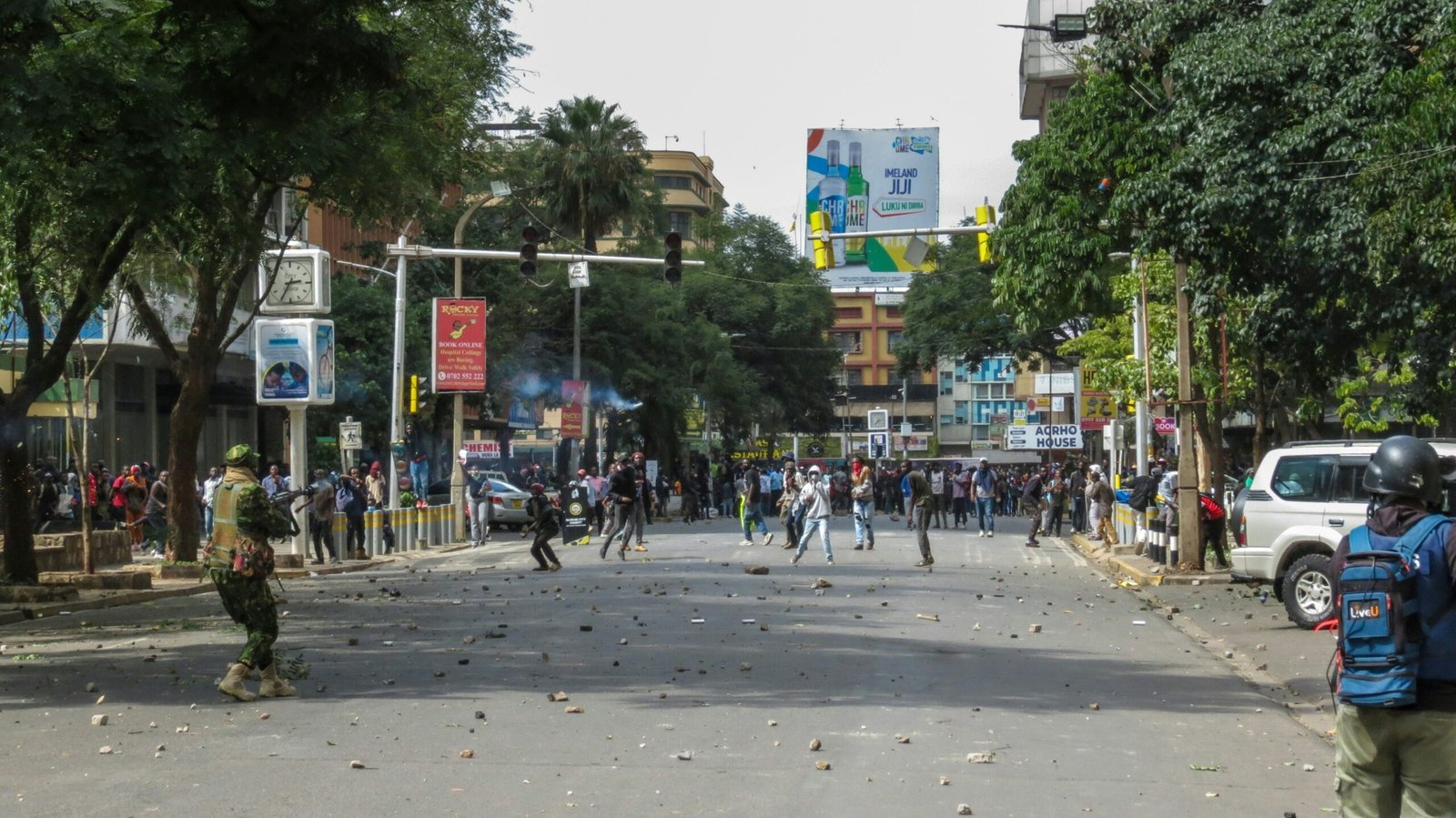
Protesters confront police officers amid civil unrest in Nairobi, Kenya. Photo by Story Zangu.

Felix Tihby Felix Tih
July 8, 2025
Reading Time: 5 mins read

Kenya’s Gen Z Protests Mark a New Era of Youth Politics

Kenya’s Gen Z Protests Mark a New Era of Youth Politics

Protesters confront police officers amid civil unrest in Nairobi, Kenya. Photo by Story Zangu.

Kenya’s Gen Z Protests Mark a New Era of Youth Politics

Protesters confront police officers amid civil unrest in Nairobi, Kenya. Photo by Story Zangu.

Felix Tihby Felix Tih
July 21, 2025
Reading Time: 5 mins read

NAIROBI – Thousands of Kenyan protesters returned to the streets in June 2025, driven by fresh outrage over police brutality and the symbolic power of an anniversary. The demonstrations erupted after blogger Albert Ojwang died in police custody on June 8, beaten to death despite official claims he committed suicide.

The protests spread across 23 counties, with authorities deploying tear gas, water cannons and live ammunition against largely peaceful crowds. At least 16 people died in the crackdown, according to human rights monitors.

The June 2025 protests demonstrates how a generational political awakening continues to challenge authority in one of Africa’s most influential democracies, sparked by both remembrance and immediate injustice.

‘Gen Z Saba Saba’ marks a fundamental shift in Kenyan politics. The movement takes its name from the historic July 7, 1990 protests that helped establish Kenya’s multi-party system. Today’s protesters, many born after 2000, have reclaimed ‘Saba Saba” to address economic despair, police brutality and institutional failure. They organize through encrypted chats and livestreams rather than political parties. They deploy memes and music as protest tools.

Ojwang’s killing crystallized the movement’s core grievances. The young blogger from Migori was arrested over a social media post, transported 350 kilometers to Nairobi, and found dead the next day.

His death followed a pattern of police violence that has persisted since the original protests began on June 18, 2024, when demonstrations first erupted following the release of the controversial Finance Bill 2024.

What started as opposition to proposed tax increases quickly evolved into a broader movement against systemic governance failures. The demonstrations reached their climax on June 25, 2024, when thousands of protesters stormed Parliament buildings in Nairobi, forcing President William Ruto to withdraw the bill. At least 60 people died in that initial uprising.

One year later, the grievances that sparked those protests remain largely unaddressed. Youth unemployment still exceeds 35% despite rising education levels. The government has reintroduced similar tax proposals in its 2025 Finance Bill. Most critically, police violence continues unabated, with Ojwang’s death serving as the latest example of institutional impunity.

A Global Pattern Emerges

Kenya’s youth uprising mirrors global movements that have redefined 21st-century protest. Chile’s 2019 student demonstrations, Nigeria’s EndSARS movement and Hong Kong’s 2019 resistance share key characteristics with Gen Z Saba Saba.

Some of these movements operate without centralized leadership. They use digital platforms for coordination. They reject traditional political frameworks. In Kenya, protesters chant “We are the leaders we’ve been waiting for,” echoing the same defiance seen across these global uprisings.

The similarities extend beyond tactics. Young people worldwide face similar challenges. Economic inequality has widened despite technological progress. Educational achievements fail to translate into meaningful employment. Political establishments remain unresponsive to youth concerns while older generations maintain control over key institutions.

Digital connectivity enables this generation to share strategies across borders. Kenyan protesters have studied successful tactics from other movements. They adapted Hong Kong’s use of encrypted messaging apps. They borrowed Nigeria’s social media mobilization techniques. They applied Chile’s decentralized organizing principles to local conditions.

Kenya’s protesters represent this global phenomenon with particular intensity. University graduates and young professionals lead demonstrations in Nairobi, Mombasa and Kisumu. They possess political awareness and digital fluency that previous generations lacked. They express deep disillusionment with promises of reform that yield only repression.

Their grievances transcend party politics. They criticize leaders across the political spectrum for failing to address fundamental problems. They demand accountability from institutions that have operated with impunity for decades. They refuse to accept explanations that satisfied previous generations.

Institutional Legitimacy Crumbles

The participation of educated, middle-class youth reveals Kenya’s deeper crisis. Public confidence in law enforcement, the presidency and Parliament continues to erode. Government responses have accelerated this breakdown rather than addressing underlying problems.

Ojwang’s death exemplifies the state’s failure to reform. Despite widespread condemnation of police violence during the 2024 protests, authorities continue killing citizens with impunity. The pattern established during the June 2024 demonstrations continues unchanged. Internet blackouts attempt to silence dissent while disrupting economic activity. Violent crackdowns have replaced dialogue as the primary government response to criticism.

The middle class traditionally serves as a stabilizing force in democratic societies. When educated youth join protests, it indicates fundamental problems with governance that transcend economic cycles or political transitions. Kenya’s leaders face a legitimacy crisis that force cannot resolve and that threatens the foundations of democratic governance.

Government officials continue to dismiss protesters as misguided or manipulated by opposition politicians. Yet the very fact that Kenyan youth can repeatedly take to the streets demonstrates a level of democratic space that remains absent in many African countries where such protests would be crushed before they began.

This response demonstrates a profound misunderstanding of the movement’s nature and objectives. Gen Z protesters explicitly reject traditional political leadership and party structures. They organize independently and pursue goals that extend beyond electoral politics.

The government’s directive to media outlets demanding they stop live coverage of the June 2025 protests reveals an administration increasingly concerned about controlling public narrative rather than addressing public grievances.

The demonstrations prove that Gen Z Saba Saba represents a political shift rather than a temporary uprising. Ojwang’s death and the fierce response it generated show that Kenya’s young people will not accept continued state violence. They have stopped waiting for leadership from established institutions and continue providing it themselves through grassroots organizing and direct action.

Whether this movement can sustain momentum and achieve concrete reforms remains uncertain. Previous protest movements in Kenya have achieved limited success before being co-opted or suppressed by political elites. This generation appears more resistant to traditional forms of political incorporation.

What appears clear is that Kenya’s political landscape will never return to its previous form. A generation has emerged that refuses to accept the status quo and possesses the tools to challenge it effectively. The sustained mobilization triggered by Ojwang’s killing demonstrates both the movement’s enduring organizational capacity and the state’s continued inability to address core grievances.

Kenya’s future depends on whether its institutions can adapt to this new reality. The alternative is continued cycles of protest and repression that will further erode the country’s democratic foundations and potentially destabilize one of East Africa’s anchor states.

By Felix Tih

Editorial Director, Bantu Gazette

Get the inside Story

Stay informed on the stories shaping Africa’s future. Get breaking news, in-depth analysis, opinions and exclusive insights from across the continent delivered to your inbox, free and unfiltered.


Related Posts

Kenya to Recruit 20,000 Teachers as Education Investments Pay Off
Politics & Economy

Kenya Introduces School Fees as Malawi Declares Free Education

November 10, 2025
South Africa’s G20 Presidency a Catalyst for Energy Investment in Africa
Politics & Economy

G20 Report Warns of Rising Inequality, Urges Global Action

November 5, 2025
Namibia Deepens Regional Ties Through Trade and Energy
Politics & Economy

Namibia Repays $750 Million Eurobond, Largest Debt Maturity in Its History

November 4, 2025
$1.5 Billion Fund Targets Infrastructure Projects Across Africa
Politics & Economy

$1.5 Billion Fund Targets Infrastructure Projects Across Africa

November 5, 2025
Paul Biya Wins Eighth Term in Disputed Cameroon Election
Politics & Economy

Paul Biya Wins Eighth Term in Disputed Cameroon Election

October 30, 2025
Nigeria Begins Training 1 Million Youth to Boost Jobs, Economic Inclusion
Politics & Economy

Nigeria Begins Training 1 Million Youth to Boost Jobs, Economic Inclusion

October 25, 2025

Most Recent

Zimbabwe Emerges as Top Travel Spot for 2025
Tourism & Culture

Zimbabwe Emerges as Top Travel Spot for 2025

by Naledi Kgosi
November 10, 2025
0

Zimbabwe has been named the top travel destination for 2025 by Forbes, following a sharp rise in interest from international...

Read moreDetails
Kenya to Recruit 20,000 Teachers as Education Investments Pay Off

Kenya Introduces School Fees as Malawi Declares Free Education

November 10, 2025
Ethiopia Launches First Electronic Passport, Marking New Era in Secure Travel

Ethiopia’s New E-passport Earns Global Design Honor

November 10, 2025
South Africa’s G20 Presidency a Catalyst for Energy Investment in Africa

G20 Report Warns of Rising Inequality, Urges Global Action

November 5, 2025
Namibia Deepens Regional Ties Through Trade and Energy

Namibia Repays $750 Million Eurobond, Largest Debt Maturity in Its History

November 4, 2025
Mali Unveils 2nd Lithium Mine as Part of Economic Sovereignty Push

Mali Unveils 2nd Lithium Mine as Part of Economic Sovereignty Push

November 5, 2025
$1.5 Billion Fund Targets Infrastructure Projects Across Africa

$1.5 Billion Fund Targets Infrastructure Projects Across Africa

November 5, 2025
Zimbabwe Emerges as Top Travel Spot for 2025
Tourism & Culture

Zimbabwe Emerges as Top Travel Spot for 2025

by Naledi Kgosi
Reading Time: 1 min read
November 10, 2025
0

Zimbabwe has been named the top travel destination for 2025 by Forbes, following a sharp rise in interest from international...

Read moreDetails
Kenya to Recruit 20,000 Teachers as Education Investments Pay Off
Politics & Economy

Kenya Introduces School Fees as Malawi Declares Free Education

by Jane Mukami
Reading Time: 1 min read
November 10, 2025
0

Kenya will begin charging public senior secondary school students an annual fee of KSh 53,554 (approximately $414) starting in 2026,...

Read moreDetails
Ethiopia Launches First Electronic Passport, Marking New Era in Secure Travel
Tourism & Culture

Ethiopia’s New E-passport Earns Global Design Honor

by Maraki Desta
Reading Time: 1 min read
November 10, 2025
0

Ethiopia's recently introduced electronic passport has won the 2025 Red Dot Award for Brands and Communication Design, according to Selamawit...

Read moreDetails

Kenya’s Gen Z Protests Mark a New Era of Youth Politics

Kenya’s Gen Z Protests Mark a New Era of Youth Politics

Protesters confront police officers amid civil unrest in Nairobi, Kenya. Photo by Story Zangu.

NAIROBI – Thousands of Kenyan protesters returned to the streets in June 2025, driven by fresh outrage over police brutality and the symbolic power of an anniversary. The demonstrations erupted after blogger Albert Ojwang died in police custody on June 8, beaten to death despite official claims he committed suicide.

The protests spread across 23 counties, with authorities deploying tear gas, water cannons and live ammunition against largely peaceful crowds. At least 16 people died in the crackdown, according to human rights monitors.

The June 2025 protests demonstrates how a generational political awakening continues to challenge authority in one of Africa’s most influential democracies, sparked by both remembrance and immediate injustice.

‘Gen Z Saba Saba’ marks a fundamental shift in Kenyan politics. The movement takes its name from the historic July 7, 1990 protests that helped establish Kenya’s multi-party system. Today’s protesters, many born after 2000, have reclaimed ‘Saba Saba” to address economic despair, police brutality and institutional failure. They organize through encrypted chats and livestreams rather than political parties. They deploy memes and music as protest tools.

Ojwang’s killing crystallized the movement’s core grievances. The young blogger from Migori was arrested over a social media post, transported 350 kilometers to Nairobi, and found dead the next day.

His death followed a pattern of police violence that has persisted since the original protests began on June 18, 2024, when demonstrations first erupted following the release of the controversial Finance Bill 2024.

What started as opposition to proposed tax increases quickly evolved into a broader movement against systemic governance failures. The demonstrations reached their climax on June 25, 2024, when thousands of protesters stormed Parliament buildings in Nairobi, forcing President William Ruto to withdraw the bill. At least 60 people died in that initial uprising.

One year later, the grievances that sparked those protests remain largely unaddressed. Youth unemployment still exceeds 35% despite rising education levels. The government has reintroduced similar tax proposals in its 2025 Finance Bill. Most critically, police violence continues unabated, with Ojwang’s death serving as the latest example of institutional impunity.

A Global Pattern Emerges

Kenya’s youth uprising mirrors global movements that have redefined 21st-century protest. Chile’s 2019 student demonstrations, Nigeria’s EndSARS movement and Hong Kong’s 2019 resistance share key characteristics with Gen Z Saba Saba.

Some of these movements operate without centralized leadership. They use digital platforms for coordination. They reject traditional political frameworks. In Kenya, protesters chant “We are the leaders we’ve been waiting for,” echoing the same defiance seen across these global uprisings.

The similarities extend beyond tactics. Young people worldwide face similar challenges. Economic inequality has widened despite technological progress. Educational achievements fail to translate into meaningful employment. Political establishments remain unresponsive to youth concerns while older generations maintain control over key institutions.

Digital connectivity enables this generation to share strategies across borders. Kenyan protesters have studied successful tactics from other movements. They adapted Hong Kong’s use of encrypted messaging apps. They borrowed Nigeria’s social media mobilization techniques. They applied Chile’s decentralized organizing principles to local conditions.

Kenya’s protesters represent this global phenomenon with particular intensity. University graduates and young professionals lead demonstrations in Nairobi, Mombasa and Kisumu. They possess political awareness and digital fluency that previous generations lacked. They express deep disillusionment with promises of reform that yield only repression.

Their grievances transcend party politics. They criticize leaders across the political spectrum for failing to address fundamental problems. They demand accountability from institutions that have operated with impunity for decades. They refuse to accept explanations that satisfied previous generations.

Institutional Legitimacy Crumbles

The participation of educated, middle-class youth reveals Kenya’s deeper crisis. Public confidence in law enforcement, the presidency and Parliament continues to erode. Government responses have accelerated this breakdown rather than addressing underlying problems.

Ojwang’s death exemplifies the state’s failure to reform. Despite widespread condemnation of police violence during the 2024 protests, authorities continue killing citizens with impunity. The pattern established during the June 2024 demonstrations continues unchanged. Internet blackouts attempt to silence dissent while disrupting economic activity. Violent crackdowns have replaced dialogue as the primary government response to criticism.

The middle class traditionally serves as a stabilizing force in democratic societies. When educated youth join protests, it indicates fundamental problems with governance that transcend economic cycles or political transitions. Kenya’s leaders face a legitimacy crisis that force cannot resolve and that threatens the foundations of democratic governance.

Government officials continue to dismiss protesters as misguided or manipulated by opposition politicians. Yet the very fact that Kenyan youth can repeatedly take to the streets demonstrates a level of democratic space that remains absent in many African countries where such protests would be crushed before they began.

This response demonstrates a profound misunderstanding of the movement’s nature and objectives. Gen Z protesters explicitly reject traditional political leadership and party structures. They organize independently and pursue goals that extend beyond electoral politics.

The government’s directive to media outlets demanding they stop live coverage of the June 2025 protests reveals an administration increasingly concerned about controlling public narrative rather than addressing public grievances.

The demonstrations prove that Gen Z Saba Saba represents a political shift rather than a temporary uprising. Ojwang’s death and the fierce response it generated show that Kenya’s young people will not accept continued state violence. They have stopped waiting for leadership from established institutions and continue providing it themselves through grassroots organizing and direct action.

Whether this movement can sustain momentum and achieve concrete reforms remains uncertain. Previous protest movements in Kenya have achieved limited success before being co-opted or suppressed by political elites. This generation appears more resistant to traditional forms of political incorporation.

What appears clear is that Kenya’s political landscape will never return to its previous form. A generation has emerged that refuses to accept the status quo and possesses the tools to challenge it effectively. The sustained mobilization triggered by Ojwang’s killing demonstrates both the movement’s enduring organizational capacity and the state’s continued inability to address core grievances.

Kenya’s future depends on whether its institutions can adapt to this new reality. The alternative is continued cycles of protest and repression that will further erode the country’s democratic foundations and potentially destabilize one of East Africa’s anchor states.

By Felix Tih

Editorial Director, Bantu Gazette

Kenya’s Gen Z Protests Mark a New Era of Youth Politics

Kenya’s Gen Z Protests Mark a New Era of Youth Politics

Protesters confront police officers amid civil unrest in Nairobi, Kenya. Photo by Story Zangu.

Felix Tihby Felix Tih
July 8, 2025

NAIROBI – Thousands of Kenyan protesters returned to the streets in June 2025, driven by fresh outrage over police brutality and the symbolic power of an anniversary. The demonstrations erupted after blogger Albert Ojwang died in police custody on June 8, beaten to death despite official claims he committed suicide.

The protests spread across 23 counties, with authorities deploying tear gas, water cannons and live ammunition against largely peaceful crowds. At least 16 people died in the crackdown, according to human rights monitors.

The June 2025 protests demonstrates how a generational political awakening continues to challenge authority in one of Africa’s most influential democracies, sparked by both remembrance and immediate injustice.

‘Gen Z Saba Saba’ marks a fundamental shift in Kenyan politics. The movement takes its name from the historic July 7, 1990 protests that helped establish Kenya’s multi-party system. Today’s protesters, many born after 2000, have reclaimed ‘Saba Saba” to address economic despair, police brutality and institutional failure. They organize through encrypted chats and livestreams rather than political parties. They deploy memes and music as protest tools.

Ojwang’s killing crystallized the movement’s core grievances. The young blogger from Migori was arrested over a social media post, transported 350 kilometers to Nairobi, and found dead the next day.

His death followed a pattern of police violence that has persisted since the original protests began on June 18, 2024, when demonstrations first erupted following the release of the controversial Finance Bill 2024.

What started as opposition to proposed tax increases quickly evolved into a broader movement against systemic governance failures. The demonstrations reached their climax on June 25, 2024, when thousands of protesters stormed Parliament buildings in Nairobi, forcing President William Ruto to withdraw the bill. At least 60 people died in that initial uprising.

One year later, the grievances that sparked those protests remain largely unaddressed. Youth unemployment still exceeds 35% despite rising education levels. The government has reintroduced similar tax proposals in its 2025 Finance Bill. Most critically, police violence continues unabated, with Ojwang’s death serving as the latest example of institutional impunity.

A Global Pattern Emerges

Kenya’s youth uprising mirrors global movements that have redefined 21st-century protest. Chile’s 2019 student demonstrations, Nigeria’s EndSARS movement and Hong Kong’s 2019 resistance share key characteristics with Gen Z Saba Saba.

Some of these movements operate without centralized leadership. They use digital platforms for coordination. They reject traditional political frameworks. In Kenya, protesters chant “We are the leaders we’ve been waiting for,” echoing the same defiance seen across these global uprisings.

The similarities extend beyond tactics. Young people worldwide face similar challenges. Economic inequality has widened despite technological progress. Educational achievements fail to translate into meaningful employment. Political establishments remain unresponsive to youth concerns while older generations maintain control over key institutions.

Digital connectivity enables this generation to share strategies across borders. Kenyan protesters have studied successful tactics from other movements. They adapted Hong Kong’s use of encrypted messaging apps. They borrowed Nigeria’s social media mobilization techniques. They applied Chile’s decentralized organizing principles to local conditions.

Kenya’s protesters represent this global phenomenon with particular intensity. University graduates and young professionals lead demonstrations in Nairobi, Mombasa and Kisumu. They possess political awareness and digital fluency that previous generations lacked. They express deep disillusionment with promises of reform that yield only repression.

Their grievances transcend party politics. They criticize leaders across the political spectrum for failing to address fundamental problems. They demand accountability from institutions that have operated with impunity for decades. They refuse to accept explanations that satisfied previous generations.

Institutional Legitimacy Crumbles

The participation of educated, middle-class youth reveals Kenya’s deeper crisis. Public confidence in law enforcement, the presidency and Parliament continues to erode. Government responses have accelerated this breakdown rather than addressing underlying problems.

Ojwang’s death exemplifies the state’s failure to reform. Despite widespread condemnation of police violence during the 2024 protests, authorities continue killing citizens with impunity. The pattern established during the June 2024 demonstrations continues unchanged. Internet blackouts attempt to silence dissent while disrupting economic activity. Violent crackdowns have replaced dialogue as the primary government response to criticism.

The middle class traditionally serves as a stabilizing force in democratic societies. When educated youth join protests, it indicates fundamental problems with governance that transcend economic cycles or political transitions. Kenya’s leaders face a legitimacy crisis that force cannot resolve and that threatens the foundations of democratic governance.

Government officials continue to dismiss protesters as misguided or manipulated by opposition politicians. Yet the very fact that Kenyan youth can repeatedly take to the streets demonstrates a level of democratic space that remains absent in many African countries where such protests would be crushed before they began.

This response demonstrates a profound misunderstanding of the movement’s nature and objectives. Gen Z protesters explicitly reject traditional political leadership and party structures. They organize independently and pursue goals that extend beyond electoral politics.

The government’s directive to media outlets demanding they stop live coverage of the June 2025 protests reveals an administration increasingly concerned about controlling public narrative rather than addressing public grievances.

The demonstrations prove that Gen Z Saba Saba represents a political shift rather than a temporary uprising. Ojwang’s death and the fierce response it generated show that Kenya’s young people will not accept continued state violence. They have stopped waiting for leadership from established institutions and continue providing it themselves through grassroots organizing and direct action.

Whether this movement can sustain momentum and achieve concrete reforms remains uncertain. Previous protest movements in Kenya have achieved limited success before being co-opted or suppressed by political elites. This generation appears more resistant to traditional forms of political incorporation.

What appears clear is that Kenya’s political landscape will never return to its previous form. A generation has emerged that refuses to accept the status quo and possesses the tools to challenge it effectively. The sustained mobilization triggered by Ojwang’s killing demonstrates both the movement’s enduring organizational capacity and the state’s continued inability to address core grievances.

Kenya’s future depends on whether its institutions can adapt to this new reality. The alternative is continued cycles of protest and repression that will further erode the country’s democratic foundations and potentially destabilize one of East Africa’s anchor states.

By Felix Tih

Editorial Director, Bantu Gazette

Get the inside Story

Stay informed on the stories shaping Africa’s future. Get breaking news, in-depth analysis, opinions and exclusive insights from across the continent delivered to your inbox, free and unfiltered.


Related Posts

Kenya to Recruit 20,000 Teachers as Education Investments Pay Off

Kenya Introduces School Fees as Malawi Declares Free Education

by Jane Mukami
November 10, 2025
0

...

South Africa’s G20 Presidency a Catalyst for Energy Investment in Africa

G20 Report Warns of Rising Inequality, Urges Global Action

by Naledi Kgosi
November 5, 2025
0

...

Namibia Deepens Regional Ties Through Trade and Energy

Namibia Repays $750 Million Eurobond, Largest Debt Maturity in Its History

by Amani Mwakalebela
November 4, 2025
0

...

$1.5 Billion Fund Targets Infrastructure Projects Across Africa

$1.5 Billion Fund Targets Infrastructure Projects Across Africa

by Maraki Desta
November 3, 2025
0

...

Paul Biya Wins Eighth Term in Disputed Cameroon Election

Paul Biya Wins Eighth Term in Disputed Cameroon Election

by Bantu Gazette
October 27, 2025
0

...

Nigeria Begins Training 1 Million Youth to Boost Jobs, Economic Inclusion

Nigeria Begins Training 1 Million Youth to Boost Jobs, Economic Inclusion

by Cynthia N. Ganchok
October 25, 2025
0

...

Zimbabwe Emerges as Top Travel Spot for 2025
Tourism & Culture

Zimbabwe Emerges as Top Travel Spot for 2025

by Naledi Kgosi
Reading Time: 1 min read
November 10, 2025
0

Zimbabwe has been named the top travel destination for 2025 by Forbes, following a sharp rise in interest from international...

Read moreDetails
Kenya to Recruit 20,000 Teachers as Education Investments Pay Off

Kenya Introduces School Fees as Malawi Declares Free Education

by Jane Mukami
November 10, 2025
0

Kenya will begin charging public senior secondary school students an annual fee of KSh 53,554 (approximately $414) starting in 2026,...

Ethiopia Launches First Electronic Passport, Marking New Era in Secure Travel

Ethiopia’s New E-passport Earns Global Design Honor

by Maraki Desta
November 10, 2025
0

Ethiopia's recently introduced electronic passport has won the 2025 Red Dot Award for Brands and Communication Design, according to Selamawit...

South Africa’s G20 Presidency a Catalyst for Energy Investment in Africa

G20 Report Warns of Rising Inequality, Urges Global Action

by Naledi Kgosi
November 5, 2025
0

The G20 Global Inequality Report, presented Tuesday to President Cyril Ramaphosa in Cape Town, outlines a stark portrait of inequality...

Namibia Deepens Regional Ties Through Trade and Energy

Namibia Repays $750 Million Eurobond, Largest Debt Maturity in Its History

by Amani Mwakalebela
November 4, 2025
0

Namibia has fully repaid its $750 million Eurobond issued in 2015, the country’s largest-ever debt maturity, according to a government...

Next Post
Sierra Leone Launches $180 Million Water Access Initiative

Sierra Leone Launches $180 Million Water Access Initiative

Burkina Faso : 101 milliards de F CFA collectés pour le fonds de soutien patriotique

Burkina Faso : 101 milliards de F CFA collectés pour le fonds de soutien patriotique

Cameroon Maps Path to National AI Strategy After Two-Day Conference

Cameroon Maps Path to National AI Strategy After Two-Day Conference

Kenya Officially Grants Visa-Free Entry to African Nations

Kenya Officially Grants Visa-Free Entry to African Nations

The editorial platform of Bantu Agency.

The editorial platform of Bantu Agency.

Our Platforms

  • Bantu Magazine
  • Bantu Brief
  • Black Frame Studio

Our Services

  • Bantu Agency
  • Advertise
  • Partnerships

Our Services

  • Editorial Director
  • Opportunities
  • Contact

The editorial platform of Bantu Agency.

Our Platforms

  • Bantu Magazine
  • Bantu Brief
  • Black Frame Studio

Our Services

  • Bantu Agency
  • Advertise
  • Partnerships

Our Services

  • Editorial Director
  • Opportunities
  • Contact
Bantu Gazette
  • Energy & Trade
  • Finance
  • Health
  • Politics & Economy
  • Technology
  • Environment
  • Feature
  • Opinion
  • Changemakers
  • Tourism & Culture
  • Magazine