
Bantu Gazette

Bantu Gazette
  • Policy & Governance
  • Development & Impact
  • Business, Trade & Economy
  • Energy
  • Changemakers
  • Culture & Identity
  • Perspectives
  • Magazine
Menu
  • Black Frame Studio
  • Magazine

Dangote Deepens East Africa Investment Drive

Energy, fertilizer and the continent’s push to process its own resources

Dangote Deepens East Africa Investment Drive

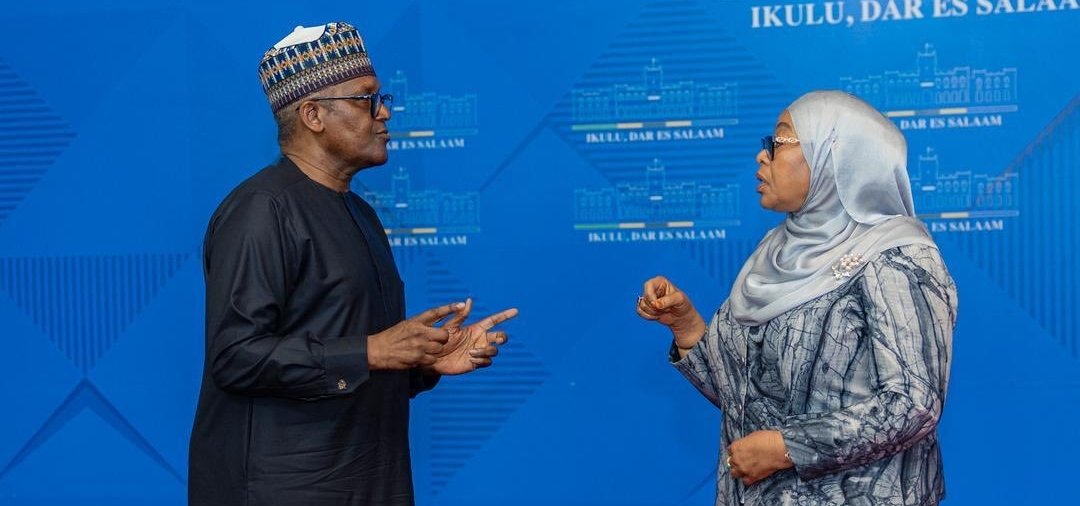
Samia Suluhu meets Ali Dangote

Kalkidan Negashby Kalkidan Negash
May 19, 2026
Reading Time: 6 mins read

Dangote Deepens East Africa Investment Drive

Energy, fertilizer and the continent’s push to process its own resources

Dangote Deepens East Africa Investment Drive

Samia Suluhu meets Ali Dangote

Dangote Deepens East Africa Investment Drive

Samia Suluhu meets Ali Dangote

Kalkidan Negashby Kalkidan Negash
July 11, 2026
Reading Time: 6 mins read

ADDIS ABABA

Aliko Dangote spent several weeks in April and May 2026 advancing a consistent message in Nairobi, Dar es Salaam, Kampala and Gode. Africa exports raw materials and imports finished products despite having the capital, institutions and industrial capacity to process its own resources.

The campaign opened at the inaugural Africa We Build Summit in Nairobi on April 23, hosted by the Africa Finance Corporation and the Kenyan government.

Dangote appeared on a panel with Kenyan President William Ruto and Ugandan President Yoweri Museveni and committed to building a 650,000-barrel-per-day regional oil refinery in East Africa modeled on his refinery in Ibeju-Lekki, Lagos, Nigeria.

The Lagos refinery began crude distillation in January 2024 and reached full nameplate capacity in early 2026. The project cost approximately $20 billion and became the world’s largest single-train refinery.

“My commitment is, if we agree here with the three or four governments, we will lead and make sure that refinery is built within the next four to five years,” Dangote told the summit. “Even now, I can give commitment to the two presidents who are here if they will support the refinery, we will build an identical one to what we have in Nigeria.”

Ruto welcomed the proposal and said Kenya would support the project. He later wrote on social media that Kenya was committed to partnering with Uganda and Tanzania on the refinery initiative.
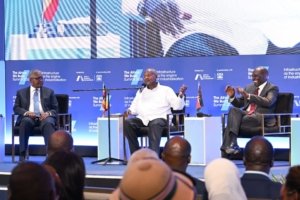
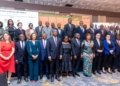
Ali Dangote, Yoweri Museveni, and William Ruto at the Africa We Build Summit

The proposed refinery carries an estimated cost of between $15 billion and $17 billion. The facility would process crude from Uganda, South Sudan, Kenya and the Democratic Republic of Congo.

East Africa currently imports most of its refined petroleum products, leaving regional markets exposed to global supply disruptions such as the tightening in fuel flows linked to US-Iran tensions from late February 2026.

Dangote urged African investors and institutions to finance industrial development across the continent.

“We have $550 billion of savings in Africa and you are funding something totally irrelevant,” he said. “A domestic investor must take the risk and start developing your own continent. Not for you to wait for foreign investors. Foreign investors will only come when things are looking rosy and good.”

Museveni framed the refinery discussion within the wider history of African integration and industrial policy.

“The mistake makers have failed, so people have seen the mistakes,” he said. “The youth have no jobs. People can now listen more.”

Ruto described the region’s development priorities as internally driven.

“The question is what is different now? There is a realization by all of us that the solution to the challenges and problems we have is not out there. It is right with us.”

The location question

The Nairobi summit identified Tanzania’s port city of Tanga as an early option for the refinery. Tanga serves as the terminal point for the 1,443-kilometer East African Crude Oil Pipeline linking Uganda’s Hoima oil fields to the Indian Ocean. First oil exports through the pipeline are expected in the second half of 2026.

A refinery at Tanga would allow Ugandan crude to move directly by pipeline for coastal refining and regional fuel distribution.

Tanzanian President Samia Suluhu Hassan later said she had not been consulted before the Nairobi announcement. Public discussion around the refinery site intensified after Ruto referenced the Tanga proposal at the Kenya Mining Investment Conference on April 28.
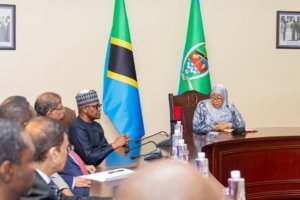
‘Dangote is one of the major investors in Tanzania,’ President Suluhu said

Dangote’s stated preference shifted toward Kenya in a Financial Times interview published May 10. He cited Mombasa’s deep-water port, logistics infrastructure and fuel market.

“Mombasa has a much larger, deeper port,” Dangote said.

Kenya imported 40 million barrels of petroleum in 2025.

Samia received Dangote at State House in Dar es Salaam on May 16. She confirmed the meeting and highlighted Dangote Group’s existing investments in Tanzania, including the Mtwara cement plant commissioned in December 2015.

The $500 million facility has an annual production capacity of 3 million tonnes and operates on locally sourced natural gas. It remains the largest cement factory in Tanzania.

Dangote met Museveni at State Lodge Nakasero in Kampala on May 17. Museveni reiterated Uganda’s long-standing position on domestic refining and value addition.

Museveni reiterated Uganda’s long-standing position on refining crude domestically before export.

“I informed him that from the very beginning, we have always opposed the export of raw materials without value addition,” Museveni wrote on May 18.
President Yoweri Museveni and Aliko Dangote discuss the proposed East African regional refinery.

He said Uganda delayed oil production because the government wanted refining capacity in place before crude exports began. Museveni described refining as both an economic and strategic priority and said regional integration remained central to Uganda’s position.

“I therefore welcomed the idea of a bigger regional refinery because our objective is African integration and shared prosperity,” he wrote.

Museveni added that Uganda would support the regional refinery initiative while continuing development of its domestic refinery project in Hoima.

Uganda’s planned 60,000-barrel-per-day refinery in Hoima remains under development through a joint venture with UAE-based Alpha MBM Investments.

The project is awaiting a final investment decision expected in July 2026. Uganda holds an estimated 1.4 billion to 6.5 billion barrels of discovered oil resources in the Albertine Graben and remains a net importer of refined fuel.

Dangote told reporters after the Kampala meeting that his team continues to evaluate Tanga, Mombasa and Lamu as potential refinery sites. Governments have not signed any formal agreements.

Project already under construction

Dangote’s fertilizer investment in Ethiopia has moved into active construction.

Prime Minister Abiy Ahmed received Dangote in Gode, in Ethiopia’s Somali Region, on May 17. The two toured the construction site of a urea fertilizer complex that Dangote said would now exceed $4 billion in total investment, up from an earlier estimate of $2.5 billion.
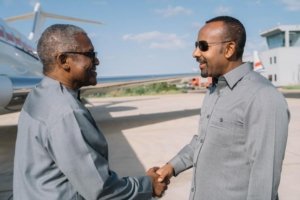
Abiy Ahmed welcomes Ali Dangote

“In total, our declared and signed investments in Ethiopia now exceed $4 billion,” Dangote said in Gode. “This makes Ethiopia the second-largest recipient of our investments in Africa, accounting for nearly nine percent of our continental outlay between now and 2030.”

The expanded project includes a 110-kilometer natural gas pipeline from the Calub field in the Ogaden Basin, a 120-megawatt captive power plant, a polypropylene packaging facility and a 2-million-tonne NPK fertilizer blending plant.

The urea plant will produce 3 million metric tonnes annually. Dangote Group holds a 60% stake in the joint venture, while Ethiopian Investment Holdings holds 40%.

The parties signed a shareholders’ agreement in Addis Ababa in August 2025 in the presence of Abiy. Construction began in October 2025.

A $4.2 billion, 25-year natural gas supply agreement with China’s GCL Group secured energy supply for the project in March 2026.
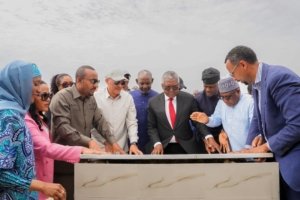
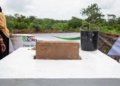
Ethiopia laid the foundation stone for two major industrial projects in October 2025 – a urea fertilizer plant and the Gode Oil Refinery.

Ethiopia imports approximately 2.32 million metric tonnes of fertilizer annually and spends close to $1 billion each year on imports. The state-owned Ethiopian Agricultural Businesses Corporation handles more than 90% of fertilizer supply.

The Gode complex would exceed Ethiopia’s current fertilizer import requirement and position the country as a supplier to regional markets.

“Africa has the capacity to feed itself and even export to the rest of the world,” Dangote told journalists in Gode. “Our fertilizer investments across the continent are designed to unlock that potential and secure a prosperous future for our people.”

Abiy described the investment as part of Ethiopia’s wider economic transformation agenda.

“This initiative is a strategic investment in Ethiopia’s agricultural transformation, food security, industrial growth and economic self-reliance,” he said. “This type of large-scale investment demonstrates the power of strong collaboration between government and the private sector.”

Dangote Group’s industrial presence in Ethiopia predates the fertilizer project. Its 2.5-million-tonne cement plant at Mugher, north of Addis Ababa, began operations in May 2015 and remains the country’s largest cement facility.

A wider commercial footprint

Dangote’s East African activities extend beyond energy and fertilizer.

Africa Travel Investments, a tourism-focused fund backed by Dangote and American investor Dave Rubenstein through Alterra Capital, acquired Pollman’s Tours and Safaris in May 2025. Kenya’s Competition Authority approved the transaction without conditions.

Pollman’s, founded in the 1950s, remains one of East Africa’s oldest tour operators.
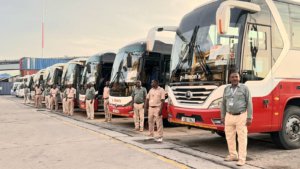
Pollman’s Tours and Safaris

Dangote Petroleum Refinery also began direct aviation fuel deliveries to Ethiopian Airlines in early May 2026 during a period of global supply tightness linked to the US-Iran conflict.

The refinery has shipped refined products to 11 African countries since late February 2026.

“Alhaji Aliko Dangote is absolutely unequivocal that it is Africa first,” refinery managing director David Bird said at an energy conference in Lagos. “We’re proud to have done a direct delivery to Ethiopian Airlines.”

Outstanding decisions

The East Africa refinery remains at the proposal stage with political backing and commercial interest across the region. Kenya, Tanzania and Uganda continue to evaluate the project within their national energy strategies.

Tanzania controls the pipeline terminus. Kenya operates the region’s largest port infrastructure. Uganda holds the crude reserves expected to supply the refinery.

Dangote’s existing industrial projects continue to shape regional confidence in the proposal. The Lagos refinery has entered full operations. Construction continues at the Gode fertilizer complex. The Mtwara cement plant has operated in Tanzania for a decade.

The Nairobi summit focused attention on Africa’s capital base, industrial resources and regional market potential. The next phase depends on coordination among East African governments and the commercial agreements required to advance a refinery project valued at up to $17 billion.

Get the inside Story

Stay informed on the stories shaping Africa’s future. Get breaking news, in-depth analysis, opinions and exclusive insights from across the continent delivered to your inbox, free and unfiltered.


Get in touch for more:
Felix Tih
Editorial Director, Bantu Gazette
WhatsApp
LinkedIn
X (Twitter)
Instagram

Related Posts

Ethiopia Defies Regional Slowdown with Record $4.32 Billion Foreign Direct Investment Inflow
Business, Trade & Economy

Ethiopia Defies Regional Slowdown with Record $4.32 Billion Foreign Direct Investment Inflow

July 11, 2026
Togo Grants Visa-Free Entry to All Africans
Business, Trade & Economy

Togo Rises to Lower-Middle-Income Status in New World Bank Income Classification

July 11, 2026
Business, Trade & Economy

Ethiopia Announces $5 Billion in Foreign Currency Savings as Industrial Push Gains Momentum

July 11, 2026
Ghana Settles $700 Million Eurobond Obligation Ahead of Schedule
Business, Trade & Economy

Ghana Settles $700 Million Eurobond Obligation Ahead of Schedule

July 11, 2026
Trade Finance Initiative Targets East Africa’s Coffee, Leather, Creative Sectors
Business, Trade & Economy

Trade Finance Initiative Targets East Africa’s Coffee, Leather, Creative Sectors

July 11, 2026
Ethiopia Tops $3 Billion in Annual Coffee Export Revenue for the First Time
Business, Trade & Economy

Ethiopia Tops $3 Billion in Annual Coffee Export Revenue for the First Time

July 4, 2026

Most Recent

Kolwezi Fashion Week Aligns Local Creativity with DR Congo’s Creative Economy Ambitions
Culture & Identity

Kolwezi Fashion Week Aligns Local Creativity with DR Congo’s Creative Economy Ambitions

by Felix Tih
July 11, 2026
0

Second edition highlights fashion, heritage and entrepreneurship as pillars of economic diversification, reflecting efforts to position the mining city as...

Read moreDetails
Ethiopia Defies Regional Slowdown with Record $4.32 Billion Foreign Direct Investment Inflow

Ethiopia Defies Regional Slowdown with Record $4.32 Billion Foreign Direct Investment Inflow

July 11, 2026
Togo Grants Visa-Free Entry to All Africans

Togo Rises to Lower-Middle-Income Status in New World Bank Income Classification

July 11, 2026
High-Level Training Strengthens African Diplomats’ Knowledge of Carbon Markets

High-Level Training Strengthens African Diplomats’ Knowledge of Carbon Markets

July 10, 2026
Chinese Travel Interest in Cape Verde Surges After World Cup Breakthrough

Chinese Travel Interest in Cape Verde Surges After World Cup Breakthrough

July 9, 2026

Ethiopia Announces $5 Billion in Foreign Currency Savings as Industrial Push Gains Momentum

July 11, 2026
Noir Fashion Week Returns to Nairobi as Kenya’s Textile Debate Continues

Noir Fashion Week Returns to Nairobi as Kenya’s Textile Debate Continues

July 7, 2026
Kolwezi Fashion Week Aligns Local Creativity with DR Congo’s Creative Economy Ambitions
Culture & Identity

Kolwezi Fashion Week Aligns Local Creativity with DR Congo’s Creative Economy Ambitions

by Felix Tih
Reading Time: 2 mins read
July 11, 2026
0

Second edition highlights fashion, heritage and entrepreneurship as pillars of economic diversification, reflecting efforts to position the mining city as...

Read moreDetails
Ethiopia Defies Regional Slowdown with Record $4.32 Billion Foreign Direct Investment Inflow
Business, Trade & Economy

Ethiopia Defies Regional Slowdown with Record $4.32 Billion Foreign Direct Investment Inflow

by Kalkidan Negash
Reading Time: 2 mins read
July 11, 2026
0

Foreign direct investment climbed 8% to a record $4.32 billion as sweeping macroeconomic reforms, renewable energy investments and digitalized government...

Read moreDetails
Togo Grants Visa-Free Entry to All Africans
Business, Trade & Economy

Togo Rises to Lower-Middle-Income Status in New World Bank Income Classification

by Marina Bisse
Reading Time: 2 mins read
July 11, 2026
0

Classification marks an economic milestone for Togo, as the West African country's statistical updates, economic growth and favorable exchange rate...

Read moreDetails

Dangote Deepens East Africa Investment Drive

Energy, fertilizer and the continent’s push to process its own resources

Dangote Deepens East Africa Investment Drive

Samia Suluhu meets Ali Dangote

ADDIS ABABA

Aliko Dangote spent several weeks in April and May 2026 advancing a consistent message in Nairobi, Dar es Salaam, Kampala and Gode. Africa exports raw materials and imports finished products despite having the capital, institutions and industrial capacity to process its own resources.

The campaign opened at the inaugural Africa We Build Summit in Nairobi on April 23, hosted by the Africa Finance Corporation and the Kenyan government.

Dangote appeared on a panel with Kenyan President William Ruto and Ugandan President Yoweri Museveni and committed to building a 650,000-barrel-per-day regional oil refinery in East Africa modeled on his refinery in Ibeju-Lekki, Lagos, Nigeria.

The Lagos refinery began crude distillation in January 2024 and reached full nameplate capacity in early 2026. The project cost approximately $20 billion and became the world’s largest single-train refinery.

“My commitment is, if we agree here with the three or four governments, we will lead and make sure that refinery is built within the next four to five years,” Dangote told the summit. “Even now, I can give commitment to the two presidents who are here if they will support the refinery, we will build an identical one to what we have in Nigeria.”

Ruto welcomed the proposal and said Kenya would support the project. He later wrote on social media that Kenya was committed to partnering with Uganda and Tanzania on the refinery initiative.

Ali Dangote, Yoweri Museveni, and William Ruto at the Africa We Build Summit

The proposed refinery carries an estimated cost of between $15 billion and $17 billion. The facility would process crude from Uganda, South Sudan, Kenya and the Democratic Republic of Congo.

East Africa currently imports most of its refined petroleum products, leaving regional markets exposed to global supply disruptions such as the tightening in fuel flows linked to US-Iran tensions from late February 2026.

Dangote urged African investors and institutions to finance industrial development across the continent.

“We have $550 billion of savings in Africa and you are funding something totally irrelevant,” he said. “A domestic investor must take the risk and start developing your own continent. Not for you to wait for foreign investors. Foreign investors will only come when things are looking rosy and good.”

Museveni framed the refinery discussion within the wider history of African integration and industrial policy.

“The mistake makers have failed, so people have seen the mistakes,” he said. “The youth have no jobs. People can now listen more.”

Ruto described the region’s development priorities as internally driven.

“The question is what is different now? There is a realization by all of us that the solution to the challenges and problems we have is not out there. It is right with us.”

The location question

The Nairobi summit identified Tanzania’s port city of Tanga as an early option for the refinery. Tanga serves as the terminal point for the 1,443-kilometer East African Crude Oil Pipeline linking Uganda’s Hoima oil fields to the Indian Ocean. First oil exports through the pipeline are expected in the second half of 2026.

A refinery at Tanga would allow Ugandan crude to move directly by pipeline for coastal refining and regional fuel distribution.

Tanzanian President Samia Suluhu Hassan later said she had not been consulted before the Nairobi announcement. Public discussion around the refinery site intensified after Ruto referenced the Tanga proposal at the Kenya Mining Investment Conference on April 28.

‘Dangote is one of the major investors in Tanzania,’ President Suluhu said

Dangote’s stated preference shifted toward Kenya in a Financial Times interview published May 10. He cited Mombasa’s deep-water port, logistics infrastructure and fuel market.

“Mombasa has a much larger, deeper port,” Dangote said.

Kenya imported 40 million barrels of petroleum in 2025.

Samia received Dangote at State House in Dar es Salaam on May 16. She confirmed the meeting and highlighted Dangote Group’s existing investments in Tanzania, including the Mtwara cement plant commissioned in December 2015.

The $500 million facility has an annual production capacity of 3 million tonnes and operates on locally sourced natural gas. It remains the largest cement factory in Tanzania.

Dangote met Museveni at State Lodge Nakasero in Kampala on May 17. Museveni reiterated Uganda’s long-standing position on domestic refining and value addition.

Museveni reiterated Uganda’s long-standing position on refining crude domestically before export.

“I informed him that from the very beginning, we have always opposed the export of raw materials without value addition,” Museveni wrote on May 18.

President Yoweri Museveni and Aliko Dangote discuss the proposed East African regional refinery.

He said Uganda delayed oil production because the government wanted refining capacity in place before crude exports began. Museveni described refining as both an economic and strategic priority and said regional integration remained central to Uganda’s position.

“I therefore welcomed the idea of a bigger regional refinery because our objective is African integration and shared prosperity,” he wrote.

Museveni added that Uganda would support the regional refinery initiative while continuing development of its domestic refinery project in Hoima.

Uganda’s planned 60,000-barrel-per-day refinery in Hoima remains under development through a joint venture with UAE-based Alpha MBM Investments.

The project is awaiting a final investment decision expected in July 2026. Uganda holds an estimated 1.4 billion to 6.5 billion barrels of discovered oil resources in the Albertine Graben and remains a net importer of refined fuel.

Dangote told reporters after the Kampala meeting that his team continues to evaluate Tanga, Mombasa and Lamu as potential refinery sites. Governments have not signed any formal agreements.

Project already under construction

Dangote’s fertilizer investment in Ethiopia has moved into active construction.

Prime Minister Abiy Ahmed received Dangote in Gode, in Ethiopia’s Somali Region, on May 17. The two toured the construction site of a urea fertilizer complex that Dangote said would now exceed $4 billion in total investment, up from an earlier estimate of $2.5 billion.

Abiy Ahmed welcomes Ali Dangote

“In total, our declared and signed investments in Ethiopia now exceed $4 billion,” Dangote said in Gode. “This makes Ethiopia the second-largest recipient of our investments in Africa, accounting for nearly nine percent of our continental outlay between now and 2030.”

The expanded project includes a 110-kilometer natural gas pipeline from the Calub field in the Ogaden Basin, a 120-megawatt captive power plant, a polypropylene packaging facility and a 2-million-tonne NPK fertilizer blending plant.

The urea plant will produce 3 million metric tonnes annually. Dangote Group holds a 60% stake in the joint venture, while Ethiopian Investment Holdings holds 40%.

The parties signed a shareholders’ agreement in Addis Ababa in August 2025 in the presence of Abiy. Construction began in October 2025.

A $4.2 billion, 25-year natural gas supply agreement with China’s GCL Group secured energy supply for the project in March 2026.

Ethiopia laid the foundation stone for two major industrial projects in October 2025 – a urea fertilizer plant and the Gode Oil Refinery.

Ethiopia imports approximately 2.32 million metric tonnes of fertilizer annually and spends close to $1 billion each year on imports. The state-owned Ethiopian Agricultural Businesses Corporation handles more than 90% of fertilizer supply.

The Gode complex would exceed Ethiopia’s current fertilizer import requirement and position the country as a supplier to regional markets.

“Africa has the capacity to feed itself and even export to the rest of the world,” Dangote told journalists in Gode. “Our fertilizer investments across the continent are designed to unlock that potential and secure a prosperous future for our people.”

Abiy described the investment as part of Ethiopia’s wider economic transformation agenda.

“This initiative is a strategic investment in Ethiopia’s agricultural transformation, food security, industrial growth and economic self-reliance,” he said. “This type of large-scale investment demonstrates the power of strong collaboration between government and the private sector.”

Dangote Group’s industrial presence in Ethiopia predates the fertilizer project. Its 2.5-million-tonne cement plant at Mugher, north of Addis Ababa, began operations in May 2015 and remains the country’s largest cement facility.

A wider commercial footprint

Dangote’s East African activities extend beyond energy and fertilizer.

Africa Travel Investments, a tourism-focused fund backed by Dangote and American investor Dave Rubenstein through Alterra Capital, acquired Pollman’s Tours and Safaris in May 2025. Kenya’s Competition Authority approved the transaction without conditions.

Pollman’s, founded in the 1950s, remains one of East Africa’s oldest tour operators.

Pollman’s Tours and Safaris

Dangote Petroleum Refinery also began direct aviation fuel deliveries to Ethiopian Airlines in early May 2026 during a period of global supply tightness linked to the US-Iran conflict.

The refinery has shipped refined products to 11 African countries since late February 2026.

“Alhaji Aliko Dangote is absolutely unequivocal that it is Africa first,” refinery managing director David Bird said at an energy conference in Lagos. “We’re proud to have done a direct delivery to Ethiopian Airlines.”

Outstanding decisions

The East Africa refinery remains at the proposal stage with political backing and commercial interest across the region. Kenya, Tanzania and Uganda continue to evaluate the project within their national energy strategies.

Tanzania controls the pipeline terminus. Kenya operates the region’s largest port infrastructure. Uganda holds the crude reserves expected to supply the refinery.

Dangote’s existing industrial projects continue to shape regional confidence in the proposal. The Lagos refinery has entered full operations. Construction continues at the Gode fertilizer complex. The Mtwara cement plant has operated in Tanzania for a decade.

The Nairobi summit focused attention on Africa’s capital base, industrial resources and regional market potential. The next phase depends on coordination among East African governments and the commercial agreements required to advance a refinery project valued at up to $17 billion.
Dangote Deepens East Africa Investment Drive

Energy, fertilizer and the continent’s push to process its own resources

Dangote Deepens East Africa Investment Drive

Samia Suluhu meets Ali Dangote

Kalkidan Negashby Kalkidan Negash
May 19, 2026

ADDIS ABABA

Aliko Dangote spent several weeks in April and May 2026 advancing a consistent message in Nairobi, Dar es Salaam, Kampala and Gode. Africa exports raw materials and imports finished products despite having the capital, institutions and industrial capacity to process its own resources.

The campaign opened at the inaugural Africa We Build Summit in Nairobi on April 23, hosted by the Africa Finance Corporation and the Kenyan government.

Dangote appeared on a panel with Kenyan President William Ruto and Ugandan President Yoweri Museveni and committed to building a 650,000-barrel-per-day regional oil refinery in East Africa modeled on his refinery in Ibeju-Lekki, Lagos, Nigeria.

The Lagos refinery began crude distillation in January 2024 and reached full nameplate capacity in early 2026. The project cost approximately $20 billion and became the world’s largest single-train refinery.

“My commitment is, if we agree here with the three or four governments, we will lead and make sure that refinery is built within the next four to five years,” Dangote told the summit. “Even now, I can give commitment to the two presidents who are here if they will support the refinery, we will build an identical one to what we have in Nigeria.”

Ruto welcomed the proposal and said Kenya would support the project. He later wrote on social media that Kenya was committed to partnering with Uganda and Tanzania on the refinery initiative.

Ali Dangote, Yoweri Museveni, and William Ruto at the Africa We Build Summit

The proposed refinery carries an estimated cost of between $15 billion and $17 billion. The facility would process crude from Uganda, South Sudan, Kenya and the Democratic Republic of Congo.

East Africa currently imports most of its refined petroleum products, leaving regional markets exposed to global supply disruptions such as the tightening in fuel flows linked to US-Iran tensions from late February 2026.

Dangote urged African investors and institutions to finance industrial development across the continent.

“We have $550 billion of savings in Africa and you are funding something totally irrelevant,” he said. “A domestic investor must take the risk and start developing your own continent. Not for you to wait for foreign investors. Foreign investors will only come when things are looking rosy and good.”

Museveni framed the refinery discussion within the wider history of African integration and industrial policy.

“The mistake makers have failed, so people have seen the mistakes,” he said. “The youth have no jobs. People can now listen more.”

Ruto described the region’s development priorities as internally driven.

“The question is what is different now? There is a realization by all of us that the solution to the challenges and problems we have is not out there. It is right with us.”

The location question

The Nairobi summit identified Tanzania’s port city of Tanga as an early option for the refinery. Tanga serves as the terminal point for the 1,443-kilometer East African Crude Oil Pipeline linking Uganda’s Hoima oil fields to the Indian Ocean. First oil exports through the pipeline are expected in the second half of 2026.

A refinery at Tanga would allow Ugandan crude to move directly by pipeline for coastal refining and regional fuel distribution.

Tanzanian President Samia Suluhu Hassan later said she had not been consulted before the Nairobi announcement. Public discussion around the refinery site intensified after Ruto referenced the Tanga proposal at the Kenya Mining Investment Conference on April 28.

‘Dangote is one of the major investors in Tanzania,’ President Suluhu said

Dangote’s stated preference shifted toward Kenya in a Financial Times interview published May 10. He cited Mombasa’s deep-water port, logistics infrastructure and fuel market.

“Mombasa has a much larger, deeper port,” Dangote said.

Kenya imported 40 million barrels of petroleum in 2025.

Samia received Dangote at State House in Dar es Salaam on May 16. She confirmed the meeting and highlighted Dangote Group’s existing investments in Tanzania, including the Mtwara cement plant commissioned in December 2015.

The $500 million facility has an annual production capacity of 3 million tonnes and operates on locally sourced natural gas. It remains the largest cement factory in Tanzania.

Dangote met Museveni at State Lodge Nakasero in Kampala on May 17. Museveni reiterated Uganda’s long-standing position on domestic refining and value addition.

Museveni reiterated Uganda’s long-standing position on refining crude domestically before export.

“I informed him that from the very beginning, we have always opposed the export of raw materials without value addition,” Museveni wrote on May 18.

President Yoweri Museveni and Aliko Dangote discuss the proposed East African regional refinery.

He said Uganda delayed oil production because the government wanted refining capacity in place before crude exports began. Museveni described refining as both an economic and strategic priority and said regional integration remained central to Uganda’s position.

“I therefore welcomed the idea of a bigger regional refinery because our objective is African integration and shared prosperity,” he wrote.

Museveni added that Uganda would support the regional refinery initiative while continuing development of its domestic refinery project in Hoima.

Uganda’s planned 60,000-barrel-per-day refinery in Hoima remains under development through a joint venture with UAE-based Alpha MBM Investments.

The project is awaiting a final investment decision expected in July 2026. Uganda holds an estimated 1.4 billion to 6.5 billion barrels of discovered oil resources in the Albertine Graben and remains a net importer of refined fuel.

Dangote told reporters after the Kampala meeting that his team continues to evaluate Tanga, Mombasa and Lamu as potential refinery sites. Governments have not signed any formal agreements.

Project already under construction

Dangote’s fertilizer investment in Ethiopia has moved into active construction.

Prime Minister Abiy Ahmed received Dangote in Gode, in Ethiopia’s Somali Region, on May 17. The two toured the construction site of a urea fertilizer complex that Dangote said would now exceed $4 billion in total investment, up from an earlier estimate of $2.5 billion.

Abiy Ahmed welcomes Ali Dangote

“In total, our declared and signed investments in Ethiopia now exceed $4 billion,” Dangote said in Gode. “This makes Ethiopia the second-largest recipient of our investments in Africa, accounting for nearly nine percent of our continental outlay between now and 2030.”

The expanded project includes a 110-kilometer natural gas pipeline from the Calub field in the Ogaden Basin, a 120-megawatt captive power plant, a polypropylene packaging facility and a 2-million-tonne NPK fertilizer blending plant.

The urea plant will produce 3 million metric tonnes annually. Dangote Group holds a 60% stake in the joint venture, while Ethiopian Investment Holdings holds 40%.

The parties signed a shareholders’ agreement in Addis Ababa in August 2025 in the presence of Abiy. Construction began in October 2025.

A $4.2 billion, 25-year natural gas supply agreement with China’s GCL Group secured energy supply for the project in March 2026.

Ethiopia laid the foundation stone for two major industrial projects in October 2025 – a urea fertilizer plant and the Gode Oil Refinery.

Ethiopia imports approximately 2.32 million metric tonnes of fertilizer annually and spends close to $1 billion each year on imports. The state-owned Ethiopian Agricultural Businesses Corporation handles more than 90% of fertilizer supply.

The Gode complex would exceed Ethiopia’s current fertilizer import requirement and position the country as a supplier to regional markets.

“Africa has the capacity to feed itself and even export to the rest of the world,” Dangote told journalists in Gode. “Our fertilizer investments across the continent are designed to unlock that potential and secure a prosperous future for our people.”

Abiy described the investment as part of Ethiopia’s wider economic transformation agenda.

“This initiative is a strategic investment in Ethiopia’s agricultural transformation, food security, industrial growth and economic self-reliance,” he said. “This type of large-scale investment demonstrates the power of strong collaboration between government and the private sector.”

Dangote Group’s industrial presence in Ethiopia predates the fertilizer project. Its 2.5-million-tonne cement plant at Mugher, north of Addis Ababa, began operations in May 2015 and remains the country’s largest cement facility.

A wider commercial footprint

Dangote’s East African activities extend beyond energy and fertilizer.

Africa Travel Investments, a tourism-focused fund backed by Dangote and American investor Dave Rubenstein through Alterra Capital, acquired Pollman’s Tours and Safaris in May 2025. Kenya’s Competition Authority approved the transaction without conditions.

Pollman’s, founded in the 1950s, remains one of East Africa’s oldest tour operators.

Pollman’s Tours and Safaris

Dangote Petroleum Refinery also began direct aviation fuel deliveries to Ethiopian Airlines in early May 2026 during a period of global supply tightness linked to the US-Iran conflict.

The refinery has shipped refined products to 11 African countries since late February 2026.

“Alhaji Aliko Dangote is absolutely unequivocal that it is Africa first,” refinery managing director David Bird said at an energy conference in Lagos. “We’re proud to have done a direct delivery to Ethiopian Airlines.”

Outstanding decisions

The East Africa refinery remains at the proposal stage with political backing and commercial interest across the region. Kenya, Tanzania and Uganda continue to evaluate the project within their national energy strategies.

Tanzania controls the pipeline terminus. Kenya operates the region’s largest port infrastructure. Uganda holds the crude reserves expected to supply the refinery.

Dangote’s existing industrial projects continue to shape regional confidence in the proposal. The Lagos refinery has entered full operations. Construction continues at the Gode fertilizer complex. The Mtwara cement plant has operated in Tanzania for a decade.

The Nairobi summit focused attention on Africa’s capital base, industrial resources and regional market potential. The next phase depends on coordination among East African governments and the commercial agreements required to advance a refinery project valued at up to $17 billion.
Get the inside Story

Stay informed on the stories shaping Africa’s future. Get breaking news, in-depth analysis, opinions and exclusive insights from across the continent delivered to your inbox, free and unfiltered.


Get in touch for more:
Felix Tih
Editorial Director, Bantu Gazette
WhatsApp
LinkedIn
X (Twitter)
Instagram

Related Posts

Ethiopia Defies Regional Slowdown with Record $4.32 Billion Foreign Direct Investment Inflow

Ethiopia Defies Regional Slowdown with Record $4.32 Billion Foreign Direct Investment Inflow

by Kalkidan Negash
July 10, 2026
0

...

Togo Grants Visa-Free Entry to All Africans

Togo Rises to Lower-Middle-Income Status in New World Bank Income Classification

by Marina Bisse
July 9, 2026
0

...

Ethiopia Announces $5 Billion in Foreign Currency Savings as Industrial Push Gains Momentum

by Kalkidan Negash
July 7, 2026
0

...

Ghana Settles $700 Million Eurobond Obligation Ahead of Schedule

Ghana Settles $700 Million Eurobond Obligation Ahead of Schedule

by Marina Bisse
July 6, 2026
0

...

Trade Finance Initiative Targets East Africa’s Coffee, Leather, Creative Sectors

Trade Finance Initiative Targets East Africa’s Coffee, Leather, Creative Sectors

by Felix Tih
July 6, 2026
0

...

Ethiopia Tops $3 Billion in Annual Coffee Export Revenue for the First Time

Ethiopia Tops $3 Billion in Annual Coffee Export Revenue for the First Time

by Kalkidan Negash
July 3, 2026
0

...

Kolwezi Fashion Week Aligns Local Creativity with DR Congo’s Creative Economy Ambitions
Culture & Identity

Kolwezi Fashion Week Aligns Local Creativity with DR Congo’s Creative Economy Ambitions

by Felix Tih
Reading Time: 2 mins read
July 10, 2026
0

Second edition highlights fashion, heritage and entrepreneurship as pillars of economic diversification, reflecting efforts to position the mining city as...

Read moreDetails
Ethiopia Defies Regional Slowdown with Record $4.32 Billion Foreign Direct Investment Inflow

Ethiopia Defies Regional Slowdown with Record $4.32 Billion Foreign Direct Investment Inflow

by Kalkidan Negash
July 10, 2026
0

Foreign direct investment climbed 8% to a record $4.32 billion as sweeping macroeconomic reforms, renewable energy investments and digitalized government...

Togo Grants Visa-Free Entry to All Africans

Togo Rises to Lower-Middle-Income Status in New World Bank Income Classification

by Marina Bisse
July 9, 2026
0

Classification marks an economic milestone for Togo, as the West African country's statistical updates, economic growth and favorable exchange rate...

High-Level Training Strengthens African Diplomats’ Knowledge of Carbon Markets

High-Level Training Strengthens African Diplomats’ Knowledge of Carbon Markets

by Felix Tih
July 8, 2026
0

ACBF, AUC and AIDA convene African ambassadors and diplomats in Addis Ababa to strengthen technical expertise and policy engagement on...

Chinese Travel Interest in Cape Verde Surges After World Cup Breakthrough

Chinese Travel Interest in Cape Verde Surges After World Cup Breakthrough

by Felix Tih
July 8, 2026
0

Online searches, flight bookings and hotel reservations climbed after the Blue Sharks emerged as one of the tournament's biggest surprises

Next Post
Togo Adopts New Competition, Consumer Protection Law to Modernize Economic Framework

Togo Grants Visa-Free Entry to All Africans

Ethiopia Breaks Ground on Livestock Trading Center to Strengthen Export Supply Chain

Ethiopia Breaks Ground on Livestock Trading Center to Strengthen Export Supply Chain

Africa’s Free Trade Secretariat, ITC Renew Partnership to Expand Markets for Small Businesses

Africa’s Free Trade Secretariat, ITC Renew Partnership to Expand Markets for Small Businesses

Nigeria Backs Togo’s Leadership on African Free Trade at Lomé Forum

Nigeria Backs Togo's Leadership on African Free Trade at Lomé Forum

Bantu Gazette is a pioneering news platform that champions Africa's development, culture, and heritage. We spotlight the continent's successes, address its challenges, and provide insightful coverage of events that shape its future.

Bantu Gazette is a pioneering news platform that champions Africa's development, culture, and heritage. We spotlight the continent's successes, address its challenges, and provide insightful coverage of events that shape its future.

Our Platforms

  • Bantu Magazine
  • Bantu Brief
  • Black Frame Studio

Our Services

  • Bantu Agency
  • Advertise
  • Partnerships

Our Services

  • Editorial Director
  • Opportunities
  • Contact

Bantu Gazette is a pioneering news platform that champions Africa's development, culture, and heritage. We spotlight the continent's successes, address its challenges, and provide insightful coverage of events that shape its future.

Our Platforms

  • Bantu Magazine
  • Bantu Brief
  • Black Frame Studio

Our Services

  • Bantu Agency
  • Advertise
  • Partnerships

Our Services

  • Editorial Director
  • Opportunities
  • Contact
Bantu Gazette
  • Energy & Trade
  • Finance
  • Health
  • Politics & Economy
  • Technology
  • Environment
  • Feature
  • Opinion
  • Changemakers
  • Tourism & Culture
  • Magazine