


NAIROBI
Kenya’s government ordered a nationwide inspection of boarding school infrastructure after a fire at Utumishi Girls Academy in Gilgil, Nakuru County, on May 28 killed 16 students and injured 79 others, exposing persistent safety failures that a 2024 government assessment had already identified and sought to address.
Education Cabinet Secretary Julius Ogamba announced accountability measures within 24 hours of the fire. The Board of Management of Utumishi Girls Academy was dissolved for non-compliance with the School Safety Manual and the Basic Education Regulations.
The Teachers Service Commission received instructions to begin disciplinary proceedings against Principal Joycelene Muraguri for negligence. Three teachers faced internal action for failing to act on warnings about student unrest received before the fire.
Ogamba said investigations into negligence extended beyond school administration to officials within the Ministry of Education and the TSC itself.
The government committed to paying KSh 200,000 ($1,540) to each bereaved family, covering all medical costs for the 79 injured students, and meeting all funeral expenses, including mortuary fees, transport, coffins and a joint national requiem mass.
The support extended to the family of a parent who died in a road accident while traveling to school after the fire.
The Kenya Red Cross Society provided psychosocial support and first aid to affected families throughout the response period.
The Investigation
The Directorate of Criminal Investigations launched a criminal inquiry led by the Director of Homicide. Forensic teams reviewed CCTV footage that captured evidence of planning before the fire began, with matchboxes and paraffin reportedly obtained in the hours before the attack. Eight students were detained as persons of interest.
Seven of those detained later gave accounts to investigators. They cited anger over a change in exam dates, a compulsory cultural event fee and the influence of a recent strike at a nearby boys’ school. Officers from the DCI’s Child Protection Unit and counsellors were present during all interviews.
Ogamba said two Form Three students had warned two teachers about potential unrest before the fire. The teachers did not act on those warnings.
The National Requiem
The severity of the fire complicated the identification of victims. Authorities used DNA analysis, collecting samples from relatives, to confirm all 16 identities by June 6. One student, Zuhura Rama, was buried in Mkwakwani Village, Kwale County, before the joint service, in accordance with Islamic customs.
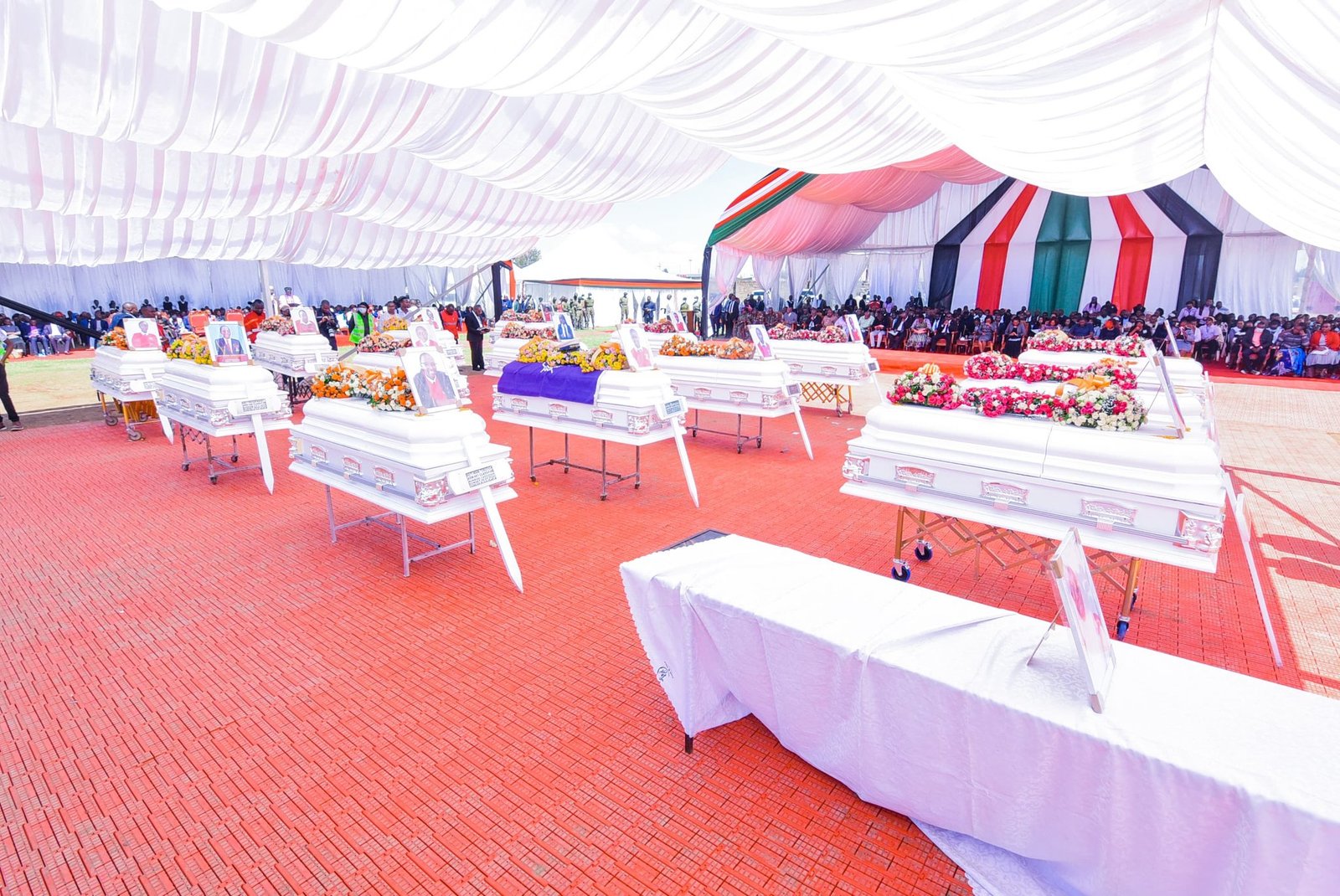
A national requiem mass took place June 12 at Gilgil Sub-County Stadium in Nakuru County. Fifteen white caskets arrived in a solemn procession from Naivasha Funeral Home. Deputy President Kithure Kindiki, Deputy Inspector-General of Police Eliud Lagat and Nairobi Senator Edwin Sifuna attended alongside thousands of mourners.
“On behalf of the government and the people of Kenya, I extend my condolences to the families, friends, and the entire Utumishi Girls Academy fraternity following the tragic loss of our daughters. To the parents facing the unimaginable, no words can carry the weight of your loss,” President William Ruto said in a national address. Ruto pledged that the government would pursue accountability and enact reforms.
School captain Abigael Wanjiku gave a tribute on behalf of students. “As students, we have lost more than classmates. We have lost sisters,” she said. Student Cynthia Wanja sang Wimbo wa Historia, a song about the night of the fire. Bodies were released to families for burial in their home areas after the service.
What the 2024 Assessment Already Found
A 2024 assessment by the Ministry of Education found widespread non-compliance with fire safety standards across Kenyan boarding schools, citing dormitories with barred windows, single exits, inward-opening doors and chronic overcrowding. The ministry ordered 348 schools to close as a result.
Utumishi was overcrowded at the time of the fire. The school admitted 715 students in 2026 against a stated capacity of 650. One exit door on the affected dormitory was locked during the fire.
A fire at St. Kizito Secondary School in Meru killed 19 students in 1991. A fire at Bombolulu Girls Secondary School in Kwale County in 1997, where the only exit was locked from the outside and windows were barred, killed 26 girls.
Sixty-seven boys died at Kyanguli Secondary School in Machakos County in 2001 in an arson attack linked to student grievances over exam results, prompting the creation of the Wangai Task Force that year. Eight pupils died at Asumbi Girls Primary School in Homa Bay County in 2012. A wave of arson affected more than 100 institutions in 2016.
Ten students died at Moi Girls High School in Nairobi in a deliberate arson attack in September 2017. In September 2024, 21 boys aged 9 to 13 died at Hillside Endarasha Academy in Nyeri County in an overcrowded dormitory with dangerously narrow exits. The school subsequently closed its boarding section and reopened as a day school.
The response to Utumishi represents the most comprehensive state accountability chain Kenya has deployed after a school fire. A board has been dissolved, a principal faces disciplinary proceedings, a homicide directorate leads the criminal inquiry, DNA technology identified every victim, and a nationwide audit is underway. Each of those steps is measurable, and each can be tracked.
The 16 students killed were Purity Naisula, Imani Boit, Mercy Precious, Cecilia Wanjiku, Juliet Linah, Neema Wairimu, Getrude Muthoni, Zuhura Rama, Jane Kimani, Jullie Hinga, Fortune Aimaya, Sheril Onderi, Sallystine Melly, Precious Wanjeri, Nicole Michelle and Abigael Chepng’eno.