
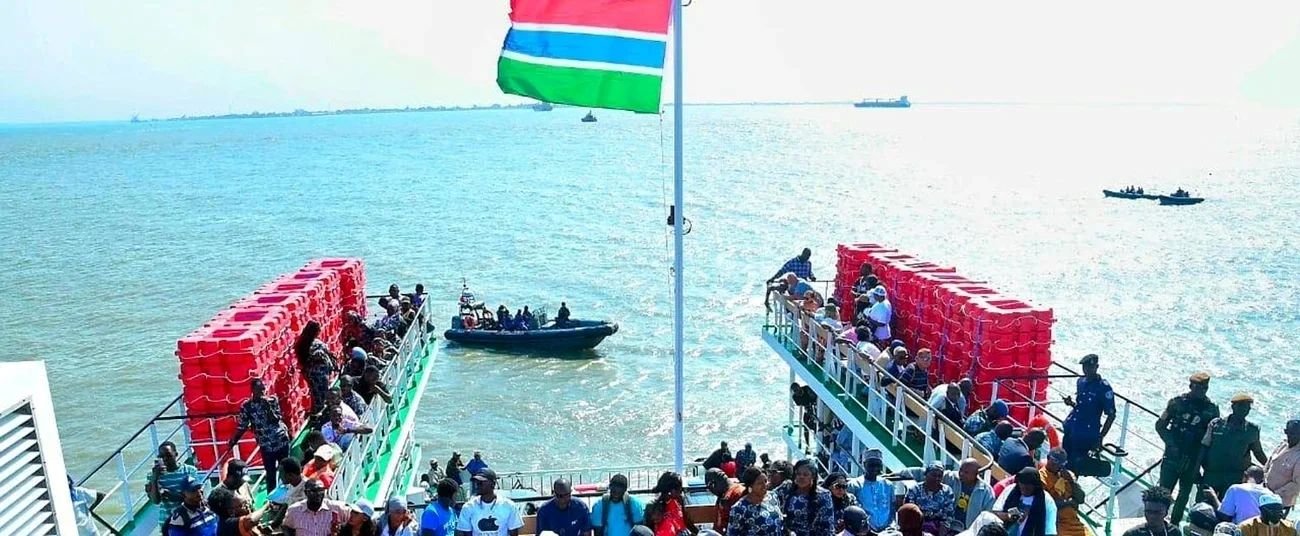

President Adama Barrow has officially inaugurated the Barra Ferry, a vessel capable of carrying 1,000 passengers and more than 50 vehicles per crossing, positioning the country as one of West Africa’s early adopters of sustainable maritime transport.
The ferry serves one of West Africa’s busiest river corridors. The Banjul-Barra corridor is a 7-kilometer transit route across the mouth of the River Gambia estuary. It is a critical economic lifeline connecting the capital, Banjul, with the town of Barra on the north bank.
The River Gambia stretches approximately 360 kilometers inland and divides the country into north and south banks, making reliable crossings essential for commerce and daily movement.
The African Development Bank (AfDB) financed the ferry under its $20.56 million Banjul Port Fourth Expansion Project.
The vessel was constructed in the Netherlands by DAMEN Shipyard and is powered by a hybrid system combining fuel generators with battery-assisted technology.
The new vessel is expected to reduce travel delays and improve the safety and reliability of services used daily by thousands of Gambians.
The AfDB President Sidi Ould Tah was represented at the ceremony by Lamin G. Barrow, the bank’s director general for West Africa, who described the ferry as a meaningful advance in sustainable maritime transport on the continent.
President Barrow highlighted the connection between transport infrastructure and economic growth, arguing that the efficiency of major trade gateways, including ports, ferry services, airports and telecommunications, is fundamental to sustained development.
“The socioeconomic well-being of The Gambia is closely linked to the strength of its domestic production base and its participation in regional and international trade,” he said during the official ceremony March 27.
The AfDB’s active portfolio in The Gambia comprises 17 projects valued at approximately $252 million, with cumulative commitments since 1974 exceeding $450 million.