


Bantu Gazette

Bantu Gazette
  • Policy & Governance
  • Development & Impact
  • Business, Trade & Economy
  • Energy
  • Changemakers
  • Culture & Identity
  • Perspectives
  • Magazine
Menu
  • Black Frame Studio
  • Magazine

Women Entrepreneurs Seen as Catalyst for Africa’s Growth

Women-led enterprises continue to power local economies, with women accounting for 58% of Africa's self-employed population and contributing about 13% of GDP

Women Entrepreneurs Seen as Catalyst for Africa’s Growth

HERizon Africa Dialogue on Women Entrepreneurs - Driving Economic Growth, Job Creation and Policy Reform

Felix Tihby Felix Tih
July 30, 2026
Reading Time: 2 mins read

Women Entrepreneurs Seen as Catalyst for Africa’s Growth

Women-led enterprises continue to power local economies, with women accounting for 58% of Africa's self-employed population and contributing about 13% of GDP

Women Entrepreneurs Seen as Catalyst for Africa’s Growth

HERizon Africa Dialogue on Women Entrepreneurs - Driving Economic Growth, Job Creation and Policy Reform

Women Entrepreneurs Seen as Catalyst for Africa’s Growth

HERizon Africa Dialogue on Women Entrepreneurs - Driving Economic Growth, Job Creation and Policy Reform

Felix Tihby Felix Tih
July 30, 2026
Reading Time: 2 mins read

Women entrepreneurs across Africa are playing a critical role in driving economic growth, creating jobs and shaping policy reforms, but structural barriers continue to limit their full potential, according to Agnes Phiri Utunga, strategic partnerships and programme manager at UN Women.

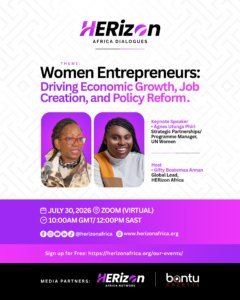
Speaking during HERizon Africa Dialogues on Thursday, themed ‘Women Entrepreneurs: Driving Economic Growth, Job Creation, and Policy Reform,’ Utunga said investing in women is both a human rights imperative and an economic necessity.

Moderated by Gifty Boatemaa Annan, founder and global lead of HERizon Africa, the event brought together participants from across Africa and beyond to discuss how women-led enterprises can drive economic growth and development.

Utunga, who oversees the Entrepreneur Programme implemented in Botswana, Namibia and South Africa with support from the De Beers Group and UN Women, highlighted the resilience of women operating small businesses across the continent.

“Someone, a mother, a grandmother, a sister, a young woman has woken up to do this,” she said, referring to women who run businesses to support their families. “She’s her own accountant, her own logistics manager and her own marketing department.”

According to Utunga, women account for 58% of Africa’s self-employed population and contribute about 13% of the continent’s Gross Domestic Product (GDP).

She noted that sub-Saharan Africa has the highest rate of female entrepreneurial activity in the world, with nearly one-quarter of adult women engaged in business.

$42 Billion Financing Gap Facing Women-Led Businesses

Despite those gains, she warned that women’s economic participation has declined in recent years and that, at the current pace, Africa could take 170 years to achieve full economic parity between men and women.

She also pointed to a $42 billion financing gap facing women-led businesses across the continent.

Utunga argued that governments, financial institutions and the private sector must adopt policies that promote women’s entrepreneurship, including easier business registration processes, affordable financing, stronger digital infrastructure and greater access to public procurement opportunities.

She also stressed the importance of childcare support, noting that many women entrepreneurs juggle business responsibilities with caring for their families. “Policy is strongest when shaped by the lived experience of the women it is meant to serve,” she said.

Addressing the role of technology, Utunga said digital platforms, e-commerce and financial technology offer significant opportunities for women-owned businesses.

She shared an example of women entrepreneurs in rural communities who generated about $8,000 in sales within three months after being introduced to online marketplaces.

“Investing in women is smart economics,” Utunga said, adding that women-owned businesses have the potential to boost productivity, increase innovation and create jobs in local communities.

She called for stronger partnerships among governments, financial institutions, development organizations, civil society groups and entrepreneurs to address systemic barriers and create more inclusive economies.

Closing the session, Utunga urged stakeholders to remove barriers to women’s participation, intentionally invest in women-led enterprises and ensure that policies promote inclusion.

“When women succeed, economies grow. When economies grow inclusively, societies prosper,” she said.

The webinar also featured a presentation by HERizon Africa, which outlined its work in promoting women’s leadership, economic empowerment and policy advocacy across the continent.

“Our goal is to bring women together, amplify their voices and create opportunities for collaboration that can transform lives and communities across the continent,” Annan said.

HERizon Africa


Get the inside Story

Stay informed on the stories shaping Africa’s future. Get breaking news, in-depth analysis, opinions and exclusive insights from across the continent delivered to your inbox, free and unfiltered.


Get in touch for more:
Felix Tih
Editorial Director, Bantu Gazette
WhatsApp
LinkedIn
X (Twitter)
Instagram

Related Posts

ATLAS Umoja AI Unites Partners to Drive AI in African Languages
Development & Impact

ATLAS Umoja AI Unites Partners to Drive AI in African Languages

July 30, 2026
‘Innovation Must Reach Communities That Need It Most,’ Bill Gates Says During Rwanda Visit
Development & Impact

‘Innovation Must Reach Communities That Need It Most,’ Bill Gates Says During Rwanda Visit

July 30, 2026
Ethiopia’s First AI Startup Incubation Program Graduates Inaugural Cohort
Development & Impact

Ethiopia’s First AI Startup Incubation Program Graduates Inaugural Cohort

July 30, 2026
1,700 Refugee and Host Community Youth Receive Digital Skills Training in Kenya
Development & Impact

1,700 Refugee and Host Community Youth Receive Digital Skills Training in Kenya

July 23, 2026
Beyond the Broken Promise of Education
Development & Impact

Inclusive Education Seen as Foundation for Africa’s Sustainable Growth

July 30, 2026
Coding Our Own Future Ending digital dependency starts with mental sovereignty - Bantu Gazette
Development & Impact

People, Not Technology, Remain Africa’s Biggest Digital Transformation Challenge

July 20, 2026

Most Recent

Multilateral Fund Approves $22.3 Million for African Cooling and Ozone Projects
Energy

Multilateral Fund Approves $22.3 Million for African Cooling and Ozone Projects

by Marina Bisse
July 30, 2026
0

Funding will support sustainable cooling, energy efficiency and climate-friendly technologies in eight African countries as demand for cooling rises.

Read moreDetails
Women Entrepreneurs Seen as Catalyst for Africa’s Growth

Women Entrepreneurs Seen as Catalyst for Africa’s Growth

July 30, 2026
ATLAS Umoja AI Unites Partners to Drive AI in African Languages

ATLAS Umoja AI Unites Partners to Drive AI in African Languages

July 30, 2026
‘Innovation Must Reach Communities That Need It Most,’ Bill Gates Says During Rwanda Visit

‘Innovation Must Reach Communities That Need It Most,’ Bill Gates Says During Rwanda Visit

July 30, 2026
Ethiopia’s First AI Startup Incubation Program Graduates Inaugural Cohort

Ethiopia’s First AI Startup Incubation Program Graduates Inaugural Cohort

July 30, 2026
Luanda Declaration Pushes African Leaders to Turn Blue Economy Plans into Action

Luanda Declaration Pushes African Leaders to Turn Blue Economy Plans into Action

July 26, 2026
Nigerian Entrepreneur Raises $7 Million for Hair-Braiding Robot

Nigerian Entrepreneur Raises $7 Million for Hair-Braiding Robot

July 29, 2026
Multilateral Fund Approves $22.3 Million for African Cooling and Ozone Projects
Energy

Multilateral Fund Approves $22.3 Million for African Cooling and Ozone Projects

by Marina Bisse
Reading Time: 3 mins read
July 30, 2026
0

Funding will support sustainable cooling, energy efficiency and climate-friendly technologies in eight African countries as demand for cooling rises.

Read moreDetails
Women Entrepreneurs Seen as Catalyst for Africa’s Growth
Development & Impact

Women Entrepreneurs Seen as Catalyst for Africa’s Growth

by Felix Tih
Reading Time: 2 mins read
July 30, 2026
0

Women-led enterprises continue to power local economies, with women accounting for 58% of Africa's self-employed population and contributing about 13%...

Read moreDetails
ATLAS Umoja AI Unites Partners to Drive AI in African Languages
Development & Impact

ATLAS Umoja AI Unites Partners to Drive AI in African Languages

by Felix Tih
Reading Time: 2 mins read
July 30, 2026
0

Supporters say the initiative will also help attract investment, strengthen national AI capabilities and expand access to digital services across...

Read moreDetails

Women Entrepreneurs Seen as Catalyst for Africa’s Growth

Women-led enterprises continue to power local economies, with women accounting for 58% of Africa's self-employed population and contributing about 13% of GDP

Women Entrepreneurs Seen as Catalyst for Africa’s Growth

HERizon Africa Dialogue on Women Entrepreneurs - Driving Economic Growth, Job Creation and Policy Reform

Women entrepreneurs across Africa are playing a critical role in driving economic growth, creating jobs and shaping policy reforms, but structural barriers continue to limit their full potential, according to Agnes Phiri Utunga, strategic partnerships and programme manager at UN Women.

Speaking during HERizon Africa Dialogues on Thursday, themed ‘Women Entrepreneurs: Driving Economic Growth, Job Creation, and Policy Reform,’ Utunga said investing in women is both a human rights imperative and an economic necessity.

Moderated by Gifty Boatemaa Annan, founder and global lead of HERizon Africa, the event brought together participants from across Africa and beyond to discuss how women-led enterprises can drive economic growth and development.

Utunga, who oversees the Entrepreneur Programme implemented in Botswana, Namibia and South Africa with support from the De Beers Group and UN Women, highlighted the resilience of women operating small businesses across the continent.

“Someone, a mother, a grandmother, a sister, a young woman has woken up to do this,” she said, referring to women who run businesses to support their families. “She’s her own accountant, her own logistics manager and her own marketing department.”

According to Utunga, women account for 58% of Africa’s self-employed population and contribute about 13% of the continent’s Gross Domestic Product (GDP).

She noted that sub-Saharan Africa has the highest rate of female entrepreneurial activity in the world, with nearly one-quarter of adult women engaged in business.

$42 Billion Financing Gap Facing Women-Led Businesses

Despite those gains, she warned that women’s economic participation has declined in recent years and that, at the current pace, Africa could take 170 years to achieve full economic parity between men and women.

She also pointed to a $42 billion financing gap facing women-led businesses across the continent.

Utunga argued that governments, financial institutions and the private sector must adopt policies that promote women’s entrepreneurship, including easier business registration processes, affordable financing, stronger digital infrastructure and greater access to public procurement opportunities.

She also stressed the importance of childcare support, noting that many women entrepreneurs juggle business responsibilities with caring for their families. “Policy is strongest when shaped by the lived experience of the women it is meant to serve,” she said.

Addressing the role of technology, Utunga said digital platforms, e-commerce and financial technology offer significant opportunities for women-owned businesses.

She shared an example of women entrepreneurs in rural communities who generated about $8,000 in sales within three months after being introduced to online marketplaces.

“Investing in women is smart economics,” Utunga said, adding that women-owned businesses have the potential to boost productivity, increase innovation and create jobs in local communities.

She called for stronger partnerships among governments, financial institutions, development organizations, civil society groups and entrepreneurs to address systemic barriers and create more inclusive economies.

Closing the session, Utunga urged stakeholders to remove barriers to women’s participation, intentionally invest in women-led enterprises and ensure that policies promote inclusion.

“When women succeed, economies grow. When economies grow inclusively, societies prosper,” she said.

The webinar also featured a presentation by HERizon Africa, which outlined its work in promoting women’s leadership, economic empowerment and policy advocacy across the continent.

“Our goal is to bring women together, amplify their voices and create opportunities for collaboration that can transform lives and communities across the continent,” Annan said.

HERizon Africa


Women Entrepreneurs Seen as Catalyst for Africa’s Growth

Women-led enterprises continue to power local economies, with women accounting for 58% of Africa's self-employed population and contributing about 13% of GDP

Women Entrepreneurs Seen as Catalyst for Africa’s Growth

HERizon Africa Dialogue on Women Entrepreneurs - Driving Economic Growth, Job Creation and Policy Reform

Felix Tihby Felix Tih
July 30, 2026

Women entrepreneurs across Africa are playing a critical role in driving economic growth, creating jobs and shaping policy reforms, but structural barriers continue to limit their full potential, according to Agnes Phiri Utunga, strategic partnerships and programme manager at UN Women.

Speaking during HERizon Africa Dialogues on Thursday, themed ‘Women Entrepreneurs: Driving Economic Growth, Job Creation, and Policy Reform,’ Utunga said investing in women is both a human rights imperative and an economic necessity.

Moderated by Gifty Boatemaa Annan, founder and global lead of HERizon Africa, the event brought together participants from across Africa and beyond to discuss how women-led enterprises can drive economic growth and development.

Utunga, who oversees the Entrepreneur Programme implemented in Botswana, Namibia and South Africa with support from the De Beers Group and UN Women, highlighted the resilience of women operating small businesses across the continent.

“Someone, a mother, a grandmother, a sister, a young woman has woken up to do this,” she said, referring to women who run businesses to support their families. “She’s her own accountant, her own logistics manager and her own marketing department.”

According to Utunga, women account for 58% of Africa’s self-employed population and contribute about 13% of the continent’s Gross Domestic Product (GDP).

She noted that sub-Saharan Africa has the highest rate of female entrepreneurial activity in the world, with nearly one-quarter of adult women engaged in business.

$42 Billion Financing Gap Facing Women-Led Businesses

Despite those gains, she warned that women’s economic participation has declined in recent years and that, at the current pace, Africa could take 170 years to achieve full economic parity between men and women.

She also pointed to a $42 billion financing gap facing women-led businesses across the continent.

Utunga argued that governments, financial institutions and the private sector must adopt policies that promote women’s entrepreneurship, including easier business registration processes, affordable financing, stronger digital infrastructure and greater access to public procurement opportunities.

She also stressed the importance of childcare support, noting that many women entrepreneurs juggle business responsibilities with caring for their families. “Policy is strongest when shaped by the lived experience of the women it is meant to serve,” she said.

Addressing the role of technology, Utunga said digital platforms, e-commerce and financial technology offer significant opportunities for women-owned businesses.

She shared an example of women entrepreneurs in rural communities who generated about $8,000 in sales within three months after being introduced to online marketplaces.

“Investing in women is smart economics,” Utunga said, adding that women-owned businesses have the potential to boost productivity, increase innovation and create jobs in local communities.

She called for stronger partnerships among governments, financial institutions, development organizations, civil society groups and entrepreneurs to address systemic barriers and create more inclusive economies.

Closing the session, Utunga urged stakeholders to remove barriers to women’s participation, intentionally invest in women-led enterprises and ensure that policies promote inclusion.

“When women succeed, economies grow. When economies grow inclusively, societies prosper,” she said.

The webinar also featured a presentation by HERizon Africa, which outlined its work in promoting women’s leadership, economic empowerment and policy advocacy across the continent.

“Our goal is to bring women together, amplify their voices and create opportunities for collaboration that can transform lives and communities across the continent,” Annan said.

HERizon Africa


Get the inside Story

Stay informed on the stories shaping Africa’s future. Get breaking news, in-depth analysis, opinions and exclusive insights from across the continent delivered to your inbox, free and unfiltered.


Get in touch for more:
Felix Tih
Editorial Director, Bantu Gazette
WhatsApp
LinkedIn
X (Twitter)
Instagram

Related Posts

ATLAS Umoja AI Unites Partners to Drive AI in African Languages

ATLAS Umoja AI Unites Partners to Drive AI in African Languages

by Felix Tih
July 29, 2026
0

...

‘Innovation Must Reach Communities That Need It Most,’ Bill Gates Says During Rwanda Visit

‘Innovation Must Reach Communities That Need It Most,’ Bill Gates Says During Rwanda Visit

by Mary Oduor
July 28, 2026
0

...

Ethiopia’s First AI Startup Incubation Program Graduates Inaugural Cohort

Ethiopia’s First AI Startup Incubation Program Graduates Inaugural Cohort

by Maraki Desta
July 26, 2026
0

...

1,700 Refugee and Host Community Youth Receive Digital Skills Training in Kenya

1,700 Refugee and Host Community Youth Receive Digital Skills Training in Kenya

by Waceke Nganga
July 21, 2026
0

...

Beyond the Broken Promise of Education

Inclusive Education Seen as Foundation for Africa’s Sustainable Growth

by Felix Tih
July 17, 2026
0

...

Coding Our Own Future Ending digital dependency starts with mental sovereignty - Bantu Gazette

People, Not Technology, Remain Africa’s Biggest Digital Transformation Challenge

by Felix Tih
July 17, 2026
0

...

Multilateral Fund Approves $22.3 Million for African Cooling and Ozone Projects
Energy

Multilateral Fund Approves $22.3 Million for African Cooling and Ozone Projects

by Marina Bisse
Reading Time: 3 mins read
July 30, 2026
0

Funding will support sustainable cooling, energy efficiency and climate-friendly technologies in eight African countries as demand for cooling rises.

Read moreDetails
Women Entrepreneurs Seen as Catalyst for Africa’s Growth

Women Entrepreneurs Seen as Catalyst for Africa’s Growth

by Felix Tih
July 30, 2026
0

Women-led enterprises continue to power local economies, with women accounting for 58% of Africa's self-employed population and contributing about 13%...

ATLAS Umoja AI Unites Partners to Drive AI in African Languages

ATLAS Umoja AI Unites Partners to Drive AI in African Languages

by Felix Tih
July 29, 2026
0

Supporters say the initiative will also help attract investment, strengthen national AI capabilities and expand access to digital services across...

‘Innovation Must Reach Communities That Need It Most,’ Bill Gates Says During Rwanda Visit

‘Innovation Must Reach Communities That Need It Most,’ Bill Gates Says During Rwanda Visit

by Mary Oduor
July 28, 2026
0

American philanthropist spent a week meeting government officials, researchers and health workers while exploring Rwanda's investments in AI, digital infrastructure...

Ethiopia’s First AI Startup Incubation Program Graduates Inaugural Cohort

Ethiopia’s First AI Startup Incubation Program Graduates Inaugural Cohort

by Maraki Desta
July 26, 2026
0

Six-month incubation program equips entrepreneurs with mentorship, technical support and industry connections to bring AI innovations to market.

Next Post
Multilateral Fund Approves $22.3 Million for African Cooling and Ozone Projects

Multilateral Fund Approves $22.3 Million for African Cooling and Ozone Projects

Bantu Gazette is a pioneering news platform that champions Africa's development, culture, and heritage. We spotlight the continent's successes, address its challenges, and provide insightful coverage of events that shape its future.

Bantu Gazette is a pioneering news platform that champions Africa's development, culture, and heritage. We spotlight the continent's successes, address its challenges, and provide insightful coverage of events that shape its future.

Our Platforms

  • Bantu Magazine
  • Bantu Brief
  • Black Frame Studio

Our Services

  • Bantu Agency
  • Advertise
  • Partnerships

Our Services

  • Editorial Director
  • Opportunities
  • Contact

Bantu Gazette is a pioneering news platform that champions Africa's development, culture, and heritage. We spotlight the continent's successes, address its challenges, and provide insightful coverage of events that shape its future.

Our Platforms

  • Bantu Magazine
  • Bantu Brief
  • Black Frame Studio

Our Services

  • Bantu Agency
  • Advertise
  • Partnerships

Our Services

  • Editorial Director
  • Opportunities
  • Contact
Bantu Gazette
  • Energy & Trade
  • Finance
  • Health
  • Politics & Economy
  • Technology
  • Environment
  • Feature
  • Opinion
  • Changemakers
  • Tourism & Culture
  • Magazine