

Bantu Gazette

Bantu Gazette
  • Policy & Governance
  • Development & Impact
  • Business, Trade & Economy
  • Energy
  • Changemakers
  • Culture & Identity
  • Perspectives
  • Magazine
Menu
  • Black Frame Studio
  • Magazine

ATTS2026 | Africa’s Power Reform Push Turns to Private Capital, Regional Trade

Ministerial panel calls for cost-reflective tariffs, stronger regional power markets and greater private-sector participation to improve the financial viability of Africa’s electricity systems.

ATTS2026 | Africa’s Power Reform Push Turns to Private Capital, Regional Trade
Felix Tihby Felix Tih
October 29, 2026
Reading Time: 2 mins read

ATTS2026 | Africa’s Power Reform Push Turns to Private Capital, Regional Trade

Ministerial panel calls for cost-reflective tariffs, stronger regional power markets and greater private-sector participation to improve the financial viability of Africa’s electricity systems.

ATTS2026 | Africa’s Power Reform Push Turns to Private Capital, Regional Trade
Felix Tihby Felix Tih
November 2, 2026
Reading Time: 2 mins read

Cotonou, Benin

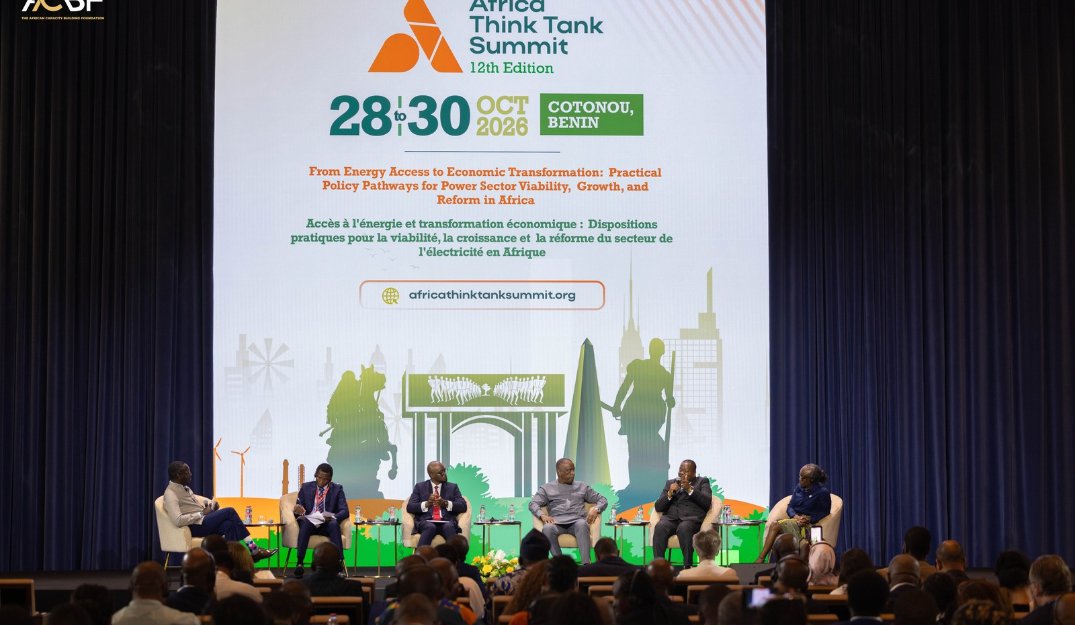
African governments need to accelerate electricity-market reforms, attract more private capital and deepen regional power trading if the continent is to overcome persistent supply gaps and financially weak utilities, speakers at the Africa Think Tank Summit said on Thursday.

The discussion took place during the high-level panel, “Political Leadership for Power Sector Reform – Challenges, Trade-Offs, and Accountability,” which examined how governments can balance political control, private-sector participation, regional integration and accountability while expanding electricity access.

Convened by the African Capacity Building Foundation, the 12th Africa Think Tank Summit, taking place Oct. 28-30 in Cotonou, Benin, brings together ministers, policymakers, think tanks and development partners. The summit is being held under the theme, “From Energy Access to Economic Transformation: Practical Policy Pathways for Power Sector Viability, Growth and Reform in Africa.”

Panelists said fragmented national approaches have raised costs, discouraged investment and left many state-owned utilities unable to finance the infrastructure needed to meet growing demand. They called for stronger political leadership, tariffs that better reflect the cost of electricity and greater transparency in the management of utilities and regulators.

Tanzania was cited as an example of a country gradually opening its electricity industry. Reforms introduced in 2015 allowed greater private participation in generation and distribution, while transmission remains under state control because of its strategic importance.

Private producers now include large companies generating more than 189 megawatts, medium-sized operators producing more than 59 megawatts and smaller producers contributing about 2.21 megawatts, according to figures presented during the panel. More than 100 companies are licensed to participate in distribution.

Tanzania’s installed capacity has risen to about 4,650 megawatts from 2,461 megawatts following completion of the Julius Nyerere Hydropower Project. Peak demand is about 2,271 megawatts, leaving surplus capacity that the country is seeking to sell to neighboring markets through regional power pools.

That surplus illustrates the case for deeper regional integration, speakers said. Excess electricity in one market could offset shortages elsewhere, lowering the need for countries to build costly reserve capacity independently.

The Sovereignty Question

National sovereignty remains a major obstacle to regional integration, panelists said, as governments often prioritize domestic control even when cross-border infrastructure and pooled generation could reduce costs and improve reliability.

Benin continues to depend heavily on electricity imports, including supplies from Nigeria and Ghana, while the Communauté Électrique du Bénin, which manages transmission infrastructure for Benin and Togo, is undergoing restructuring.

Senegal has pursued regional cooperation through shared hydropower projects and an agreement with Mauritania on offshore gas resources spanning their maritime border.

The panel also highlighted the risks of poorly structured private-sector participation. Ghana’s electricity-distribution concession collapsed in 2019 after problems involving payment guarantees, resulting in losses of more than $190 million, speakers said.

Nigeria, meanwhile, has moved toward more cost-reflective pricing. In 2024, the government introduced its Band A tariff for customers receiving at least 20 hours of electricity a day.

Panelists said politically suppressed tariffs are among the biggest threats to utility finances. When prices fail to cover costs, governments absorb the gap through subsidies, guarantees and debt, while consumers often turn to expensive diesel generation.

Speakers also proposed an independently verified annual scorecard to assess utilities and regulators, saying stronger accountability could reduce policy reversals and improve investor confidence.

The broader message was that Africa’s power challenge is no longer only about adding generation. Governments must also build financially viable utilities, stronger regional markets and credible regulatory systems capable of attracting private investment while protecting the public interest.

Get the inside Story

Stay informed on the stories shaping Africa’s future. Get breaking news, in-depth analysis, opinions and exclusive insights from across the continent delivered to your inbox, free and unfiltered.


Get in touch for more:
Felix Tih
Editorial Director, Bantu Gazette
WhatsApp
LinkedIn
X (Twitter)
Instagram

Related Posts

Africa’s Water Security Ambitions Face a Defining Test at COP31
Development & Impact

Africa’s Water Security Ambitions Face a Defining Test at COP31

November 18, 2026
Five African Nations Finish in Dakar 2026’s Top 10 as Youth Olympics Make History
Development & Impact

Five African Nations Finish in Dakar 2026’s Top 10 as Youth Olympics Make History

November 18, 2026
Ethiopia Pledges Early Climate Action as It Prepares to Host COP32 in 2027
Development & Impact

Ethiopia Pledges Early Climate Action as It Prepares to Host COP32 in 2027

November 13, 2026
COP31 | UN Official Urges Shift from Climate Pledges to Concrete Action in Africa
Development & Impact

COP31 | UN Official Urges Shift from Climate Pledges to Concrete Action in Africa

November 12, 2026
Hidden Trade Costs Threaten Africa’s Free Trade Ambitions, Report Warns
Development & Impact

Hidden Trade Costs Threaten Africa’s Free Trade Ambitions, Report Warns

November 11, 2026
Uganda Secures Deal to Host African Humanitarian Agency
Development & Impact

Uganda Secures Deal to Host African Humanitarian Agency

November 10, 2026

Most Recent

Africa’s Water Security Ambitions Face a Defining Test at COP31
Development & Impact

Africa’s Water Security Ambitions Face a Defining Test at COP31

by Felix Tih
November 18, 2026
0

With a $30 billion annual financing gap, African governments face growing pressure to turn water investment priorities into projects that...

Read moreDetails
Rwanda, Cambodia Launch Cross-Border Remittance Initiative to Boost Trade

Rwanda, Cambodia Launch Cross-Border Remittance Initiative to Boost Trade

November 16, 2026
Five African Nations Finish in Dakar 2026’s Top 10 as Youth Olympics Make History

Five African Nations Finish in Dakar 2026’s Top 10 as Youth Olympics Make History

November 18, 2026
Ethiopia Pledges Early Climate Action as It Prepares to Host COP32 in 2027

Ethiopia Pledges Early Climate Action as It Prepares to Host COP32 in 2027

November 13, 2026
COP31 | UN Official Urges Shift from Climate Pledges to Concrete Action in Africa

COP31 | UN Official Urges Shift from Climate Pledges to Concrete Action in Africa

November 12, 2026
Hidden Trade Costs Threaten Africa’s Free Trade Ambitions, Report Warns

Hidden Trade Costs Threaten Africa’s Free Trade Ambitions, Report Warns

November 11, 2026
Uganda Secures Deal to Host African Humanitarian Agency

Uganda Secures Deal to Host African Humanitarian Agency

November 10, 2026
Africa’s Water Security Ambitions Face a Defining Test at COP31
Development & Impact

Africa’s Water Security Ambitions Face a Defining Test at COP31

by Felix Tih
Reading Time: 4 mins read
November 18, 2026
0

With a $30 billion annual financing gap, African governments face growing pressure to turn water investment priorities into projects that...

Read moreDetails
Rwanda, Cambodia Launch Cross-Border Remittance Initiative to Boost Trade
Business, Trade & Economy

Rwanda, Cambodia Launch Cross-Border Remittance Initiative to Boost Trade

by Amani Mwakalebela
Reading Time: 2 mins read
November 16, 2026
0

PHNOM PENH, Cambodia The National Bank of Rwanda and the National Bank of Cambodia have jointly launched a proof of...

Read moreDetails
Five African Nations Finish in Dakar 2026’s Top 10 as Youth Olympics Make History
Development & Impact

Five African Nations Finish in Dakar 2026’s Top 10 as Youth Olympics Make History

by Aissatou Fall
Reading Time: 4 mins read
November 18, 2026
0

Senegal's five gold medals included three in beach wrestling, while Kenya's women became the first African rugby sevens Olympic champions.

Read moreDetails

ATTS2026 | Africa’s Power Reform Push Turns to Private Capital, Regional Trade

Ministerial panel calls for cost-reflective tariffs, stronger regional power markets and greater private-sector participation to improve the financial viability of Africa’s electricity systems.

ATTS2026 | Africa’s Power Reform Push Turns to Private Capital, Regional Trade

Cotonou, Benin

African governments need to accelerate electricity-market reforms, attract more private capital and deepen regional power trading if the continent is to overcome persistent supply gaps and financially weak utilities, speakers at the Africa Think Tank Summit said on Thursday.

The discussion took place during the high-level panel, “Political Leadership for Power Sector Reform – Challenges, Trade-Offs, and Accountability,” which examined how governments can balance political control, private-sector participation, regional integration and accountability while expanding electricity access.

Convened by the African Capacity Building Foundation, the 12th Africa Think Tank Summit, taking place Oct. 28-30 in Cotonou, Benin, brings together ministers, policymakers, think tanks and development partners. The summit is being held under the theme, “From Energy Access to Economic Transformation: Practical Policy Pathways for Power Sector Viability, Growth and Reform in Africa.”

Panelists said fragmented national approaches have raised costs, discouraged investment and left many state-owned utilities unable to finance the infrastructure needed to meet growing demand. They called for stronger political leadership, tariffs that better reflect the cost of electricity and greater transparency in the management of utilities and regulators.

Tanzania was cited as an example of a country gradually opening its electricity industry. Reforms introduced in 2015 allowed greater private participation in generation and distribution, while transmission remains under state control because of its strategic importance.

Private producers now include large companies generating more than 189 megawatts, medium-sized operators producing more than 59 megawatts and smaller producers contributing about 2.21 megawatts, according to figures presented during the panel. More than 100 companies are licensed to participate in distribution.

Tanzania’s installed capacity has risen to about 4,650 megawatts from 2,461 megawatts following completion of the Julius Nyerere Hydropower Project. Peak demand is about 2,271 megawatts, leaving surplus capacity that the country is seeking to sell to neighboring markets through regional power pools.

That surplus illustrates the case for deeper regional integration, speakers said. Excess electricity in one market could offset shortages elsewhere, lowering the need for countries to build costly reserve capacity independently.

The Sovereignty Question

National sovereignty remains a major obstacle to regional integration, panelists said, as governments often prioritize domestic control even when cross-border infrastructure and pooled generation could reduce costs and improve reliability.

Benin continues to depend heavily on electricity imports, including supplies from Nigeria and Ghana, while the Communauté Électrique du Bénin, which manages transmission infrastructure for Benin and Togo, is undergoing restructuring.

Senegal has pursued regional cooperation through shared hydropower projects and an agreement with Mauritania on offshore gas resources spanning their maritime border.

The panel also highlighted the risks of poorly structured private-sector participation. Ghana’s electricity-distribution concession collapsed in 2019 after problems involving payment guarantees, resulting in losses of more than $190 million, speakers said.

Nigeria, meanwhile, has moved toward more cost-reflective pricing. In 2024, the government introduced its Band A tariff for customers receiving at least 20 hours of electricity a day.

Panelists said politically suppressed tariffs are among the biggest threats to utility finances. When prices fail to cover costs, governments absorb the gap through subsidies, guarantees and debt, while consumers often turn to expensive diesel generation.

Speakers also proposed an independently verified annual scorecard to assess utilities and regulators, saying stronger accountability could reduce policy reversals and improve investor confidence.

The broader message was that Africa’s power challenge is no longer only about adding generation. Governments must also build financially viable utilities, stronger regional markets and credible regulatory systems capable of attracting private investment while protecting the public interest.

ATTS2026 | Africa’s Power Reform Push Turns to Private Capital, Regional Trade

Ministerial panel calls for cost-reflective tariffs, stronger regional power markets and greater private-sector participation to improve the financial viability of Africa’s electricity systems.

ATTS2026 | Africa’s Power Reform Push Turns to Private Capital, Regional Trade
Felix Tihby Felix Tih
October 29, 2026

Cotonou, Benin

African governments need to accelerate electricity-market reforms, attract more private capital and deepen regional power trading if the continent is to overcome persistent supply gaps and financially weak utilities, speakers at the Africa Think Tank Summit said on Thursday.

The discussion took place during the high-level panel, “Political Leadership for Power Sector Reform – Challenges, Trade-Offs, and Accountability,” which examined how governments can balance political control, private-sector participation, regional integration and accountability while expanding electricity access.

Convened by the African Capacity Building Foundation, the 12th Africa Think Tank Summit, taking place Oct. 28-30 in Cotonou, Benin, brings together ministers, policymakers, think tanks and development partners. The summit is being held under the theme, “From Energy Access to Economic Transformation: Practical Policy Pathways for Power Sector Viability, Growth and Reform in Africa.”

Panelists said fragmented national approaches have raised costs, discouraged investment and left many state-owned utilities unable to finance the infrastructure needed to meet growing demand. They called for stronger political leadership, tariffs that better reflect the cost of electricity and greater transparency in the management of utilities and regulators.

Tanzania was cited as an example of a country gradually opening its electricity industry. Reforms introduced in 2015 allowed greater private participation in generation and distribution, while transmission remains under state control because of its strategic importance.

Private producers now include large companies generating more than 189 megawatts, medium-sized operators producing more than 59 megawatts and smaller producers contributing about 2.21 megawatts, according to figures presented during the panel. More than 100 companies are licensed to participate in distribution.

Tanzania’s installed capacity has risen to about 4,650 megawatts from 2,461 megawatts following completion of the Julius Nyerere Hydropower Project. Peak demand is about 2,271 megawatts, leaving surplus capacity that the country is seeking to sell to neighboring markets through regional power pools.

That surplus illustrates the case for deeper regional integration, speakers said. Excess electricity in one market could offset shortages elsewhere, lowering the need for countries to build costly reserve capacity independently.

The Sovereignty Question

National sovereignty remains a major obstacle to regional integration, panelists said, as governments often prioritize domestic control even when cross-border infrastructure and pooled generation could reduce costs and improve reliability.

Benin continues to depend heavily on electricity imports, including supplies from Nigeria and Ghana, while the Communauté Électrique du Bénin, which manages transmission infrastructure for Benin and Togo, is undergoing restructuring.

Senegal has pursued regional cooperation through shared hydropower projects and an agreement with Mauritania on offshore gas resources spanning their maritime border.

The panel also highlighted the risks of poorly structured private-sector participation. Ghana’s electricity-distribution concession collapsed in 2019 after problems involving payment guarantees, resulting in losses of more than $190 million, speakers said.

Nigeria, meanwhile, has moved toward more cost-reflective pricing. In 2024, the government introduced its Band A tariff for customers receiving at least 20 hours of electricity a day.

Panelists said politically suppressed tariffs are among the biggest threats to utility finances. When prices fail to cover costs, governments absorb the gap through subsidies, guarantees and debt, while consumers often turn to expensive diesel generation.

Speakers also proposed an independently verified annual scorecard to assess utilities and regulators, saying stronger accountability could reduce policy reversals and improve investor confidence.

The broader message was that Africa’s power challenge is no longer only about adding generation. Governments must also build financially viable utilities, stronger regional markets and credible regulatory systems capable of attracting private investment while protecting the public interest.
Get the inside Story

Stay informed on the stories shaping Africa’s future. Get breaking news, in-depth analysis, opinions and exclusive insights from across the continent delivered to your inbox, free and unfiltered.


Get in touch for more:
Felix Tih
Editorial Director, Bantu Gazette
WhatsApp
LinkedIn
X (Twitter)
Instagram

Related Posts

Africa’s Water Security Ambitions Face a Defining Test at COP31

Africa’s Water Security Ambitions Face a Defining Test at COP31

by Felix Tih
November 18, 2026
0

...

Five African Nations Finish in Dakar 2026’s Top 10 as Youth Olympics Make History

Five African Nations Finish in Dakar 2026’s Top 10 as Youth Olympics Make History

by Aissatou Fall
November 15, 2026
0

...

Ethiopia Pledges Early Climate Action as It Prepares to Host COP32 in 2027

Ethiopia Pledges Early Climate Action as It Prepares to Host COP32 in 2027

by Felix Tih
November 12, 2026
0

...

COP31 | UN Official Urges Shift from Climate Pledges to Concrete Action in Africa

COP31 | UN Official Urges Shift from Climate Pledges to Concrete Action in Africa

by Felix Tih
November 11, 2026
0

...

Hidden Trade Costs Threaten Africa’s Free Trade Ambitions, Report Warns

Hidden Trade Costs Threaten Africa’s Free Trade Ambitions, Report Warns

by Maureen Amogelang Garetshoge
November 10, 2026
0

...

Uganda Secures Deal to Host African Humanitarian Agency

Uganda Secures Deal to Host African Humanitarian Agency

by Jane Mukami
November 10, 2026
0

...

Africa’s Water Security Ambitions Face a Defining Test at COP31
Development & Impact

Africa’s Water Security Ambitions Face a Defining Test at COP31

by Felix Tih
Reading Time: 4 mins read
November 18, 2026
0

With a $30 billion annual financing gap, African governments face growing pressure to turn water investment priorities into projects that...

Read moreDetails
Rwanda, Cambodia Launch Cross-Border Remittance Initiative to Boost Trade

Rwanda, Cambodia Launch Cross-Border Remittance Initiative to Boost Trade

by Amani Mwakalebela
November 16, 2026
0

PHNOM PENH, Cambodia The National Bank of Rwanda and the National Bank of Cambodia have jointly launched a proof of...

Five African Nations Finish in Dakar 2026’s Top 10 as Youth Olympics Make History

Five African Nations Finish in Dakar 2026’s Top 10 as Youth Olympics Make History

by Aissatou Fall
November 15, 2026
0

Senegal's five gold medals included three in beach wrestling, while Kenya's women became the first African rugby sevens Olympic champions.

Ethiopia Pledges Early Climate Action as It Prepares to Host COP32 in 2027

Ethiopia Pledges Early Climate Action as It Prepares to Host COP32 in 2027

by Felix Tih
November 12, 2026
0

Ethiopian Prime Minister Abiy Ahmed Ali urged early climate action at COP31 in Antalya, highlighting tree-planting efforts as Addis Ababa...

COP31 | UN Official Urges Shift from Climate Pledges to Concrete Action in Africa

COP31 | UN Official Urges Shift from Climate Pledges to Concrete Action in Africa

by Felix Tih
November 11, 2026
0

Claver Gatete highlights financing gaps, weak institutional arrangements and the need for sustained investment to deliver lasting climate results across...

Next Post
Dakar 2026 opens in Senegal, bringing Olympic competition to Africa for first time

Dakar 2026 opens in Senegal, bringing Olympic competition to Africa for first time

Africa Cup of Nations Returns to Two-Year Cycle as 2027 Preparations Gather Pace

Africa Cup of Nations Returns to Two-Year Cycle as 2027 Preparations Gather Pace

Mali’s Rokiatu Traoré wins United Nations Changemaker Award

Mali’s Rokiatu Traoré wins United Nations Changemaker Award

Think Tanks Urge Practical Fixes to Make Africa’s Free Trade Work

Think Tanks Urge Practical Fixes to Make Africa’s Free Trade Work

Bantu Gazette is a pioneering news platform that champions Africa's development, culture, and heritage. We spotlight the continent's successes, address its challenges, and provide insightful coverage of events that shape its future.

Bantu Gazette is a pioneering news platform that champions Africa's development, culture, and heritage. We spotlight the continent's successes, address its challenges, and provide insightful coverage of events that shape its future.

Our Platforms

  • Bantu Magazine
  • Bantu Brief
  • Black Frame Studio

Our Services

  • Bantu Agency
  • Advertise
  • Partnerships

Our Services

  • Editorial Director
  • Opportunities
  • Contact
Bantu Gazette
  • Energy & Trade
  • Finance
  • Health
  • Politics & Economy
  • Technology
  • Environment
  • Feature
  • Opinion
  • Changemakers
  • Tourism & Culture
  • Magazine