
Bantu Gazette

Bantu Gazette
  • Policy & Governance
  • Development & Impact
  • Business, Trade & Economy
  • Energy
  • Changemakers
  • Culture & Identity
  • Perspectives
  • Magazine
Menu
  • Black Frame Studio
  • Magazine

Burkina Faso Links Mechanized Harvests to a New Push for Local Food Processing

West African country expands farm mechanization and local processing at Bagré in a push to boost output, cut losses and strengthen food self-sufficiency

Burkina Faso Links Mechanized Harvests to a New Push for Local Food Processing
Aissatou Fallby Aissatou Fall
October 27, 2026
Reading Time: 2 mins read

Burkina Faso Links Mechanized Harvests to a New Push for Local Food Processing

West African country expands farm mechanization and local processing at Bagré in a push to boost output, cut losses and strengthen food self-sufficiency

Burkina Faso Links Mechanized Harvests to a New Push for Local Food Processing
Aissatou Fallby Aissatou Fall
November 1, 2026
Reading Time: 2 mins read

BAGRÉ, Burkina Faso

On farmland at Bagré, a combine harvester moving through a maize field and a newly commissioned rice mill offer two sides of Burkina Faso’s effort to reshape its agricultural system.

Prime Minister Rimtalba Jean Emmanuel Ouédraogo visited the area on Oct. 20 to launch mechanized maize harvesting on land operated by state-owned Faso Agropoles, known as SOFA, and inaugurate a government-funded rice processing plant.

The projects are part of an attempt to link higher agricultural production with faster harvesting and more domestic processing, as the government pursues its goal of greater food self-sufficiency.

SOFA is cultivating 300 hectares across its sites in the Nakambé agropole. In a media release, the Prime Ministry said it launched the mechanized harvest on a demonstration plot covering more than 70 hectares.

The combine harvester used at Bagré was among the agricultural equipment President Ibrahim Traoré made available to the rural sector in June 2025. Technical officials cited in the statement said the machine can harvest about 10 hectares in eight to 10 hours.

Beyond reducing the physical burden of harvesting, the equipment is intended to limit post-harvest losses and clear farmland more quickly for another crop.

The government wants irrigated areas under controlled water management to eventually support as many as three production cycles a year.

“To achieve the ambitious goals we have set for ourselves in food self-sufficiency, we need to modernize farming practices and equipment,” Ouédraogo said.

The prime minister said mechanization should extend beyond land preparation.

Equipment distributed by the government has already supported agricultural mechanization brigades that provide free or subsidized plowing services in municipalities, he said, adding that producers also need enough capacity to bring expanded harvests in on time.

From Harvest to Processing

A few steps further along the agricultural chain, the new Bagré rice mill is designed to address another constraint.

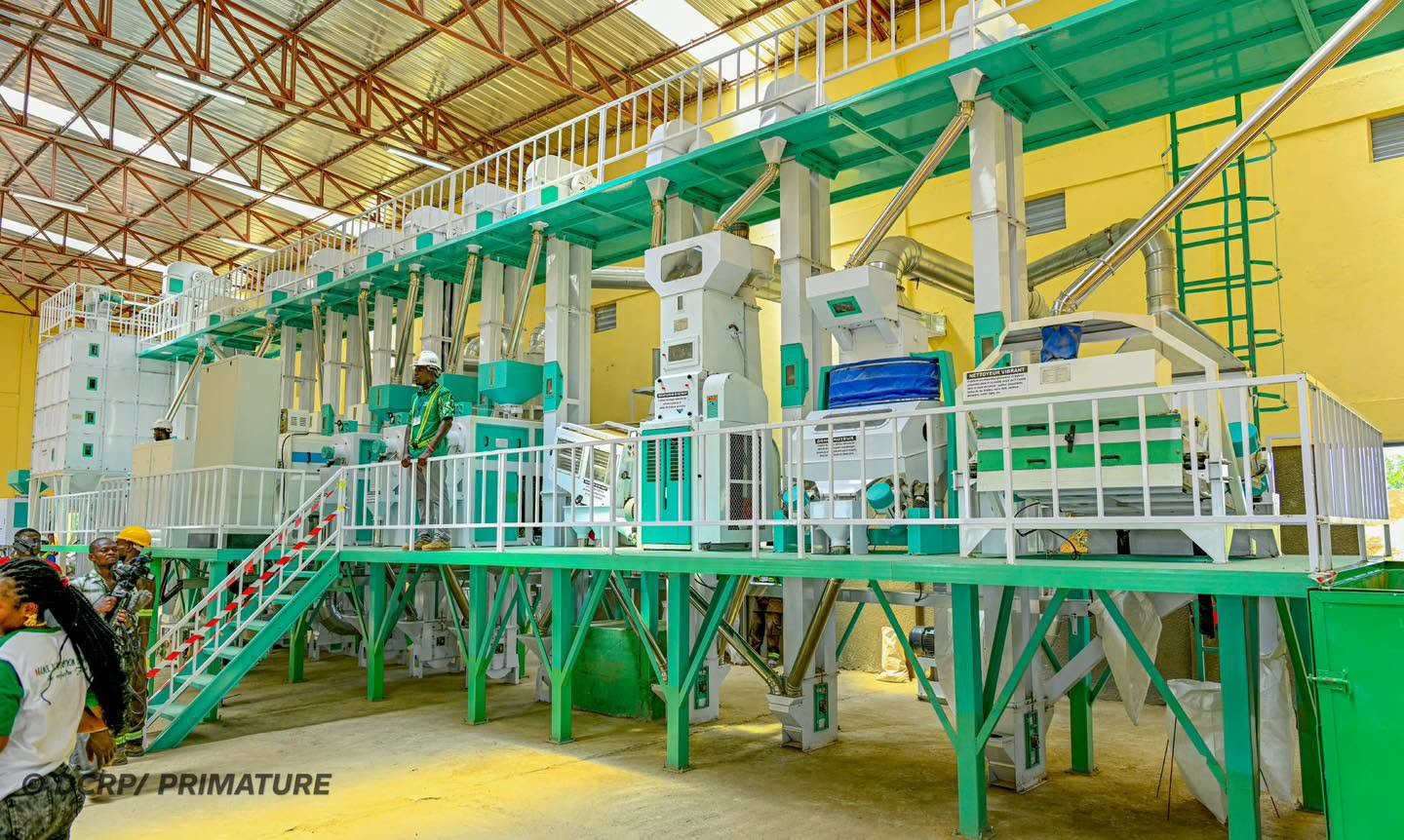
The state-funded facility, also managed by SOFA, can process 100 metric tons of paddy rice a day.

Its production line cleans the harvested rice, removes stones and other foreign material, separates husks and remaining paddy, and then whitens and water-polishes the grain.

The mill also has optical sorting equipment to remove discolored grains and foreign material, as well as machinery to separate whole grains from broken rice.

Automated weighing, bagging and bag-closing equipment complete the processing line.

The government expects the facility to help process paddy rice stocks accumulated through state purchases directly from producers, easing constraints on milling while creating an outlet for locally grown crops.

Ouédraogo told residents that food self-sufficiency is part of the government’s broader vision of national sovereignty.

He also reiterated Traoré’s position that expanding farm production should be accompanied by industrial processing that captures more value from domestic harvests.

The government plans to continue establishing processing plants alongside agropoles in different parts of the country, according to the Prime Ministry.

At Bagré, that strategy is visible in machinery serving different stages of the agricultural cycle, from getting crops out of the field faster to turning part of the harvest into a finished food product.

The government’s challenge is to make the connection between the two durable, ensuring that investment in expanded production is matched by the harvesting and processing capacity needed to handle what farmers grow.

 

Get the inside Story

Stay informed on the stories shaping Africa’s future. Get breaking news, in-depth analysis, opinions and exclusive insights from across the continent delivered to your inbox, free and unfiltered.


Get in touch for more:
Felix Tih
Editorial Director, Bantu Gazette
WhatsApp
LinkedIn
X (Twitter)
Instagram

Related Posts

Africa’s Water Security Ambitions Face a Defining Test at COP31
Development & Impact

Africa’s Water Security Ambitions Face a Defining Test at COP31

November 18, 2026
Five African Nations Finish in Dakar 2026’s Top 10 as Youth Olympics Make History
Development & Impact

Five African Nations Finish in Dakar 2026’s Top 10 as Youth Olympics Make History

November 18, 2026
Ethiopia Pledges Early Climate Action as It Prepares to Host COP32 in 2027
Development & Impact

Ethiopia Pledges Early Climate Action as It Prepares to Host COP32 in 2027

November 13, 2026
COP31 | UN Official Urges Shift from Climate Pledges to Concrete Action in Africa
Development & Impact

COP31 | UN Official Urges Shift from Climate Pledges to Concrete Action in Africa

November 12, 2026
Hidden Trade Costs Threaten Africa’s Free Trade Ambitions, Report Warns
Development & Impact

Hidden Trade Costs Threaten Africa’s Free Trade Ambitions, Report Warns

November 11, 2026
Uganda Secures Deal to Host African Humanitarian Agency
Development & Impact

Uganda Secures Deal to Host African Humanitarian Agency

November 10, 2026

Most Recent

Africa’s Water Security Ambitions Face a Defining Test at COP31
Development & Impact

Africa’s Water Security Ambitions Face a Defining Test at COP31

by Felix Tih
November 18, 2026
0

With a $30 billion annual financing gap, African governments face growing pressure to turn water investment priorities into projects that...

Read moreDetails
Rwanda, Cambodia Launch Cross-Border Remittance Initiative to Boost Trade

Rwanda, Cambodia Launch Cross-Border Remittance Initiative to Boost Trade

November 16, 2026
Five African Nations Finish in Dakar 2026’s Top 10 as Youth Olympics Make History

Five African Nations Finish in Dakar 2026’s Top 10 as Youth Olympics Make History

November 18, 2026
Ethiopia Pledges Early Climate Action as It Prepares to Host COP32 in 2027

Ethiopia Pledges Early Climate Action as It Prepares to Host COP32 in 2027

November 13, 2026
COP31 | UN Official Urges Shift from Climate Pledges to Concrete Action in Africa

COP31 | UN Official Urges Shift from Climate Pledges to Concrete Action in Africa

November 12, 2026
Hidden Trade Costs Threaten Africa’s Free Trade Ambitions, Report Warns

Hidden Trade Costs Threaten Africa’s Free Trade Ambitions, Report Warns

November 11, 2026
Uganda Secures Deal to Host African Humanitarian Agency

Uganda Secures Deal to Host African Humanitarian Agency

November 10, 2026
Africa’s Water Security Ambitions Face a Defining Test at COP31
Development & Impact

Africa’s Water Security Ambitions Face a Defining Test at COP31

by Felix Tih
Reading Time: 4 mins read
November 18, 2026
0

With a $30 billion annual financing gap, African governments face growing pressure to turn water investment priorities into projects that...

Read moreDetails
Rwanda, Cambodia Launch Cross-Border Remittance Initiative to Boost Trade
Business, Trade & Economy

Rwanda, Cambodia Launch Cross-Border Remittance Initiative to Boost Trade

by Amani Mwakalebela
Reading Time: 2 mins read
November 16, 2026
0

PHNOM PENH, Cambodia The National Bank of Rwanda and the National Bank of Cambodia have jointly launched a proof of...

Read moreDetails
Five African Nations Finish in Dakar 2026’s Top 10 as Youth Olympics Make History
Development & Impact

Five African Nations Finish in Dakar 2026’s Top 10 as Youth Olympics Make History

by Aissatou Fall
Reading Time: 4 mins read
November 18, 2026
0

Senegal's five gold medals included three in beach wrestling, while Kenya's women became the first African rugby sevens Olympic champions.

Read moreDetails

Burkina Faso Links Mechanized Harvests to a New Push for Local Food Processing

West African country expands farm mechanization and local processing at Bagré in a push to boost output, cut losses and strengthen food self-sufficiency

Burkina Faso Links Mechanized Harvests to a New Push for Local Food Processing

BAGRÉ, Burkina Faso

On farmland at Bagré, a combine harvester moving through a maize field and a newly commissioned rice mill offer two sides of Burkina Faso’s effort to reshape its agricultural system.

Prime Minister Rimtalba Jean Emmanuel Ouédraogo visited the area on Oct. 20 to launch mechanized maize harvesting on land operated by state-owned Faso Agropoles, known as SOFA, and inaugurate a government-funded rice processing plant.

The projects are part of an attempt to link higher agricultural production with faster harvesting and more domestic processing, as the government pursues its goal of greater food self-sufficiency.

SOFA is cultivating 300 hectares across its sites in the Nakambé agropole. In a media release, the Prime Ministry said it launched the mechanized harvest on a demonstration plot covering more than 70 hectares.

The combine harvester used at Bagré was among the agricultural equipment President Ibrahim Traoré made available to the rural sector in June 2025. Technical officials cited in the statement said the machine can harvest about 10 hectares in eight to 10 hours.

Beyond reducing the physical burden of harvesting, the equipment is intended to limit post-harvest losses and clear farmland more quickly for another crop.

The government wants irrigated areas under controlled water management to eventually support as many as three production cycles a year.

“To achieve the ambitious goals we have set for ourselves in food self-sufficiency, we need to modernize farming practices and equipment,” Ouédraogo said.

The prime minister said mechanization should extend beyond land preparation.

Equipment distributed by the government has already supported agricultural mechanization brigades that provide free or subsidized plowing services in municipalities, he said, adding that producers also need enough capacity to bring expanded harvests in on time.

From Harvest to Processing

A few steps further along the agricultural chain, the new Bagré rice mill is designed to address another constraint.

The state-funded facility, also managed by SOFA, can process 100 metric tons of paddy rice a day.

Its production line cleans the harvested rice, removes stones and other foreign material, separates husks and remaining paddy, and then whitens and water-polishes the grain.

The mill also has optical sorting equipment to remove discolored grains and foreign material, as well as machinery to separate whole grains from broken rice.

Automated weighing, bagging and bag-closing equipment complete the processing line.

The government expects the facility to help process paddy rice stocks accumulated through state purchases directly from producers, easing constraints on milling while creating an outlet for locally grown crops.

Ouédraogo told residents that food self-sufficiency is part of the government’s broader vision of national sovereignty.

He also reiterated Traoré’s position that expanding farm production should be accompanied by industrial processing that captures more value from domestic harvests.

The government plans to continue establishing processing plants alongside agropoles in different parts of the country, according to the Prime Ministry.

At Bagré, that strategy is visible in machinery serving different stages of the agricultural cycle, from getting crops out of the field faster to turning part of the harvest into a finished food product.

The government’s challenge is to make the connection between the two durable, ensuring that investment in expanded production is matched by the harvesting and processing capacity needed to handle what farmers grow.
 

Burkina Faso Links Mechanized Harvests to a New Push for Local Food Processing

West African country expands farm mechanization and local processing at Bagré in a push to boost output, cut losses and strengthen food self-sufficiency

Burkina Faso Links Mechanized Harvests to a New Push for Local Food Processing
Aissatou Fallby Aissatou Fall
October 27, 2026

BAGRÉ, Burkina Faso

On farmland at Bagré, a combine harvester moving through a maize field and a newly commissioned rice mill offer two sides of Burkina Faso’s effort to reshape its agricultural system.

Prime Minister Rimtalba Jean Emmanuel Ouédraogo visited the area on Oct. 20 to launch mechanized maize harvesting on land operated by state-owned Faso Agropoles, known as SOFA, and inaugurate a government-funded rice processing plant.

The projects are part of an attempt to link higher agricultural production with faster harvesting and more domestic processing, as the government pursues its goal of greater food self-sufficiency.

SOFA is cultivating 300 hectares across its sites in the Nakambé agropole. In a media release, the Prime Ministry said it launched the mechanized harvest on a demonstration plot covering more than 70 hectares.

The combine harvester used at Bagré was among the agricultural equipment President Ibrahim Traoré made available to the rural sector in June 2025. Technical officials cited in the statement said the machine can harvest about 10 hectares in eight to 10 hours.

Beyond reducing the physical burden of harvesting, the equipment is intended to limit post-harvest losses and clear farmland more quickly for another crop.

The government wants irrigated areas under controlled water management to eventually support as many as three production cycles a year.

“To achieve the ambitious goals we have set for ourselves in food self-sufficiency, we need to modernize farming practices and equipment,” Ouédraogo said.

The prime minister said mechanization should extend beyond land preparation.

Equipment distributed by the government has already supported agricultural mechanization brigades that provide free or subsidized plowing services in municipalities, he said, adding that producers also need enough capacity to bring expanded harvests in on time.

From Harvest to Processing

A few steps further along the agricultural chain, the new Bagré rice mill is designed to address another constraint.

The state-funded facility, also managed by SOFA, can process 100 metric tons of paddy rice a day.

Its production line cleans the harvested rice, removes stones and other foreign material, separates husks and remaining paddy, and then whitens and water-polishes the grain.

The mill also has optical sorting equipment to remove discolored grains and foreign material, as well as machinery to separate whole grains from broken rice.

Automated weighing, bagging and bag-closing equipment complete the processing line.

The government expects the facility to help process paddy rice stocks accumulated through state purchases directly from producers, easing constraints on milling while creating an outlet for locally grown crops.

Ouédraogo told residents that food self-sufficiency is part of the government’s broader vision of national sovereignty.

He also reiterated Traoré’s position that expanding farm production should be accompanied by industrial processing that captures more value from domestic harvests.

The government plans to continue establishing processing plants alongside agropoles in different parts of the country, according to the Prime Ministry.

At Bagré, that strategy is visible in machinery serving different stages of the agricultural cycle, from getting crops out of the field faster to turning part of the harvest into a finished food product.

The government’s challenge is to make the connection between the two durable, ensuring that investment in expanded production is matched by the harvesting and processing capacity needed to handle what farmers grow.
 

Get the inside Story

Stay informed on the stories shaping Africa’s future. Get breaking news, in-depth analysis, opinions and exclusive insights from across the continent delivered to your inbox, free and unfiltered.


Get in touch for more:
Felix Tih
Editorial Director, Bantu Gazette
WhatsApp
LinkedIn
X (Twitter)
Instagram

Related Posts

Africa’s Water Security Ambitions Face a Defining Test at COP31

Africa’s Water Security Ambitions Face a Defining Test at COP31

by Felix Tih
November 18, 2026
0

...

Five African Nations Finish in Dakar 2026’s Top 10 as Youth Olympics Make History

Five African Nations Finish in Dakar 2026’s Top 10 as Youth Olympics Make History

by Aissatou Fall
November 15, 2026
0

...

Ethiopia Pledges Early Climate Action as It Prepares to Host COP32 in 2027

Ethiopia Pledges Early Climate Action as It Prepares to Host COP32 in 2027

by Felix Tih
November 12, 2026
0

...

COP31 | UN Official Urges Shift from Climate Pledges to Concrete Action in Africa

COP31 | UN Official Urges Shift from Climate Pledges to Concrete Action in Africa

by Felix Tih
November 11, 2026
0

...

Hidden Trade Costs Threaten Africa’s Free Trade Ambitions, Report Warns

Hidden Trade Costs Threaten Africa’s Free Trade Ambitions, Report Warns

by Maureen Amogelang Garetshoge
November 10, 2026
0

...

Uganda Secures Deal to Host African Humanitarian Agency

Uganda Secures Deal to Host African Humanitarian Agency

by Jane Mukami
November 10, 2026
0

...

Africa’s Water Security Ambitions Face a Defining Test at COP31
Development & Impact

Africa’s Water Security Ambitions Face a Defining Test at COP31

by Felix Tih
Reading Time: 4 mins read
November 18, 2026
0

With a $30 billion annual financing gap, African governments face growing pressure to turn water investment priorities into projects that...

Read moreDetails
Rwanda, Cambodia Launch Cross-Border Remittance Initiative to Boost Trade

Rwanda, Cambodia Launch Cross-Border Remittance Initiative to Boost Trade

by Amani Mwakalebela
November 16, 2026
0

PHNOM PENH, Cambodia The National Bank of Rwanda and the National Bank of Cambodia have jointly launched a proof of...

Five African Nations Finish in Dakar 2026’s Top 10 as Youth Olympics Make History

Five African Nations Finish in Dakar 2026’s Top 10 as Youth Olympics Make History

by Aissatou Fall
November 15, 2026
0

Senegal's five gold medals included three in beach wrestling, while Kenya's women became the first African rugby sevens Olympic champions.

Ethiopia Pledges Early Climate Action as It Prepares to Host COP32 in 2027

Ethiopia Pledges Early Climate Action as It Prepares to Host COP32 in 2027

by Felix Tih
November 12, 2026
0

Ethiopian Prime Minister Abiy Ahmed Ali urged early climate action at COP31 in Antalya, highlighting tree-planting efforts as Addis Ababa...

COP31 | UN Official Urges Shift from Climate Pledges to Concrete Action in Africa

COP31 | UN Official Urges Shift from Climate Pledges to Concrete Action in Africa

by Felix Tih
November 11, 2026
0

Claver Gatete highlights financing gaps, weak institutional arrangements and the need for sustained investment to deliver lasting climate results across...

Next Post
ACBF Governors Put Implementation at the Heart of Capacity-Building Agenda

ACBF Governors Put Implementation at the Heart of Capacity-Building Agenda

ATTS2026 | Africa’s Power Reform Push Turns to Private Capital, Regional Trade

ATTS2026 | Africa’s Power Reform Push Turns to Private Capital, Regional Trade

Dakar 2026 opens in Senegal, bringing Olympic competition to Africa for first time

Dakar 2026 opens in Senegal, bringing Olympic competition to Africa for first time

Africa Cup of Nations Returns to Two-Year Cycle as 2027 Preparations Gather Pace

Africa Cup of Nations Returns to Two-Year Cycle as 2027 Preparations Gather Pace

Bantu Gazette is a pioneering news platform that champions Africa's development, culture, and heritage. We spotlight the continent's successes, address its challenges, and provide insightful coverage of events that shape its future.

Bantu Gazette is a pioneering news platform that champions Africa's development, culture, and heritage. We spotlight the continent's successes, address its challenges, and provide insightful coverage of events that shape its future.

Our Platforms

  • Bantu Magazine
  • Bantu Brief
  • Black Frame Studio

Our Services

  • Bantu Agency
  • Advertise
  • Partnerships

Our Services

  • Editorial Director
  • Opportunities
  • Contact
Bantu Gazette
  • Energy & Trade
  • Finance
  • Health
  • Politics & Economy
  • Technology
  • Environment
  • Feature
  • Opinion
  • Changemakers
  • Tourism & Culture
  • Magazine