
With about 600 million Africans still lacking electricity, experts say the continent’s think tanks need to turn research into policy that can expand reliable power, support jobs and guide the energy transition.
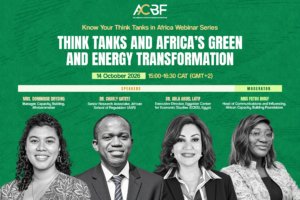
The call came during the final session of the African Capacity Building Foundation (ACBF)’s 2026 Know Your Think Tanks in Africa Webinar Series, held Oct. 14 under the theme “Think Tanks and Africa’s Green and Energy Transformation.”
The session featured Dr. Abla Abdel Latif, executive director of the Egyptian Center for Economic Studies (ECES), and Dominique Dryding, manager of capacity building at Afrobarometer.
Moderating the session, Fatou Diouf, ACBF’s head of communications and influencing, said the continent’s significant renewable energy potential and critical mineral resources coexist with a major energy-access challenge.
The question, she said, is not simply whether Africa should pursue a green and energy transformation, but how that transformation happens, whose priorities shape it, how it is financed and regulated, and whether it improves people’s lives and economic prospects.
“When we talk about power, we’re not just talking about electricity,” Diouf said, linking energy to jobs, business growth, stronger industries and opportunities for economies to thrive.
Abdel Latif said one of the biggest challenges facing think tanks is not necessarily a lack of knowledge, but getting research to policymakers in a form they can use.
Policymakers should be involved from the beginning of the research process rather than receiving completed studies after decisions have already been made, she said.
Research also needs to be translated from technical language into clear recommendations for decision-makers.
For politically sensitive reforms such as changes to energy subsidies, Abdel Latif advocated systematic cost-benefit analysis that considers economic efficiency, social justice, social acceptance and the rights of future generations.
Such analysis, she said, should identify who benefits, who loses and what protections may be needed for vulnerable groups.
Think tanks should also become involved before investments are made, she said, helping governments assess local content requirements, incentives and tax holidays, opportunities for domestic supply chains, and the skills needed for emerging industries.
Stronger African Voice
Abdel Latif also called for a stronger African voice in determining the direction of the continent’s energy transition, arguing that African interests and development needs should shape policy rather than simply following external agendas.
She urged research institutions to look beyond the cost of taking action and examine “the price of inaction,” including the economic consequences of failing to invest in infrastructure, trade and manufacturing.
Dryding brought citizens’ experiences into the discussion, saying think tanks can serve as a bridge between people and the institutions making decisions that affect their lives.
Afrobarometer data shows a significant gap between electricity infrastructure and reliable household access.
While 72% of respondents said the electricity grid reached their area, 60% reported having a household connection and only 43% said electricity worked most or all of the time.
Meanwhile, 41% said they either had no connection or that their connection never worked. Only 45% rated their government’s performance on electricity provision fairly or very well.
Uneven Climate Awareness
Climate change awareness is also uneven. Dryding said about 56% of Africans surveyed had heard of climate change, with wide variations among countries.
At the same time, 3 in 5 respondents reported making at least one change in response to changing weather over the previous five years, including changes in water use, crops, livestock, outdoor work or where they live.
She also highlighted the challenge governments face when climate policies impose direct household costs. While 81% supported government investment in infrastructure that can better withstand floods and droughts, support fell to 51% for banning tree cutting for firewood when alternative fuels would cost more.
Diouf said the findings underscored why the transition cannot follow a one-size-fits-all approach. Different countries and communities have different priorities and needs, while households enter the transition from widely different economic circumstances.
Both speakers also called for greater collaboration among research institutions. Dryding said organizations can combine their evidence, expertise and policy networks so research reaches decision-makers even when individual institutions are not directly “in the room.”
Abdel Latif called for practical research coordination that reduces duplication and allows institutions to build on one another’s work.
Dryding also urged think tanks to explore alternative sources of funding, saying dependence on outside funders can make it harder for African institutions to set their own research agendas.
Closing the discussion, Diouf emphasized collaboration, capacity building, accessible data and the need to center policy on African priorities. She returned to Abdel Latif’s question, asking participants to consider, “What is the price of our inaction?”
Energy transformation, she said, is ultimately about what energy enables, including productive economies, competitive industries, jobs, stronger institutions and improved lives.
The discussion’s focus on renewable energy and climate resilience also reflects the African Union’s Agenda 2063, particularly Aspiration 1, which calls for environmentally sustainable and climate-resilient economies and communities.