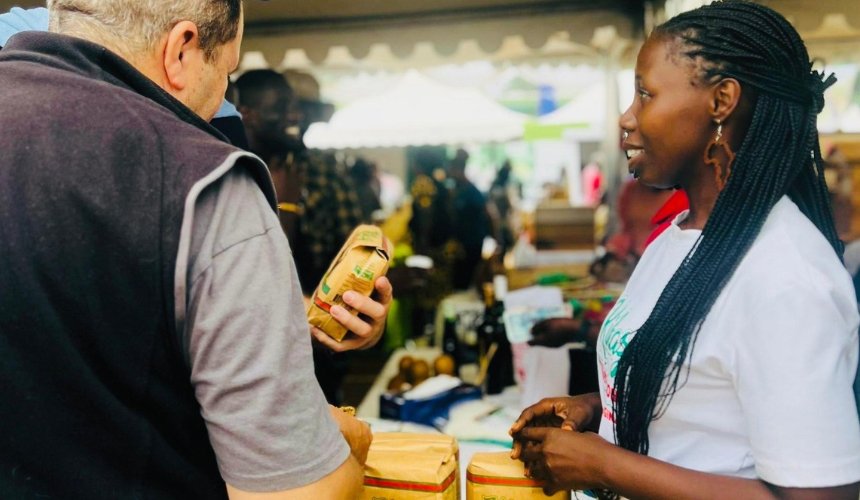

When Grace Akatuha’s mother was diagnosed with diabetes, finding specialist care meant traveling from rural Uganda to the capital, Kampala.
A doctor recommended dietary changes, and the advice changed how Akatuha viewed millet, a grain long grown and consumed locally but receiving limited commercial attention.
She also realized that diabetes was increasingly common in her community, reinforcing her interest in millet as a locally grown food with wider potential.
That experience eventually helped inspire Kikazi Agri-Products Ltd, an agro-processing company Akatuha founded to turn indigenous crops into commercially packaged food products.
She is now trying to turn that local idea into something bigger, building a Ugandan food brand that can find customers across borders.
Kikazi produces millet and cassava flour and is looking to the African Continental Free Trade Area (AfCFTA) as a potential route into markets across the continent.
The company’s immediate targets are Kenya and Burundi, chosen because of their proximity to Uganda and what she describes as existing consumer interest.
Kikazi products have also reached the United Kingdom and Dubai through third-party suppliers.
The opportunity raises a larger question facing many of Africa’s small agro-processors. Can indigenous crops grown by local farmers become competitive regional brands?
Building From the Farm
Kikazi’s ambitions begin with its supply chain.
The company works with more than 1,000 smallholder farmers and farming households, according to Akatuha, with farmers concentrated in Kashongi village in Kiruhura District and Kasheshe village in Rukungiri District.
The network creates a market for crops that farmers have traditionally produced on a smaller scale.
Akatuha told Bantu Gazette that about 40% of the farmers working with Kikazi are women and 20% are young people.
She said expanding production creates an income opportunity, particularly for women who have traditionally played a significant role in growing millet.
Maintaining quality across a large smallholder network presents its own challenge.
“Quality is a journey,” Akatuha said.
Kikazi concentrates its sourcing geographically, allowing the company to better understand local growing conditions and expected yields.
The company also trains farmers in post-harvest handling, including practices that prevent grain from being dried directly on bare ground.
Quality checks include moisture content and grain size, while Kikazi’s certification from the Uganda National Bureau of Standards sets requirements for products distributed locally.
Akatuha also shares quality-control knowledge with farmers because she believes knowledge becomes “more valuable when it is shared,” helping strengthen production and improve the quality of agricultural products coming from Uganda.
AfCFTA Meets the Reality of Cross-Border Trade
Akatuha’s regional ambitions gained another platform when she received a bronze medal in the 2026 AfCFTA My IP Story competition. Kikazi has also registered two trademarks.
The African Continental Free Trade Area is a flagship initiative of the African Union’s Agenda 2063, designed to create a single continental market for goods and services and deepen economic integration across Africa.
It brings together the AU’s 55 member states and eight Regional Economic Communities, covering a market of about 1.3 billion people with a combined gross domestic product of approximately $3.4 trillion.
Beyond reducing barriers to intra-African trade, the agreement is intended to support industrialization, agricultural development, food security and structural transformation.
For African agro-processors such as Kikazi, that ambition could mean greater opportunities to turn locally grown crops into higher-value products and sell them across a much larger continental market.
Akatuha sees AfCFTA as a platform for connecting and trading with other African countries, opening access to more markets while reducing some of the costs associated with trade and logistics.
Turning that opportunity into actual sales remains difficult for a growing processor.
“There is no clear information of what it takes to penetrate the market, especially outside Uganda,” Akatuha said.
She said Kikazi sometimes misses opportunities to attend regional trade exhibitions that could provide market intelligence and connections, widening the knowledge gap between growing businesses and larger companies.
Certification, Financing, Logistics Present Another Hurdle
Kikazi’s Ugandan certification does not automatically qualify its products for sale in other countries. Entering another market can therefore require additional permits and certifications, adding costs before a product reaches consumers.
The company has shipped products to the UK and Dubai through third parties, but the Ugandan agripreneur said small consignments can make transportation more expensive than production itself.
Replenishing those consignments can take eight to 12 months, making it difficult to maintain consistent supply for international customers.
“Lack of financial muscle inhibits Kikazi from transporting large quantities across borders due to high logistics costs,” she said.
Those experiences illustrate one of AfCFTA’s major challenges for small African businesses. A continental market may be opening, while the practical cost of reaching customers across borders can remain prohibitive.
Kenya and Burundi could become Kikazi’s first significant test of whether regional integration can translate into practical market access for an emerging Ugandan food brand.
Turning Indigenous Crops Into African Brands

Akatuha believes certification and intellectual property protection will become increasingly significant as African agricultural businesses seek to sell more processed products rather than raw commodities.
Her experience registering trademarks and participating in the AfCFTA competition has reinforced her view that farmers and processors need to think about branding, standards and market visibility alongside production.
Agriculture also presents an opportunity to change how a younger generation views the sector.
Akatuha grew up in Kasheshe village in Rukungiri District, where she recalls that children showed little interest in farming because it was regarded as a “poor man’s career.”
She believes agribusinesses can change that perception by exposing young people to opportunities across the agricultural economy, including agri-tech and agri-tourism.
She also wants schools and universities to pay more attention to agriculture.
Kikazi’s next stage will require financing, further certification, stronger business networks and access to regional exhibitions. Akatuha wants public and private institutions to help growing companies gain access to those opportunities.
Her ambition reaches beyond expanding Kikazi’s distribution footprint. She wants African consumers to place greater value on locally grown foods and more businesses to build commercial brands around crops that have fed communities for generations.
“We believe that feeding the future begins with preserving the nutritional wisdom of our past,” she said.