

LAGOS, Nigeria
Akeem Busari took charge of Nigeria’s U-17 women’s national team in April 2026 amid open skepticism. Critics pointed to his previous post as technical director at Pacesetter Queens, a club still finding its footing in the Nigerian women’s league, and questioned his pedigree for the global stage.
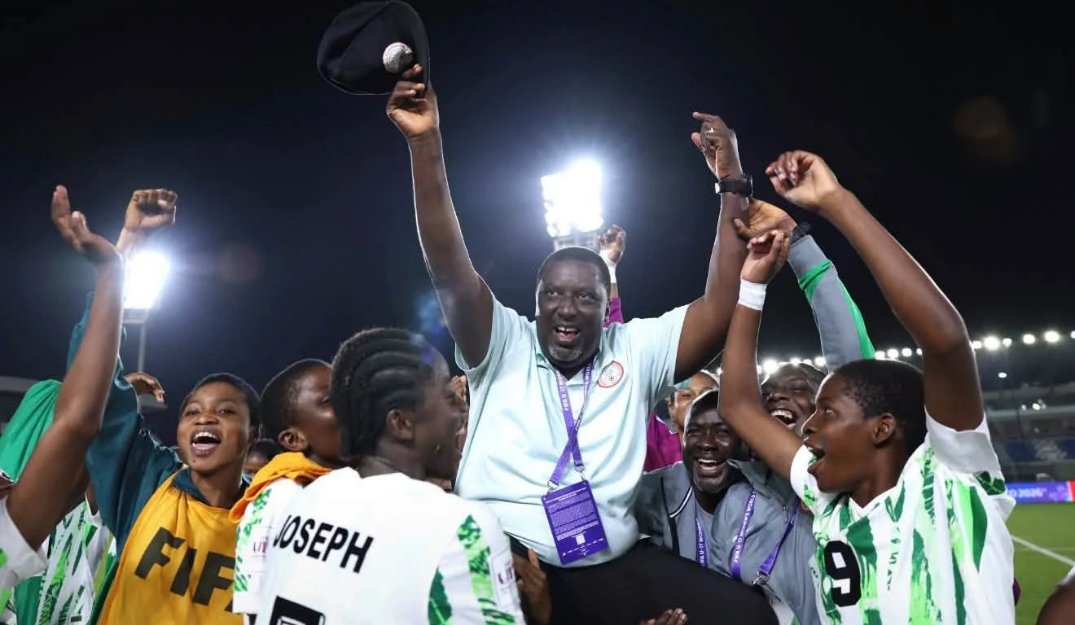
Those doubts evaporated seven months later, on November 7 in Rabat. Goals from Awawu Bashiru and Oluebube Umejiaku secured a tense 2-1 victory over Japan in the final of the FIFA U-17 Women’s World Cup. The Flamingos survived an 80th-minute reply from Fuki Ito to lift the trophy.
Nigeria became the first African nation to win the U-17 women’s title. The Confederation of African Football (CAF) also recognizes the Flamingos as the first African women’s team to claim a FIFA world title at any age level.
Busari spent more than three decades coaching in Nigerian football before that night in Morocco.
His coaching career began on dusty local pitches, long before the bright lights of Rabat. He hung up his boots in 1993 and took charge of a youth side, driven by an eye for raw talent.
“I ventured into coaching around 1993. I started with a youth team, and people used to tell me that what I had to offer was better than what some more experienced coaches were offering,” Busari told The Punch.
Early encouragement pushed him toward formal education at the National Institute for Sports (NIS), where he enrolled in 1999 and spent six years earning credentials that culminated in an Advanced Diploma.
He continued through physical and online courses and secured his CAF A Licence in 2016. He later became an instructor for both CAF and the Nigeria Football Federation (NFF).
Busari also tested himself in high-stakes club environments. He worked with Enyimba, the Aba-based Nigerian club and two-time CAF Champions League winners, during their 2022 CAF Confederation Cup run. He also helped Bayelsa Queens win the President Federation Cup and reach the CAF Women’s Champions League.
The April appointment left him almost no time to waste. He scouted the country for players within the right age bracket and drilled them into a cohesive unit that swept all five matches at the WAFU B qualifiers.
“When the opportunity to lead the women’s U17 team came in April, I had to look inward and identify players within the age bracket who could fit into the team,” he said.
From an opening defeat to six straight wins
The World Cup opened with a harsh wake-up call, a 2-1 defeat to Poland in the group stage. Many of Busari’s players, some still in secondary school, looked overwhelmed against European opponents drawn from the academies of major clubs.
“The World Cup was another level of the game, and we were able to see maturity. Some of our opponents from Europe had players from big clubs and had global experience compared to some of our girls, who were still in school,” he said.
The 50-year-old and his backroom staff took the opening loss straight to the video room. They broke down the match footage and adjusted individual roles, defensive partnerships and the team’s response when trailing.
The training sessions became pressure tests designed to harden the teenagers mentally against bigger, more physically imposing opponents.
“At the World Cup, we lost our first game, which was quite difficult but understandable. However, we knew the team we had and believed we could come back,” he said.
The adjustments produced six consecutive victories and the world title. Nigeria beat Puerto Rico 2-0 and stunned defending champions Korea DPR 3-1 to close the group stage.
The Flamingos then eliminated Mexico 2-1, Venezuela 1-0 and Brazil 3-1 before defeating Japan in the final.
Umejiaku, scorer of the winning goal in the final, received the Golden Ball as the tournament’s best player. Maddie DiMaria of the United States claimed the Golden Boot as top scorer with 12 goals.
Busari ran a tight ship beyond the tactical work, setting firm boundaries for a squad of teenagers away from home, from strict punctuality to mandatory video analysis sessions.
He leaned on his team captains as a bridge between the dugout and the dressing room, resolving minor friction before it reached the pitch.
“Everyone was locked in,” he said, describing the commitment of the players and the atmosphere within the camp.
The triumph has reignited Nigeria’s long-running debate over indigenous coaches. It has also evoked fond memories of the late Yemi Tella, who guided the Golden Eaglets to U-17 glory in 2007.
Busari wants Nigerian football administrators to judge local coaches first on technical competence and work ethic, ahead of the size of the clubs on their CV.
The rewards for delivering the title have been substantial. President Bola Tinubu awarded each of the 21 players a five-year Federal Government Savings Bond worth ₦100 million ($72,000), structured to protect the minors’ financial futures.
Busari received ₦100 million ($72,000) in cash, and each member of the technical crew received ₦50 million ($36,000).
The Nigerian Senate added ₦100 million ($72,000) for the squad.
Lagos State Governor Babajide Sanwo-Olu announced a ₦300 million ($216,000) package that gave every player and staff member ₦10 million ($7,200), along with new iPhone Pro Max devices and custom headphones.
Busari now holds the medal to match the faith people placed in him in 1993. Nigerian women’s football has a new gold standard, 33 years after his first youth session.