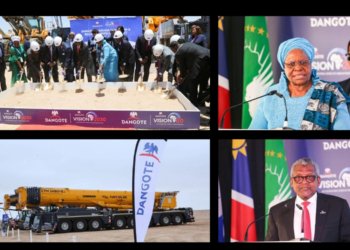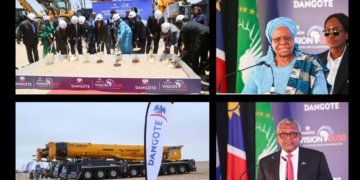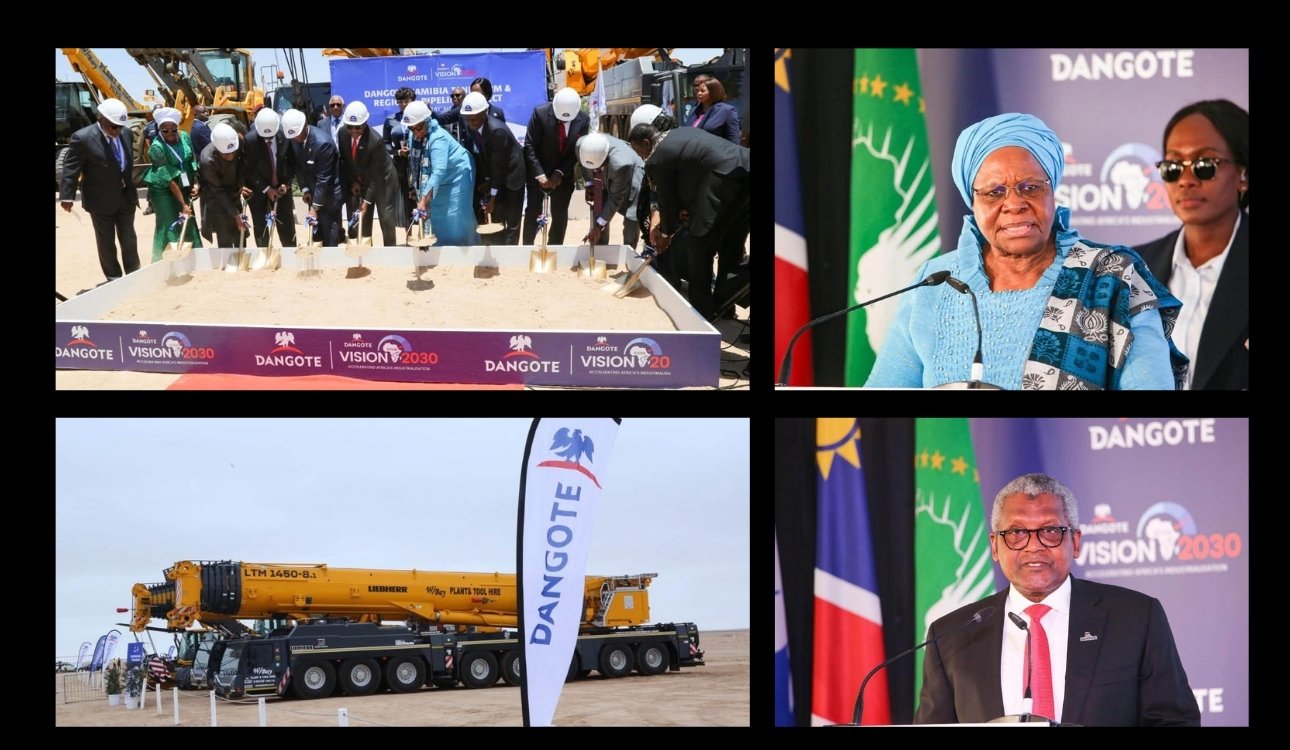

Namibian President Netumbo Nandi-Ndaitwah on Wednesday launched a proposed $2.5 billion petroleum storage and regional pipeline project backed by Nigerian billionaire Aliko Dangote, in a major infrastructure investment aimed at strengthening the country’s energy security and expanding fuel distribution across southern Africa.
The Dangote Namibia Tank Farm and Regional Pipeline Project, launched at Farm 58 in the coastal town of Walvis Bay, will include a petroleum storage facility with a capacity of 600 million liters and a pipeline network extending approximately 1,700 kilometers.
Key Facts
- Investment value: Approximately $2.5 billion.
- Infrastructure: A 600 million-liter petroleum storage facility and a planned 1,700-kilometer pipeline network.
- Location: Farm 58, Walvis Bay, Namibia.
- Government oversight: The project will remain under presidential supervision until completion.
- Regional impact: The infrastructure is intended to improve fuel distribution and serve landlocked southern African markets.
The infrastructure is expected to improve fuel storage and distribution, facilitate cross-border trade and position Namibia as a key energy and logistics hub serving neighboring landlocked economies.
Nandi-Ndaitwah said discussions over the project began when she first met Dangote, chairman and chief executive of the Dangote Group, in June 2025.
She said the investment had been placed under the direct oversight of the president’s office to accelerate implementation and prevent bureaucratic delays.
“This project will remain a presidential project until it is completed,” she said, urging government institutions to work together to ensure its successful delivery.
The president emphasized that the investment must generate tangible economic benefits for Namibians, including employment, skills development and opportunities for local businesses to participate in construction, operations and related industries.
She said the project aligned with Namibia’s Sixth National Development Plan, which prioritizes industrialization, infrastructure development and greater economic participation.
Nandi-Ndaitwah also described the investment as an example of growing economic cooperation among African countries and the continent’s ability to mobilize its own resources for development.
“As Africans, we are beginning to believe in ourselves,” she said.
Dangote, founder of one of the continent’s largest industrial conglomerates, said the planned investment reflected his group’s confidence in Namibia’s economic prospects and strategic position in regional trade.
“Africa must industrialize Africa,” Dangote said, arguing that the continent possesses the resources, markets and entrepreneurial capacity required to drive its own economic transformation.
He said the group’s expansion strategy was focused not only on profitability but also on developing local industries, creating jobs and building long-term partnerships in African economies.
“Whenever we enter another African country, we are coming home,” he said.
Dangote also indicated that the $2.5 billion project could pave the way for further investments in other sectors of Namibia’s economy.
“We will not disappoint you. We will deliver as promised,” he said.
The proposed Namibian project adds to Dangote Group’s extensive industrial footprint across Africa, where the conglomerate has invested billions of dollars in oil refining, fertilizer production, cement manufacturing and other infrastructure.
Kenya Breaks Ground on $16B Refinery
In September 2026, Kenya broke ground on the reported $16 billion Dangote East Africa Petroleum Refinery and Petrochemicals project in the coastal town of Lamu, marking another major proposed investment in the region’s energy infrastructure.
Kenyan President William Ruto described the 2.2 trillion-shilling project, being developed with Dangote, as a significant step toward expanding domestic manufacturing, attracting investment and strengthening regional energy security.
The groundbreaking ceremony, reportedly attended by several African leaders, marked the beginning of construction of the planned industrial complex.
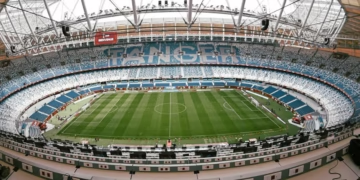
In Nigeria, the group’s flagship Dangote Petroleum Refinery, built at a reported cost of about $20 billion near Lagos, began producing refined petroleum products in 2024. The facility has a designed processing capacity of 650,000 barrels of crude oil per day and is intended to reduce Nigeria’s dependence on imported refined fuels.
The group has also developed a large fertilizer complex in Nigeria, with an annual production capacity of approximately 3 million metric tons of urea, supporting agricultural production and fertilizer exports.
Beyond Nigeria, Dangote Cement has established manufacturing operations in several African countries, including Ethiopia, Tanzania, Zambia, Senegal, South Africa and Cameroon, as part of a broader strategy to expand industrial production and reduce dependence on imports.
The proposed Namibian investment would extend the group’s infrastructure interests into petroleum storage and regional fuel transportation, potentially opening new supply routes for southern African markets.
Walvis Bay, home to one of Namibia’s principal seaports, serves as a strategic gateway for imports and exports moving between the Atlantic Ocean and landlocked countries in the region.
Erongo Regional Governor Nathalia /Goagoses welcomed the investment, saying it could strengthen the region’s role as a center for logistics, trade and industrial development.
The project also supports the African Union’s Agenda 2063, which promotes regional economic integration, industrial development and infrastructure connectivity.
With implementation still ahead, Nandi-Ndaitwah urged government agencies, investors and other stakeholders to translate their commitments into concrete economic results.
“Today we have spoken, and now we must act,” she said.