
Bantu Gazette

Bantu Gazette
  • Energy & Trade
  • Finance
  • Health
  • Politics & Economy
  • Technology
  • Environment
  • Feature
  • Opinion
  • Changemakers
  • Tourism & Culture
  • Sports
  • Magazine
Menu
  • Black Frame Studio
  • Magazine

Africa Moves Toward Food Security with New Agricultural Strategy

Africa Moves Toward Food Security with New Agricultural Strategy
Sandra Ndangby Sandra Ndang
January 15, 2025
Reading Time: 3 mins read

Africa Moves Toward Food Security with New Agricultural Strategy

Africa Moves Toward Food Security with New Agricultural Strategy
Sandra Ndangby Sandra Ndang
July 16, 2025
Reading Time: 3 mins read

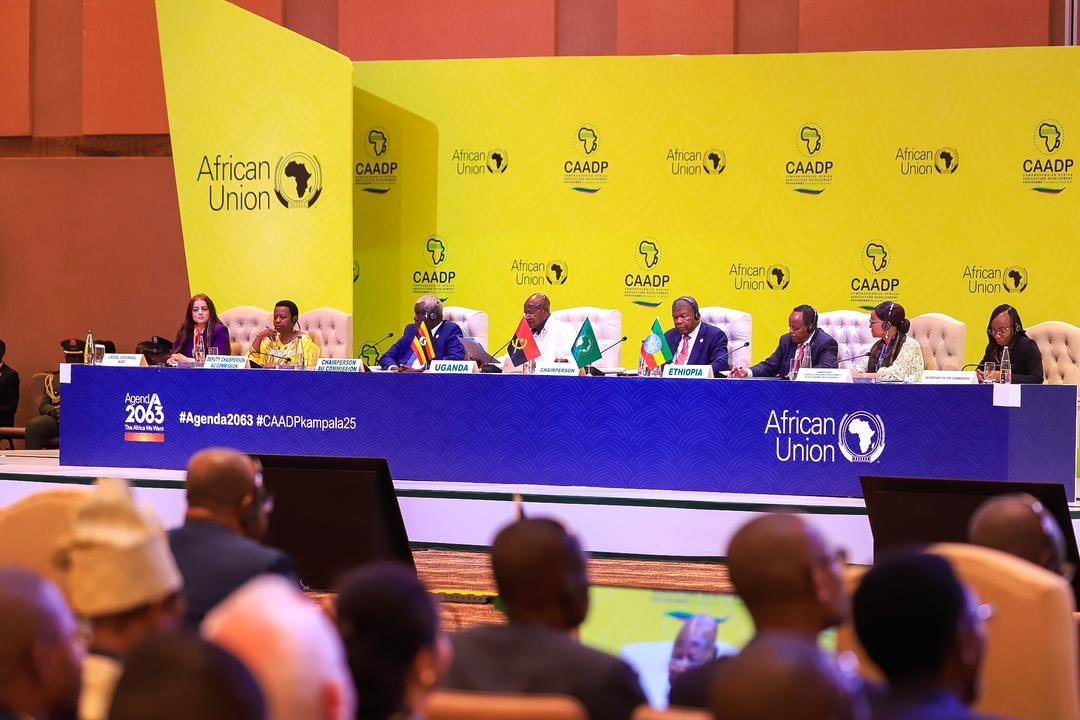
KAMPALA, Uganda (BG) — The African Union (AU) has taken a significant step toward securing food security by adopting a new agricultural development strategy to transform Africa’s agrifood systems.

The strategy, part of the Comprehensive Africa Agriculture Development Programme (CAADP), seeks to increase agrifood output by 45% by 2035.

As part of this effort, AU member states endorsed the 10-year CAADP Strategy and Action Plan alongside the Kampala Declaration on Building Resilient and Sustainable Agrifood Systems in Africa.

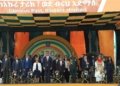
AU leaders formalized the decision during the African Union Extraordinary Summit on the Post-Malabo CAADP, held on Jan. 9–11, 2025, in Kampala, Uganda.

Six Commitments for Agricultural Transformation

The Kampala Declaration outlines six key commitments by the AU’s 55 member states to strengthen Africa’s agri-food systems.

Leaders emphasized the urgency of increasing agricultural production and trade, citing Africa’s projected population growth to 2.5 billion by 2050 and the global population’s rise to 9.8 billion.

AU heads of state pledged to intensify sustainable food production, agro-industrialization, and trade to address rising food demands.

The strategy targets a 50% reduction in post-harvest losses, a tripling of intra-African trade in agrifood products and inputs by 2035, and an increase in the share of locally processed food to 35% of agrifood GDP, according to the AU.

Museveni Urges Value Addition and Open Trade

Ugandan President Yoweri Kaguta Museveni called on African leaders to prioritize value addition in agricultural production.

“This Africa of having no food and begging is not the real Africa, but the colonial and neo-colonial Africa. It is a shame,” Museveni said.

He criticized external pressures that discourage Africa from moving beyond raw material production and stressed the importance of vertical integration in agriculture.

Museveni also urged the removal of non-tariff barriers (NTBs) that hinder agricultural trade within Africa.

He said the potential of Ugandan agricultural exports is often hindered by restrictive actions from neighboring countries, causing significant disruptions in production and trade.

This highlights the urgent need for collaborative solutions to enhance regional cooperation and support Uganda’s agricultural growth.

Calls for Faster Progress

African Union Commission (AUC) Chairperson Moussa Faki Mahamat acknowledged that progress under the Malabo Declaration since 2014 has been slower than desired.

“The various biennial evaluations of the commitments made by Member States, initiated in 2017 under this declaration, certainly show progress towards achieving the set objectives, but at an unsatisfactory pace,” Faki said.

He commended the collaborative work behind the Kampala Declaration, crediting member states, AU institutions, and development partners for their contributions.

Ethiopian President Taye Atske Selassie stressed the urgency of unified action to achieve a food-secure and prosperous Africa.

“This Summit marks a defining moment for Africa, where we will be able to chart out the course of the continent’s agrifood system,” Selassie said.

Ambassador Josefa Sacko, AU Commissioner for Agriculture, Rural Development, Blue Economy, and Sustainable Environment, emphasized that the Kampala plan differs from past declarations by including a detailed action strategy.

“We now have a clear roadmap, a theory of change that outlines the pathway to transformation, realistic and implementable strategic objectives, a broad policy scope enhancing food system approaches, and targets that reflect the continent’s aspirations,” Sacko said.

International Support

International partners have voiced their support for the AU’s bold strategy. Norway’s State Minister and development partner representative, Bjørg Sandkjær, praised the plan’s alignment with Africa’s long-term goals.

“We commend this bold vision, which aligns with the continent’s broader aspirations for prosperity, resilience and inclusive development through the AU Agenda 2063,” Sandkjær said.

Adopting the CAADP Strategy and Action Plan 2026–2035 is pivotal in Africa’s pursuit of food security and sustainable agricultural transformation.
Get the inside Story

Stay informed on the stories shaping Africa’s future. Get breaking news, in-depth analysis, opinions and exclusive insights from across the continent delivered to your inbox, free and unfiltered.


Get in touch for more:
Felix Tih
Editorial Director, Bantu Gazette
WhatsApp
LinkedIn
X (Twitter)
Instagram

Related Posts

Politics & Economy

Africa’s Growth Future Lies in Value-Added Trade, WTO Chief Says

January 14, 2026
Ghana’s Energy Sector Remains Country’s Biggest Economic Risk, Finance Minister Says
Politics & Economy

Ghana Clears $1.47 Billion in Energy Debts, Restores World Bank Guarantee

January 12, 2026
Ethiopia Breaks Ground on Africa’s Largest Airport
Politics & Economy

Ethiopia Breaks Ground on Africa’s Largest Airport

January 10, 2026
Egypt Tapped as Potential Hub for Pan-African Gold Bank
Politics & Economy

Egypt Tapped as Potential Hub for Pan-African Gold Bank

January 6, 2026
Equatorial Guinea Moves Capital from Malabo to Ciudad de la Paz
Finance

Equatorial Guinea Moves Capital from Malabo to Ciudad de la Paz

January 7, 2026
Rwanda Tops Africa in World Bank Business Ready Rankings
Politics & Economy

Rwanda Tops Africa in World Bank Business Ready Rankings

January 3, 2026

Most Recent

Italian Journalists Admire Morocco’s World-Class Stadiums
Sports

Italian Journalists Admire Morocco’s World-Class Stadiums

by Nora Tabe
January 14, 2026
0

Italian journalists have expressed strong admiration for the level of organization and infrastructure provided by Morocco during the Africa Cup...

Read moreDetails

Africa’s Growth Future Lies in Value-Added Trade, WTO Chief Says

January 14, 2026
Nigeria, UAE Agree to Eliminate Tariffs on Over 7,000 Products

Nigeria, UAE Agree to Eliminate Tariffs on Over 7,000 Products

January 13, 2026
Ghana’s Energy Sector Remains Country’s Biggest Economic Risk, Finance Minister Says

Ghana Clears $1.47 Billion in Energy Debts, Restores World Bank Guarantee

January 12, 2026
Eto’o Commends Morocco’s AFCON Hosting, Sportsmanship After Cameroon’s Exit

Eto’o Commends Morocco’s AFCON Hosting, Sportsmanship After Cameroon’s Exit

January 11, 2026
Africa’s Oldest Cremation Pyre Found in Malawi, Dating Back 9,500 Years

Africa’s Oldest Cremation Pyre Found in Malawi, Dating Back 9,500 Years

January 10, 2026
Ethiopia Breaks Ground on Africa’s Largest Airport

Ethiopia Breaks Ground on Africa’s Largest Airport

January 10, 2026
Italian Journalists Admire Morocco’s World-Class Stadiums
Sports

Italian Journalists Admire Morocco’s World-Class Stadiums

by Nora Tabe
Reading Time: 2 mins read
January 14, 2026
0

Italian journalists have expressed strong admiration for the level of organization and infrastructure provided by Morocco during the Africa Cup...

Read moreDetails
Politics & Economy

Africa’s Growth Future Lies in Value-Added Trade, WTO Chief Says

by Felix Tih
Reading Time: 2 mins read
January 14, 2026
0

Africa can anchor a new model of global growth by moving beyond commodity dependence and expanding value-added production integrated into...

Read moreDetails
Nigeria, UAE Agree to Eliminate Tariffs on Over 7,000 Products
Energy & Trade

Nigeria, UAE Agree to Eliminate Tariffs on Over 7,000 Products

by Aissatou Fall
Reading Time: 1 min read
January 13, 2026
0

Nigeria and the United Arab Emirates on Tuesday signed a Comprehensive Economic Partnership Agreement that removes tariffs on more than...

Read moreDetails

Africa Moves Toward Food Security with New Agricultural Strategy

Africa Moves Toward Food Security with New Agricultural Strategy

KAMPALA, Uganda (BG) — The African Union (AU) has taken a significant step toward securing food security by adopting a new agricultural development strategy to transform Africa’s agrifood systems.

The strategy, part of the Comprehensive Africa Agriculture Development Programme (CAADP), seeks to increase agrifood output by 45% by 2035.

As part of this effort, AU member states endorsed the 10-year CAADP Strategy and Action Plan alongside the Kampala Declaration on Building Resilient and Sustainable Agrifood Systems in Africa.

AU leaders formalized the decision during the African Union Extraordinary Summit on the Post-Malabo CAADP, held on Jan. 9–11, 2025, in Kampala, Uganda.

Six Commitments for Agricultural Transformation

The Kampala Declaration outlines six key commitments by the AU’s 55 member states to strengthen Africa’s agri-food systems.

Leaders emphasized the urgency of increasing agricultural production and trade, citing Africa’s projected population growth to 2.5 billion by 2050 and the global population’s rise to 9.8 billion.

AU heads of state pledged to intensify sustainable food production, agro-industrialization, and trade to address rising food demands.

The strategy targets a 50% reduction in post-harvest losses, a tripling of intra-African trade in agrifood products and inputs by 2035, and an increase in the share of locally processed food to 35% of agrifood GDP, according to the AU.

Museveni Urges Value Addition and Open Trade

Ugandan President Yoweri Kaguta Museveni called on African leaders to prioritize value addition in agricultural production.

“This Africa of having no food and begging is not the real Africa, but the colonial and neo-colonial Africa. It is a shame,” Museveni said.

He criticized external pressures that discourage Africa from moving beyond raw material production and stressed the importance of vertical integration in agriculture.

Museveni also urged the removal of non-tariff barriers (NTBs) that hinder agricultural trade within Africa.

He said the potential of Ugandan agricultural exports is often hindered by restrictive actions from neighboring countries, causing significant disruptions in production and trade.

This highlights the urgent need for collaborative solutions to enhance regional cooperation and support Uganda’s agricultural growth.

Calls for Faster Progress

African Union Commission (AUC) Chairperson Moussa Faki Mahamat acknowledged that progress under the Malabo Declaration since 2014 has been slower than desired.

“The various biennial evaluations of the commitments made by Member States, initiated in 2017 under this declaration, certainly show progress towards achieving the set objectives, but at an unsatisfactory pace,” Faki said.

He commended the collaborative work behind the Kampala Declaration, crediting member states, AU institutions, and development partners for their contributions.

Ethiopian President Taye Atske Selassie stressed the urgency of unified action to achieve a food-secure and prosperous Africa.

“This Summit marks a defining moment for Africa, where we will be able to chart out the course of the continent’s agrifood system,” Selassie said.

Ambassador Josefa Sacko, AU Commissioner for Agriculture, Rural Development, Blue Economy, and Sustainable Environment, emphasized that the Kampala plan differs from past declarations by including a detailed action strategy.

“We now have a clear roadmap, a theory of change that outlines the pathway to transformation, realistic and implementable strategic objectives, a broad policy scope enhancing food system approaches, and targets that reflect the continent’s aspirations,” Sacko said.

International Support

International partners have voiced their support for the AU’s bold strategy. Norway’s State Minister and development partner representative, Bjørg Sandkjær, praised the plan’s alignment with Africa’s long-term goals.

“We commend this bold vision, which aligns with the continent’s broader aspirations for prosperity, resilience and inclusive development through the AU Agenda 2063,” Sandkjær said.

Adopting the CAADP Strategy and Action Plan 2026–2035 is pivotal in Africa’s pursuit of food security and sustainable agricultural transformation.

Africa Moves Toward Food Security with New Agricultural Strategy

Africa Moves Toward Food Security with New Agricultural Strategy
Sandra Ndangby Sandra Ndang
January 15, 2025

KAMPALA, Uganda (BG) — The African Union (AU) has taken a significant step toward securing food security by adopting a new agricultural development strategy to transform Africa’s agrifood systems.

The strategy, part of the Comprehensive Africa Agriculture Development Programme (CAADP), seeks to increase agrifood output by 45% by 2035.

As part of this effort, AU member states endorsed the 10-year CAADP Strategy and Action Plan alongside the Kampala Declaration on Building Resilient and Sustainable Agrifood Systems in Africa.

AU leaders formalized the decision during the African Union Extraordinary Summit on the Post-Malabo CAADP, held on Jan. 9–11, 2025, in Kampala, Uganda.

Six Commitments for Agricultural Transformation

The Kampala Declaration outlines six key commitments by the AU’s 55 member states to strengthen Africa’s agri-food systems.

Leaders emphasized the urgency of increasing agricultural production and trade, citing Africa’s projected population growth to 2.5 billion by 2050 and the global population’s rise to 9.8 billion.

AU heads of state pledged to intensify sustainable food production, agro-industrialization, and trade to address rising food demands.

The strategy targets a 50% reduction in post-harvest losses, a tripling of intra-African trade in agrifood products and inputs by 2035, and an increase in the share of locally processed food to 35% of agrifood GDP, according to the AU.

Museveni Urges Value Addition and Open Trade

Ugandan President Yoweri Kaguta Museveni called on African leaders to prioritize value addition in agricultural production.

“This Africa of having no food and begging is not the real Africa, but the colonial and neo-colonial Africa. It is a shame,” Museveni said.

He criticized external pressures that discourage Africa from moving beyond raw material production and stressed the importance of vertical integration in agriculture.

Museveni also urged the removal of non-tariff barriers (NTBs) that hinder agricultural trade within Africa.

He said the potential of Ugandan agricultural exports is often hindered by restrictive actions from neighboring countries, causing significant disruptions in production and trade.

This highlights the urgent need for collaborative solutions to enhance regional cooperation and support Uganda’s agricultural growth.

Calls for Faster Progress

African Union Commission (AUC) Chairperson Moussa Faki Mahamat acknowledged that progress under the Malabo Declaration since 2014 has been slower than desired.

“The various biennial evaluations of the commitments made by Member States, initiated in 2017 under this declaration, certainly show progress towards achieving the set objectives, but at an unsatisfactory pace,” Faki said.

He commended the collaborative work behind the Kampala Declaration, crediting member states, AU institutions, and development partners for their contributions.

Ethiopian President Taye Atske Selassie stressed the urgency of unified action to achieve a food-secure and prosperous Africa.

“This Summit marks a defining moment for Africa, where we will be able to chart out the course of the continent’s agrifood system,” Selassie said.

Ambassador Josefa Sacko, AU Commissioner for Agriculture, Rural Development, Blue Economy, and Sustainable Environment, emphasized that the Kampala plan differs from past declarations by including a detailed action strategy.

“We now have a clear roadmap, a theory of change that outlines the pathway to transformation, realistic and implementable strategic objectives, a broad policy scope enhancing food system approaches, and targets that reflect the continent’s aspirations,” Sacko said.

International Support

International partners have voiced their support for the AU’s bold strategy. Norway’s State Minister and development partner representative, Bjørg Sandkjær, praised the plan’s alignment with Africa’s long-term goals.

“We commend this bold vision, which aligns with the continent’s broader aspirations for prosperity, resilience and inclusive development through the AU Agenda 2063,” Sandkjær said.

Adopting the CAADP Strategy and Action Plan 2026–2035 is pivotal in Africa’s pursuit of food security and sustainable agricultural transformation.

Get the inside Story

Stay informed on the stories shaping Africa’s future. Get breaking news, in-depth analysis, opinions and exclusive insights from across the continent delivered to your inbox, free and unfiltered.


Get in touch for more:
Felix Tih
Editorial Director, Bantu Gazette
WhatsApp
LinkedIn
X (Twitter)
Instagram

Related Posts

Africa’s Growth Future Lies in Value-Added Trade, WTO Chief Says

by Felix Tih
January 14, 2026
0

...

Ghana’s Energy Sector Remains Country’s Biggest Economic Risk, Finance Minister Says

Ghana Clears $1.47 Billion in Energy Debts, Restores World Bank Guarantee

by Marcelo Edjang
January 12, 2026
0

...

Ethiopia Breaks Ground on Africa’s Largest Airport

Ethiopia Breaks Ground on Africa’s Largest Airport

by Maraki Desta
January 10, 2026
0

...

Egypt Tapped as Potential Hub for Pan-African Gold Bank

Egypt Tapped as Potential Hub for Pan-African Gold Bank

by Samira Benhadda
January 6, 2026
0

...

Equatorial Guinea Moves Capital from Malabo to Ciudad de la Paz

Equatorial Guinea Moves Capital from Malabo to Ciudad de la Paz

by Bantu Gazette
January 4, 2026
0

...

Rwanda Tops Africa in World Bank Business Ready Rankings

Rwanda Tops Africa in World Bank Business Ready Rankings

by Jane Mukami
January 3, 2026
0

...

Italian Journalists Admire Morocco’s World-Class Stadiums
Sports

Italian Journalists Admire Morocco’s World-Class Stadiums

by Nora Tabe
Reading Time: 2 mins read
January 14, 2026
0

Italian journalists have expressed strong admiration for the level of organization and infrastructure provided by Morocco during the Africa Cup...

Read moreDetails

Africa’s Growth Future Lies in Value-Added Trade, WTO Chief Says

by Felix Tih
January 14, 2026
0

Africa can anchor a new model of global growth by moving beyond commodity dependence and expanding value-added production integrated into...

Nigeria, UAE Agree to Eliminate Tariffs on Over 7,000 Products

Nigeria, UAE Agree to Eliminate Tariffs on Over 7,000 Products

by Aissatou Fall
January 13, 2026
0

Nigeria and the United Arab Emirates on Tuesday signed a Comprehensive Economic Partnership Agreement that removes tariffs on more than...

Ghana’s Energy Sector Remains Country’s Biggest Economic Risk, Finance Minister Says

Ghana Clears $1.47 Billion in Energy Debts, Restores World Bank Guarantee

by Marcelo Edjang
January 12, 2026
0

The Government of Ghana paid about $1.47 billion in 2025 to clear energy sector arrears, restore a key World Bank...

Eto’o Commends Morocco’s AFCON Hosting, Sportsmanship After Cameroon’s Exit

Eto’o Commends Morocco’s AFCON Hosting, Sportsmanship After Cameroon’s Exit

by Elise Ntebah
January 11, 2026
0

Samuel Eto’o, president of the Cameroon Football Federation, praised Morocco for its exemplary organization and warm hospitality during the 2025...

Next Post
Africa’s Growth Is Unstoppable

Africa’s Growth Is Unstoppable

PowerGen Forms Strategic Alliances to Expand Renewable Energy in Africa

Seychelles Leads Global Push for Marine Conservation, Sustainable Energy

Seychelles Leads Global Push for Marine Conservation, Sustainable Energy

Le Gouvernement Ivoirien Renforce le Dialogue pour Moderniser l’Éducation

Le Gouvernement Ivoirien Renforce le Dialogue pour Moderniser l'Éducation

Bantu Gazette is a pioneering news platform that champions Africa's development, culture, and heritage. We spotlight the continent's successes, address its challenges, and provide insightful coverage of events that shape its future.

Bantu Gazette is a pioneering news platform that champions Africa's development, culture, and heritage. We spotlight the continent's successes, address its challenges, and provide insightful coverage of events that shape its future.

Our Platforms

  • Bantu Magazine
  • Bantu Brief
  • Black Frame Studio

Our Services

  • Bantu Agency
  • Advertise
  • Partnerships

Our Services

  • Editorial Director
  • Opportunities
  • Contact

Bantu Gazette is a pioneering news platform that champions Africa's development, culture, and heritage. We spotlight the continent's successes, address its challenges, and provide insightful coverage of events that shape its future.

Our Platforms

  • Bantu Magazine
  • Bantu Brief
  • Black Frame Studio

Our Services

  • Bantu Agency
  • Advertise
  • Partnerships

Our Services

  • Editorial Director
  • Opportunities
  • Contact
Bantu Gazette
  • Energy & Trade
  • Finance
  • Health
  • Politics & Economy
  • Technology
  • Environment
  • Feature
  • Opinion
  • Changemakers
  • Tourism & Culture
  • Magazine