

Bantu Gazette

Bantu Gazette
  • Policy & Governance
  • Development & Impact
  • Business, Trade & Economy
  • Energy
  • Changemakers
  • Culture & Identity
  • Perspectives
  • Magazine
Menu
  • Black Frame Studio
  • Magazine

Africa Ready to ‘Build and Deploy AI at Scale,’ President Kagame Tells UN Summit

Addressing delegates at the U.N. AI for Good Summit, the Rwandan president said countries must be intentional about how AI is designed, financed and governed.

Africa Ready to ‘Build and Deploy AI at Scale,’ President Kagame Tells UN Summit

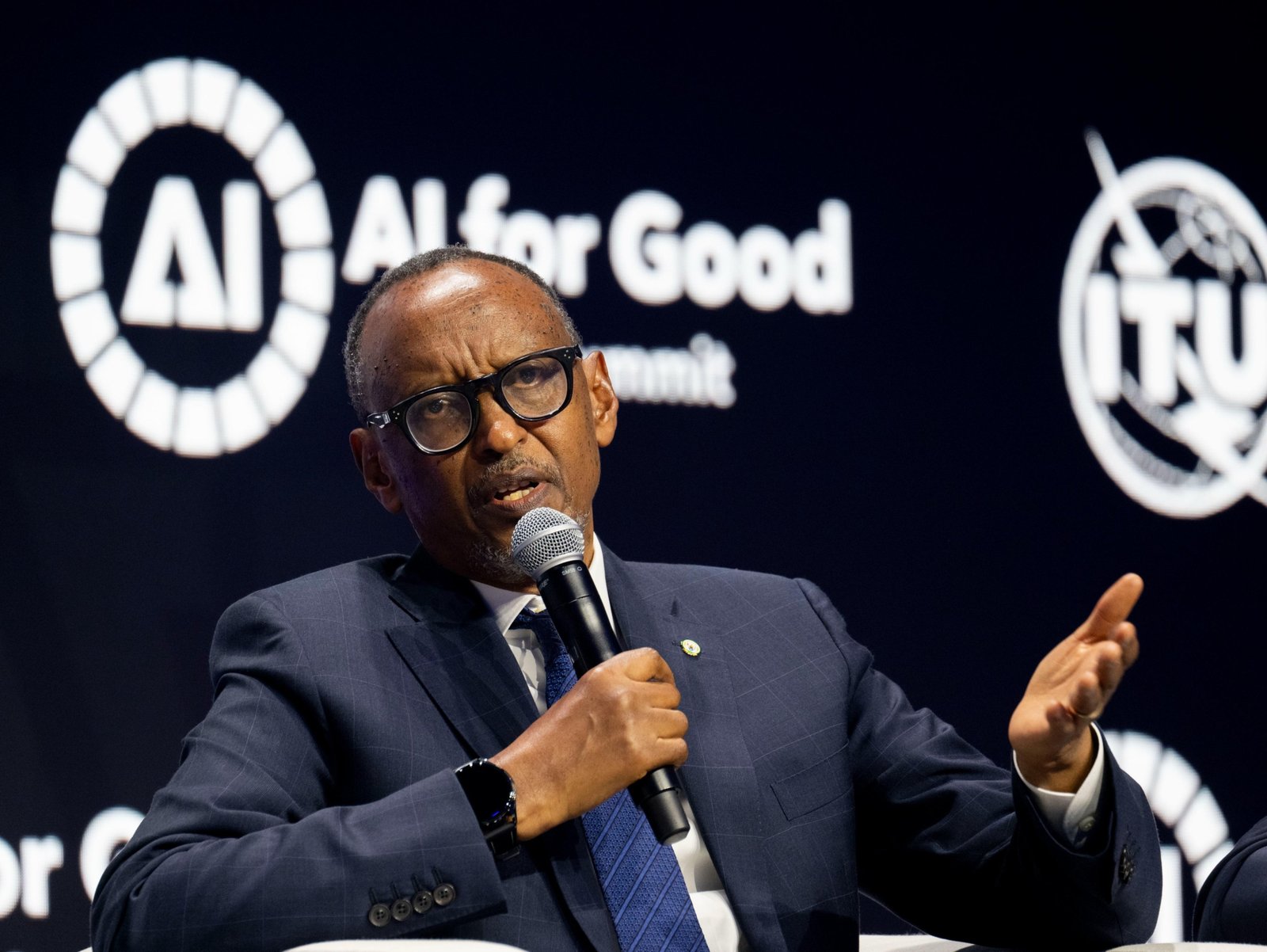
President Paul Kagame at UN AI for Good Summit

Mary Oduorby Mary Oduor
July 15, 2026
Reading Time: 3 mins read

Africa Ready to ‘Build and Deploy AI at Scale,’ President Kagame Tells UN Summit

Addressing delegates at the U.N. AI for Good Summit, the Rwandan president said countries must be intentional about how AI is designed, financed and governed.

Africa Ready to ‘Build and Deploy AI at Scale,’ President Kagame Tells UN Summit

President Paul Kagame at UN AI for Good Summit

Africa Ready to ‘Build and Deploy AI at Scale,’ President Kagame Tells UN Summit

President Paul Kagame at UN AI for Good Summit

Mary Oduorby Mary Oduor
July 20, 2026
Reading Time: 3 mins read

GENEVA

President Paul Kagame called on African nations to move beyond being consumers of artificial intelligence and become builders of the technology, telling delegates at the United Nations’ AI for Good Global Summit that Africa is ready to “build and deploy it at scale.”

Addressing heads of state, technology executives, policymakers and development leaders gathered in Geneva, Kagame said countries must be intentional about how artificial intelligence is designed, financed and governed to ensure it drives development rather than deepens global inequality.

“We must be intentional about designing, funding and governing AI so as to reach its full potential,” Kagame said.

“In Africa, we are no longer satisfied with being passive consumers of technology. We want to build and deploy it at scale. Our objectives are clear and we will continue working together to achieve them,” he added.

Kagame outlined three priorities he said are essential if AI is to deliver equitable growth: expanding infrastructure to support computing capacity, connectivity and clean energy; investing in skills through continuous education reform; and strengthening global governance frameworks that promote accountability and trust.

His remarks came during the AI for Good Global Summit, the United Nations’ leading platform on artificial intelligence.

The July 7-10 summit was organized by the International Telecommunication Union (ITU) in partnership with more than 50 U.N. agencies and was co-convened in Geneva with the Government of Switzerland.

It brought together governments, technology companies, researchers and international organizations to explore how AI can advance sustainable development while establishing global guardrails for its use.

Kagame said the world had entered a new phase of digital transformation, where connectivity alone was no longer sufficient.

“Today, connectivity is no longer the end goal. We are now transitioning to the era of data-driven growth. Artificial intelligence is the common denominator that will redefine healthcare, education and energy, among many other sectors,” he said.

“As a commission, our mission is to ensure this transformation does not widen existing divisions. The task ahead of us is urgent, but we will face challenges. The objective isn’t just to have a conversation. It is to ensure everything we agree to do gets translated into tangible and practical outcomes.”

New commission aims to shape global AI governance

Kagame’s address followed the launch of the AI for Good Global Commission, announced five days before the summit.

The high-level initiative is co-chaired by Kagame and Salesforce Chair and CEO Marc Benioff, with ITU Secretary-General Doreen Bogdan-Martin serving as vice chair.

The commission brings together 44 leaders from government, industry, academia and the United Nations to identify practical ways artificial intelligence can be harnessed to address some of the world’s most pressing challenges while promoting responsible governance.

During the summit, Kagame joined Benioff and Bogdan-Martin for a fireside chat marking the commission’s official launch before co-chairing its inaugural meeting.

Reflecting on his decision to accept the role, Kagame noted that after serving for 16 years as co-chair of the Broadband Commission for Sustainable Development, a body he credited with helping expand connectivity around the world, he had initially considered stepping back from additional international responsibilities.

“I thought I needed to take a break,” he said. “But this is a very good task to carry out.”
President Kagame joined fellow Co-Chair Marc Benioff and Vice-Chair Doreen Bogdan-Martin for a fireside chat marking the launch of the AI for Good Global Commission.

The commission’s founding members include Nvidia CEO Jensen Huang, Amazon CEO Andy Jassy, Microsoft Vice Chair and President Brad Smith, Anthropic co-founder Jack Clark, Estonian President Alar Karis and senior officials from Kazakhstan, Namibia, Saudi Arabia, Singapore and Nigeria.

The launch comes as governments and technology companies face growing pressure to ensure AI systems are developed responsibly and equitably.

At the summit, U.N. Women highlighted persistent gaps in gender representation and fairness in AI.

Citing research from the University of California, Berkeley’s Haas Center for Equity, Gender and Leadership, the agency said 44% of 133 AI systems studied exhibited measurable gender bias, while 26% showed both gender and racial bias.

Only 24 of 138 countries assessed referenced gender in their national AI strategies, and just 18 included substantive provisions.

Separately, Germany’s development agency GIZ and the African Union called for AI development to be anchored in stronger national ecosystems, arguing that enabling policies, accessible data, digital infrastructure and long-term partnerships are essential if artificial intelligence is to accelerate economic transformation.


 

Get the inside Story

Stay informed on the stories shaping Africa’s future. Get breaking news, in-depth analysis, opinions and exclusive insights from across the continent delivered to your inbox, free and unfiltered.


Get in touch for more:
Felix Tih
Editorial Director, Bantu Gazette
WhatsApp
LinkedIn
X (Twitter)
Instagram

Related Posts

New Data Hub to Strengthen Health Decision-Making Across Africa
Development & Impact

New Data Hub to Strengthen Health Decision-Making Across Africa

August 28, 2026
Kagame Urges African Countries to Take Active Role in Shaping AI Future
Development & Impact

Kagame Urges African Countries to Take Active Role in Shaping AI Future

August 29, 2026
Addis Ababa ‘Walks the Talk’ Ahead of Major African Health Meeting
Development & Impact

Addis Ababa ‘Walks the Talk’ Ahead of Major African Health Meeting

August 24, 2026
Benin School Championships Showcase Youth Talent in Sports, Culture
Development & Impact

Benin School Championships Showcase Youth Talent in Sports, Culture

August 24, 2026
Africa Wants to Turn Diaspora Money into Investment
Development & Impact

Africa Wants to Turn Diaspora Money into Investment

August 23, 2026
Cameroon Defeats Malawi 3-0 To Win Its First Women’s Africa Cup of Nations Title
Development & Impact

Cameroon Defeats Malawi 3-0 To Win Its First Women’s Africa Cup of Nations Title

August 19, 2026

Most Recent

Interpol Cybercrime Chief Warns Criminal Networks are Outpacing Institutions
Partner Content

Interpol Cybercrime Chief Warns Criminal Networks are Outpacing Institutions

by Mary Oduor
August 29, 2026
0

NAIROBI, Kenya Artificial intelligence is helping criminals turn stolen photographs and personal data into synthetic identities capable of defeating biometric...

Read moreDetails
New Data Hub to Strengthen Health Decision-Making Across Africa

New Data Hub to Strengthen Health Decision-Making Across Africa

August 28, 2026
Africa Foresight Network Launches with Call for Africans to Shape Their Own Futures

Africa Foresight Network Launches with Call for Africans to Shape Their Own Futures

August 27, 2026
South Africa Allocates $1.7 Billion to Road Agency for Network Expansion

South Africa Says 3% Growth Can Change Its Jobs Equation. Can It Get There?

August 27, 2026
Rwanda Taps Japanese Yen Market for First Time in Loan Deal

Rwanda Taps Japanese Yen Market for First Time in Loan Deal

August 27, 2026
Mindset Shift Could Unlock Africa’s Development Financing Potential

Mindset Shift Could Unlock Africa’s Development Financing Potential

August 26, 2026
Kenya Approves First Locally Domiciled Exchange Traded Fund

Kenya Approves First Locally Domiciled Exchange Traded Fund

August 27, 2026
Interpol Cybercrime Chief Warns Criminal Networks are Outpacing Institutions
Partner Content

Interpol Cybercrime Chief Warns Criminal Networks are Outpacing Institutions

by Mary Oduor
Reading Time: 4 mins read
August 29, 2026
0

NAIROBI, Kenya Artificial intelligence is helping criminals turn stolen photographs and personal data into synthetic identities capable of defeating biometric...

Read moreDetails
New Data Hub to Strengthen Health Decision-Making Across Africa
Development & Impact

New Data Hub to Strengthen Health Decision-Making Across Africa

by Maraki Desta
Reading Time: 2 mins read
August 28, 2026
0

WHO says the digital platform will bring fragmented health information together to help countries track trends, allocate resources and strengthen...

Read moreDetails
Africa Foresight Network Launches with Call for Africans to Shape Their Own Futures
Partner Content

Africa Foresight Network Launches with Call for Africans to Shape Their Own Futures

by Felix Tih
Reading Time: 2 mins read
August 27, 2026
0

New pan-African network seeks to connect foresight practitioners, strengthen African knowledge and turn thinking about the continent's futures into collective...

Read moreDetails

Africa Ready to ‘Build and Deploy AI at Scale,’ President Kagame Tells UN Summit

Addressing delegates at the U.N. AI for Good Summit, the Rwandan president said countries must be intentional about how AI is designed, financed and governed.

Africa Ready to ‘Build and Deploy AI at Scale,’ President Kagame Tells UN Summit

President Paul Kagame at UN AI for Good Summit

GENEVA

President Paul Kagame called on African nations to move beyond being consumers of artificial intelligence and become builders of the technology, telling delegates at the United Nations’ AI for Good Global Summit that Africa is ready to “build and deploy it at scale.”

Addressing heads of state, technology executives, policymakers and development leaders gathered in Geneva, Kagame said countries must be intentional about how artificial intelligence is designed, financed and governed to ensure it drives development rather than deepens global inequality.

“We must be intentional about designing, funding and governing AI so as to reach its full potential,” Kagame said.

“In Africa, we are no longer satisfied with being passive consumers of technology. We want to build and deploy it at scale. Our objectives are clear and we will continue working together to achieve them,” he added.

Kagame outlined three priorities he said are essential if AI is to deliver equitable growth: expanding infrastructure to support computing capacity, connectivity and clean energy; investing in skills through continuous education reform; and strengthening global governance frameworks that promote accountability and trust.

His remarks came during the AI for Good Global Summit, the United Nations’ leading platform on artificial intelligence.

The July 7-10 summit was organized by the International Telecommunication Union (ITU) in partnership with more than 50 U.N. agencies and was co-convened in Geneva with the Government of Switzerland.

It brought together governments, technology companies, researchers and international organizations to explore how AI can advance sustainable development while establishing global guardrails for its use.

Kagame said the world had entered a new phase of digital transformation, where connectivity alone was no longer sufficient.

“Today, connectivity is no longer the end goal. We are now transitioning to the era of data-driven growth. Artificial intelligence is the common denominator that will redefine healthcare, education and energy, among many other sectors,” he said.

“As a commission, our mission is to ensure this transformation does not widen existing divisions. The task ahead of us is urgent, but we will face challenges. The objective isn’t just to have a conversation. It is to ensure everything we agree to do gets translated into tangible and practical outcomes.”

New commission aims to shape global AI governance

Kagame’s address followed the launch of the AI for Good Global Commission, announced five days before the summit.

The high-level initiative is co-chaired by Kagame and Salesforce Chair and CEO Marc Benioff, with ITU Secretary-General Doreen Bogdan-Martin serving as vice chair.

The commission brings together 44 leaders from government, industry, academia and the United Nations to identify practical ways artificial intelligence can be harnessed to address some of the world’s most pressing challenges while promoting responsible governance.

During the summit, Kagame joined Benioff and Bogdan-Martin for a fireside chat marking the commission’s official launch before co-chairing its inaugural meeting.

Reflecting on his decision to accept the role, Kagame noted that after serving for 16 years as co-chair of the Broadband Commission for Sustainable Development, a body he credited with helping expand connectivity around the world, he had initially considered stepping back from additional international responsibilities.

“I thought I needed to take a break,” he said. “But this is a very good task to carry out.”

President Kagame joined fellow Co-Chair Marc Benioff and Vice-Chair Doreen Bogdan-Martin for a fireside chat marking the launch of the AI for Good Global Commission.

The commission’s founding members include Nvidia CEO Jensen Huang, Amazon CEO Andy Jassy, Microsoft Vice Chair and President Brad Smith, Anthropic co-founder Jack Clark, Estonian President Alar Karis and senior officials from Kazakhstan, Namibia, Saudi Arabia, Singapore and Nigeria.

The launch comes as governments and technology companies face growing pressure to ensure AI systems are developed responsibly and equitably.

At the summit, U.N. Women highlighted persistent gaps in gender representation and fairness in AI.

Citing research from the University of California, Berkeley’s Haas Center for Equity, Gender and Leadership, the agency said 44% of 133 AI systems studied exhibited measurable gender bias, while 26% showed both gender and racial bias.

Only 24 of 138 countries assessed referenced gender in their national AI strategies, and just 18 included substantive provisions.

Separately, Germany’s development agency GIZ and the African Union called for AI development to be anchored in stronger national ecosystems, arguing that enabling policies, accessible data, digital infrastructure and long-term partnerships are essential if artificial intelligence is to accelerate economic transformation.

 

Africa Ready to ‘Build and Deploy AI at Scale,’ President Kagame Tells UN Summit

Addressing delegates at the U.N. AI for Good Summit, the Rwandan president said countries must be intentional about how AI is designed, financed and governed.

Africa Ready to ‘Build and Deploy AI at Scale,’ President Kagame Tells UN Summit

President Paul Kagame at UN AI for Good Summit

Mary Oduorby Mary Oduor
July 15, 2026

GENEVA

President Paul Kagame called on African nations to move beyond being consumers of artificial intelligence and become builders of the technology, telling delegates at the United Nations’ AI for Good Global Summit that Africa is ready to “build and deploy it at scale.”

Addressing heads of state, technology executives, policymakers and development leaders gathered in Geneva, Kagame said countries must be intentional about how artificial intelligence is designed, financed and governed to ensure it drives development rather than deepens global inequality.

“We must be intentional about designing, funding and governing AI so as to reach its full potential,” Kagame said.

“In Africa, we are no longer satisfied with being passive consumers of technology. We want to build and deploy it at scale. Our objectives are clear and we will continue working together to achieve them,” he added.

Kagame outlined three priorities he said are essential if AI is to deliver equitable growth: expanding infrastructure to support computing capacity, connectivity and clean energy; investing in skills through continuous education reform; and strengthening global governance frameworks that promote accountability and trust.

His remarks came during the AI for Good Global Summit, the United Nations’ leading platform on artificial intelligence.

The July 7-10 summit was organized by the International Telecommunication Union (ITU) in partnership with more than 50 U.N. agencies and was co-convened in Geneva with the Government of Switzerland.

It brought together governments, technology companies, researchers and international organizations to explore how AI can advance sustainable development while establishing global guardrails for its use.

Kagame said the world had entered a new phase of digital transformation, where connectivity alone was no longer sufficient.

“Today, connectivity is no longer the end goal. We are now transitioning to the era of data-driven growth. Artificial intelligence is the common denominator that will redefine healthcare, education and energy, among many other sectors,” he said.

“As a commission, our mission is to ensure this transformation does not widen existing divisions. The task ahead of us is urgent, but we will face challenges. The objective isn’t just to have a conversation. It is to ensure everything we agree to do gets translated into tangible and practical outcomes.”

New commission aims to shape global AI governance

Kagame’s address followed the launch of the AI for Good Global Commission, announced five days before the summit.

The high-level initiative is co-chaired by Kagame and Salesforce Chair and CEO Marc Benioff, with ITU Secretary-General Doreen Bogdan-Martin serving as vice chair.

The commission brings together 44 leaders from government, industry, academia and the United Nations to identify practical ways artificial intelligence can be harnessed to address some of the world’s most pressing challenges while promoting responsible governance.

During the summit, Kagame joined Benioff and Bogdan-Martin for a fireside chat marking the commission’s official launch before co-chairing its inaugural meeting.

Reflecting on his decision to accept the role, Kagame noted that after serving for 16 years as co-chair of the Broadband Commission for Sustainable Development, a body he credited with helping expand connectivity around the world, he had initially considered stepping back from additional international responsibilities.

“I thought I needed to take a break,” he said. “But this is a very good task to carry out.”

President Kagame joined fellow Co-Chair Marc Benioff and Vice-Chair Doreen Bogdan-Martin for a fireside chat marking the launch of the AI for Good Global Commission.

The commission’s founding members include Nvidia CEO Jensen Huang, Amazon CEO Andy Jassy, Microsoft Vice Chair and President Brad Smith, Anthropic co-founder Jack Clark, Estonian President Alar Karis and senior officials from Kazakhstan, Namibia, Saudi Arabia, Singapore and Nigeria.

The launch comes as governments and technology companies face growing pressure to ensure AI systems are developed responsibly and equitably.

At the summit, U.N. Women highlighted persistent gaps in gender representation and fairness in AI.

Citing research from the University of California, Berkeley’s Haas Center for Equity, Gender and Leadership, the agency said 44% of 133 AI systems studied exhibited measurable gender bias, while 26% showed both gender and racial bias.

Only 24 of 138 countries assessed referenced gender in their national AI strategies, and just 18 included substantive provisions.

Separately, Germany’s development agency GIZ and the African Union called for AI development to be anchored in stronger national ecosystems, arguing that enabling policies, accessible data, digital infrastructure and long-term partnerships are essential if artificial intelligence is to accelerate economic transformation.

 

Get the inside Story

Stay informed on the stories shaping Africa’s future. Get breaking news, in-depth analysis, opinions and exclusive insights from across the continent delivered to your inbox, free and unfiltered.


Get in touch for more:
Felix Tih
Editorial Director, Bantu Gazette
WhatsApp
LinkedIn
X (Twitter)
Instagram

Related Posts

New Data Hub to Strengthen Health Decision-Making Across Africa

New Data Hub to Strengthen Health Decision-Making Across Africa

by Maraki Desta
August 28, 2026
0

...

Kagame Urges African Countries to Take Active Role in Shaping AI Future

Kagame Urges African Countries to Take Active Role in Shaping AI Future

by Amani Mwakalebela
August 25, 2026
0

...

Addis Ababa ‘Walks the Talk’ Ahead of Major African Health Meeting

Addis Ababa ‘Walks the Talk’ Ahead of Major African Health Meeting

by Felix Tih
August 23, 2026
0

...

Benin School Championships Showcase Youth Talent in Sports, Culture

Benin School Championships Showcase Youth Talent in Sports, Culture

by Marina Bisse
August 22, 2026
0

...

Africa Wants to Turn Diaspora Money into Investment

Africa Wants to Turn Diaspora Money into Investment

by Felix Tih
August 21, 2026
0

...

Cameroon Defeats Malawi 3-0 To Win Its First Women’s Africa Cup of Nations Title

Cameroon Defeats Malawi 3-0 To Win Its First Women’s Africa Cup of Nations Title

by Felix Tih
August 17, 2026
0

...

Interpol Cybercrime Chief Warns Criminal Networks are Outpacing Institutions
Partner Content

Interpol Cybercrime Chief Warns Criminal Networks are Outpacing Institutions

by Mary Oduor
Reading Time: 4 mins read
August 29, 2026
0

NAIROBI, Kenya Artificial intelligence is helping criminals turn stolen photographs and personal data into synthetic identities capable of defeating biometric...

Read moreDetails
New Data Hub to Strengthen Health Decision-Making Across Africa

New Data Hub to Strengthen Health Decision-Making Across Africa

by Maraki Desta
August 28, 2026
0

WHO says the digital platform will bring fragmented health information together to help countries track trends, allocate resources and strengthen...

Africa Foresight Network Launches with Call for Africans to Shape Their Own Futures

Africa Foresight Network Launches with Call for Africans to Shape Their Own Futures

by Felix Tih
August 27, 2026
0

New pan-African network seeks to connect foresight practitioners, strengthen African knowledge and turn thinking about the continent's futures into collective...

South Africa Allocates $1.7 Billion to Road Agency for Network Expansion

South Africa Says 3% Growth Can Change Its Jobs Equation. Can It Get There?

by Monica Brown
August 27, 2026
0

South Africa is targeting growth above 3% to tackle unemployment. Reforms have improved confidence, but turning them into investment and...

Rwanda Taps Japanese Yen Market for First Time in Loan Deal

Rwanda Taps Japanese Yen Market for First Time in Loan Deal

by Jane Mukami
August 27, 2026
0

East African nation uses World Bank-backed guarantees to diversify funding sources, lower costs and expand access to Asian capital markets

Next Post
New Africa-Wide Chief Economists Network Targets Stronger Policymaking

New Africa-Wide Chief Economists Network Targets Stronger Policymaking

Chad Announces Visa-Free Entry for All Africans Beginning Jan. 1, 2027

Chad Announces Visa-Free Entry for All Africans Beginning Jan. 1, 2027

Coding Our Own Future Ending digital dependency starts with mental sovereignty - Bantu Gazette

People, Not Technology, Remain Africa's Biggest Digital Transformation Challenge

Beyond the Broken Promise of Education

Inclusive Education Seen as Foundation for Africa's Sustainable Growth

Bantu Gazette is a pioneering news platform that champions Africa's development, culture, and heritage. We spotlight the continent's successes, address its challenges, and provide insightful coverage of events that shape its future.

Bantu Gazette is a pioneering news platform that champions Africa's development, culture, and heritage. We spotlight the continent's successes, address its challenges, and provide insightful coverage of events that shape its future.

Our Platforms

  • Bantu Magazine
  • Bantu Brief
  • Black Frame Studio

Our Services

  • Bantu Agency
  • Advertise
  • Partnerships

Our Services

  • Editorial Director
  • Opportunities
  • Contact

Bantu Gazette is a pioneering news platform that champions Africa's development, culture, and heritage. We spotlight the continent's successes, address its challenges, and provide insightful coverage of events that shape its future.

Our Platforms

  • Bantu Magazine
  • Bantu Brief
  • Black Frame Studio

Our Services

  • Bantu Agency
  • Advertise
  • Partnerships

Our Services

  • Editorial Director
  • Opportunities
  • Contact
Bantu Gazette
  • Energy & Trade
  • Finance
  • Health
  • Politics & Economy
  • Technology
  • Environment
  • Feature
  • Opinion
  • Changemakers
  • Tourism & Culture
  • Magazine