
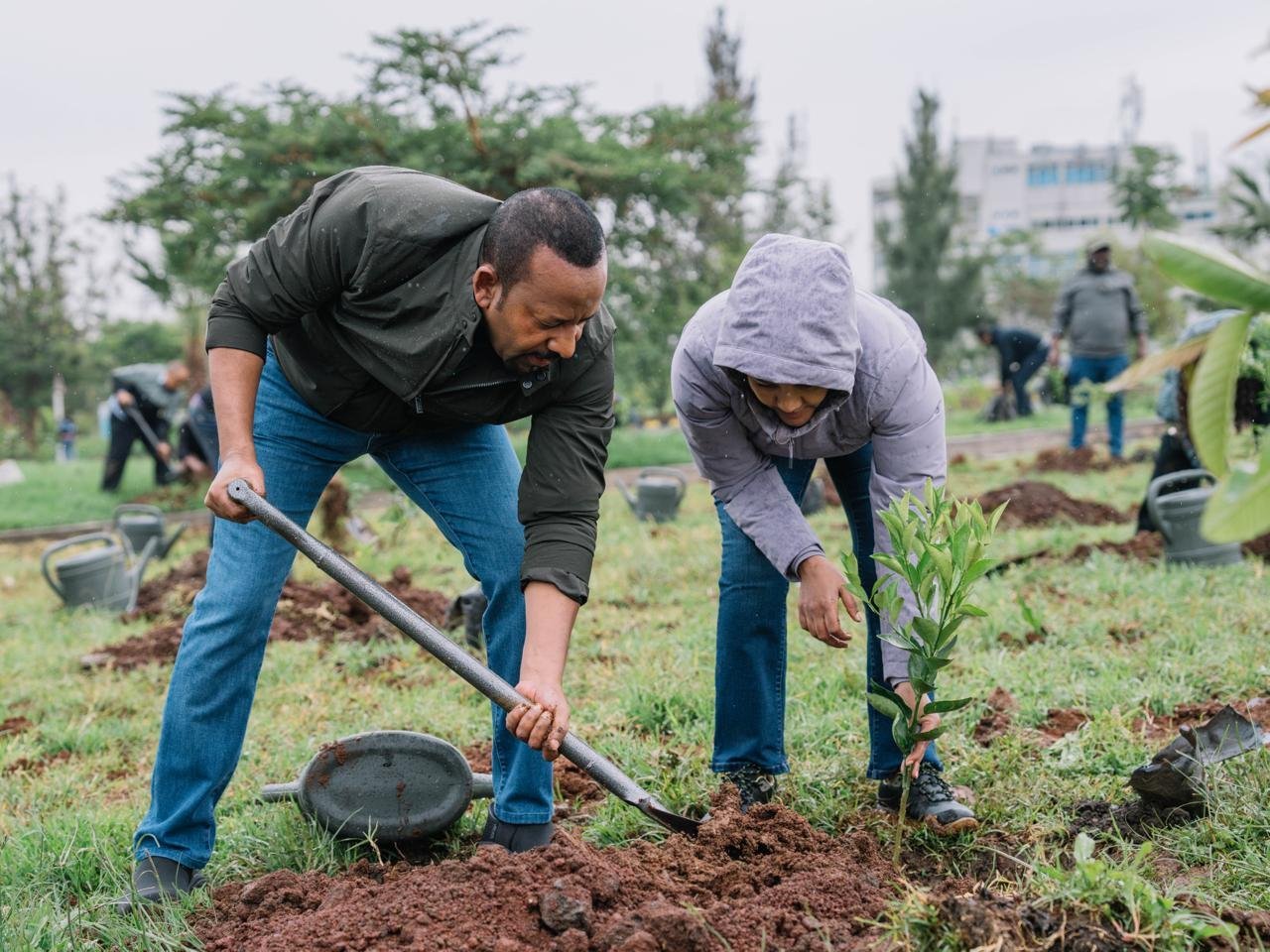

Ethiopia is scaling up one of Africa’s most ambitious reforestation drives, launching the eighth edition of its Green Legacy Initiative with plans to plant 8 billion trees this year, including 800 million on Monday, as it bets on ecosystem restoration to address climate risks and boost long-term economic resilience.
The reforestation campaign, launched in 2019 by Prime Minister Abiy Ahmed, has planted more than 40 billion forest, agroforestry and ornamental seedlings since its inception, making it one of Africa’s largest environmental restoration programs.
“Eight years of consistent action. The Green Legacy Initiative continues to grow stronger, driven by public commitment and the shared belief that, together, Ethiopians can nurture a greener, more sustainable future,” Abiy wrote on social media on Monday.
He described the nationwide planting drive as a moment when Ethiopians “from all walks of life come together to create a lasting legacy for generations to come.”
The prime minister called on citizens across the country to participate in the campaign as Ethiopia works toward its goal of planting 800 million seedlings in a single day.
Officials in Addis Ababa said residents exceeded the city’s initial target of planting 1 million seedlings, reaching 1.4 million trees during the one-day campaign.
The Environment Protection Authority also organized tree-planting activities in several locations, including areas around Lake Kilole in Bishoftu, where officials said restoration efforts are expected to improve local ecosystems and protect water resources.
The Green Legacy Initiative has become a central pillar of Ethiopia’s strategy to address climate change and environmental degradation through large-scale reforestation, watershed rehabilitation and land restoration.
In May 2026, the United Nations Environment Programme announced a new $9.8 million project to support Ethiopia’s efforts to scale up nature-based solutions to climate change. The project, financed by the Least Developed Countries Fund of the Global Environment Facility, aims to strengthen ecosystem restoration and climate adaptation across the country.
“Restoration must go beyond tree planting – it is about restoring ecosystems in ways that strengthen livelihoods, protect watersheds, improve soil and water systems, and help communities withstand future climate shocks,” Margaret Oduk, head of UNEP’s Addis Ababa Liaison Office, said in a statement.
According to UNEP, the project is intended to position Ethiopia as a regional leader in ecosystem-based adaptation by developing scalable solutions that support the country’s climate goals, adaptation priorities and international commitments under the Paris Agreement and the Sustainable Development Goals.
The Green Legacy campaign has consistently exceeded its annual planting targets in recent years. Ethiopia planted 7.5 billion seedlings in both 2023 and 2024, surpassing the target of 6.5 billion trees each year. In 2025, the country planted 8 billion trees, exceeding its goal of 7.5 billion.
Beyond Ethiopia, the initiative reflects a broader continental shift toward green development. African programs such as the Great Green Wall Initiative, the African Green Banks Initiative and the Africa Green Investment Initiative are focused on combating desertification, expanding renewable energy and promoting sustainable industries.
Ethiopia’s reforestation drive also aligns with the African Union’s Agenda 2063, which identifies environmental sustainability, climate resilience and the restoration of natural ecosystems as essential to the continent’s long-term development agenda.
Through Green Legacy, Ethiopia is seeking to link environmental protection with economic growth and climate adaptation in one of Africa’s most climate-vulnerable regions.