

KAMPALA
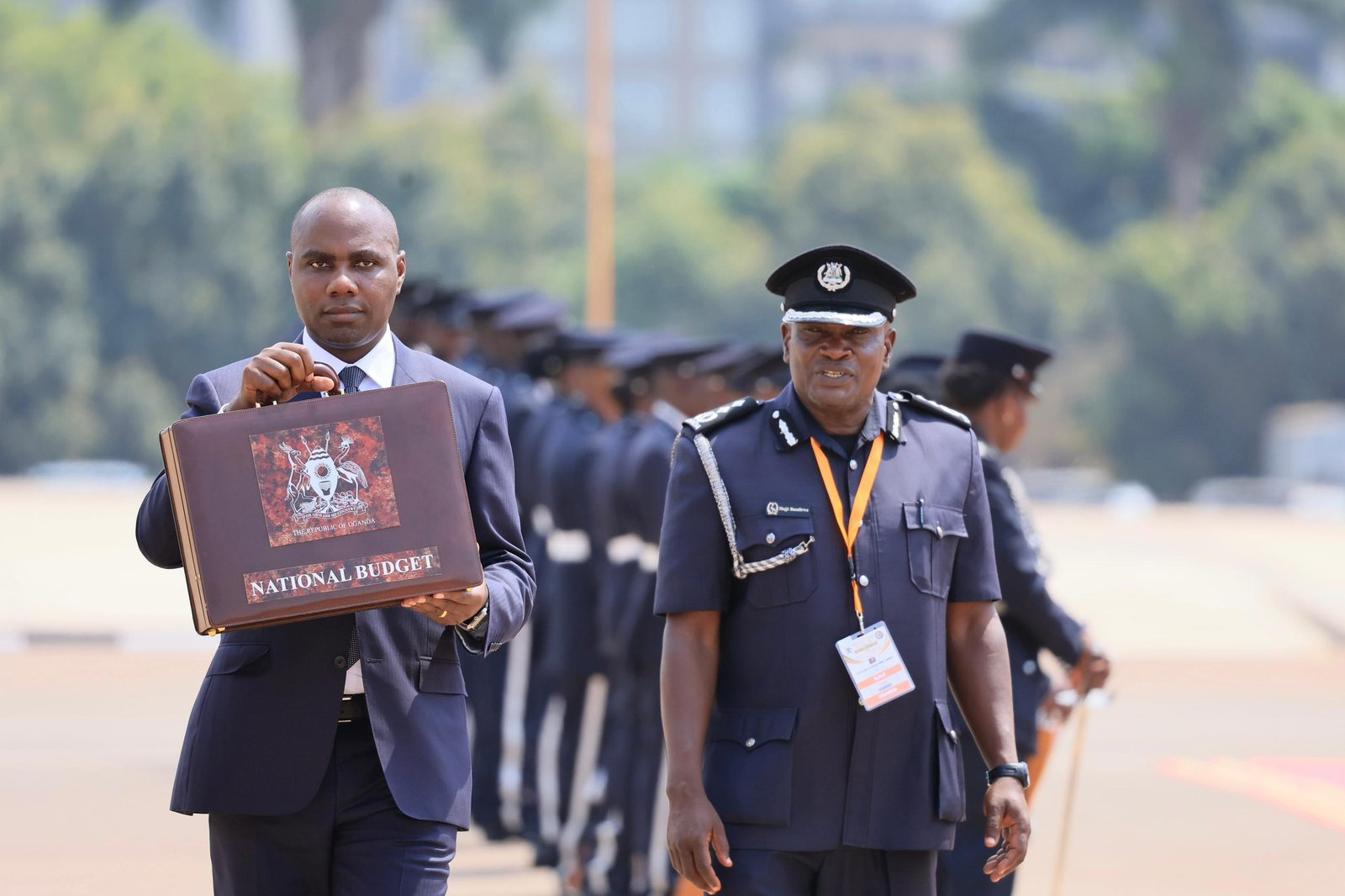
Finance Minister Henry Musasizi presented Uganda’s national budget for the 2026-27 financial year Thursday, projecting economic growth of 10.2% and setting a total resource envelope of 84.4 trillion shillings ($23.3 billion) as the government accelerates investment in oil production, infrastructure and agriculture.
Musasizi delivered the budget on behalf of President Yoweri Museveni at Kololo Independence Grounds in Kampala. He said improving macroeconomic fundamentals and rising investment inflows were driving the expansion.
“The economy is stable. Growth is accelerating. Inflation is low. The exchange rate is stable. Exports are rising. Investment is increasing,” Musasizi said.
Domestic revenue is projected at 45.96 trillion shillings ($12.7 billion), with 40.16 trillion shillings ($11.1 billion) expected from tax collections.
Domestic borrowing stands at 11.97 trillion shillings ($3.3 billion), while external project financing will contribute 11.27 trillion shillings ($3.1 billion).
The framework includes 13.97 trillion shillings ($3.9 billion) in domestic debt refinancing covering maturing obligations.
Infrastructure commands the largest single development allocation, with 8.79 trillion shillings ($2.4 billion) directed at roads, bridges, railways, airports and logistics systems.
Musasizi confirmed that construction of the Standard Gauge Railway from Malaba to Kampala is underway and said it would reduce transport costs across Uganda and the wider East African region.
The oil and gas sector anchors the government’s growth projections. Musasizi told Parliament that 51 additional wells had been drilled, bringing the cumulative total to 199 and exceeding the 189 required for first oil production.
“Fifty-one additional wells were drilled, bringing the cumulative number to 199, exceeding the 189 wells required for first oil production later this year,” he said.
Education received 6.66 trillion shillings ($1.8 billion) and health 5.23 trillion shillings ($1.4 billion), while 568.65 billion shillings ($157 million) was set aside for salary increases for primary and secondary school teachers.
Agriculture and wealth creation programs, including the Parish Development Model and Emyooga, received a combined 4.75 trillion shillings ($1.3 billion).
Uganda’s foreign exchange reserves reached $6 billion, and exports of goods and services totaled $18.04 billion in the year ending March 2026, with coffee alone generating $2.46 billion.
Musasizi acknowledged that public debt stood at $34.86 billion, equivalent to 53% of gross domestic product, and said it remained sustainable over the medium and long term.