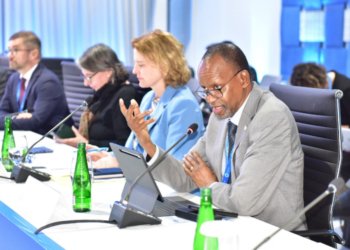



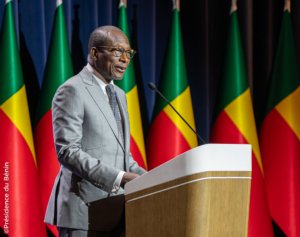
Romuald Wadagni, the technocrat who spent a decade reshaping Benin’s public finances, has won the country’s presidential election after securing 94% of the vote in a largely orderly transfer of executive power.
Sacca Lafia, president of Benin’s Commission Électorale Nationale Autonome, announced provisional results Monday night based on 90.55% of polling stations processed.
Turnout reached 58.75% of 7.9 million registered voters, with 4.25 million ballots cast for Wadagni, according to the electoral commission.
His sole challenger, Paul Hounkpè of the Cowry Forces for an Emerging Benin, secured 5.95%.
The margin was wide enough for the electoral commission to declare the outcome mathematically irreversible before the full count was complete. The results are now being sent to the Constitutional Court for final certification.
An Economic Community of West African States observation mission led by former Ghanaian President Nana Akufo-Addo praised the conduct of the ballot and its peaceful atmosphere.

From Lokossa to the presidency
Wadagni was born June 20, 1976, in Lokossa, the eldest of five children in a family that emphasized education and public service.
He graduated at the top of his class from the École Supérieure des Affaires in Grenoble, qualified as a chartered accountant in both France and the United States, and completed a program at Harvard Business School.
He spent 17 years at Deloitte across offices in Paris, New York and Kinshasa before his appointment as finance minister in April 2016.
In government, he negotiated a $700 million agreement with the International Monetary Fund in 2022 and, in January 2025, secured $500 million in international bonds at rates below initial guidance, backed by $3.5 billion in investor demand.
The vision behind the transformation
When Patrice Talon came to power in April 2016, Benin faced erratic growth, high public deficits, rising debt levels and a challenging business climate, with the economy heavily dependent on cotton and trade with Nigeria.
Talon, a businessman who built his fortune in the cotton industry before entering politics, pursued a reform agenda focused on fiscal discipline and economic diversification.
Two successive Government Action Programs, a 9-trillion CFA franc investment package from 2016 to 2021 and a 12-trillion CFA franc program from 2021 to 2026, channeled capital into infrastructure, agricultural diversification, and social policy.
GDP growth rose from 3.3% in 2016 to 7.5% in 2024, and both S&P and Fitch upgraded Benin’s credit rating in 2024.
The Glo-Djigbé Special Economic Zone, launched in 2021, generated more than 14,000 jobs and attracted investors from Asia, Europe, and the Middle East.
Talon leaves office after respecting the two-term constitutional limit, reinforcing the credibility of Sunday’s transition.