
Bantu Gazette

Bantu Gazette
  • Policy & Governance
  • Development & Impact
  • Business, Trade & Economy
  • Energy
  • Changemakers
  • Culture & Identity
  • Perspectives
  • Magazine
Menu
  • Black Frame Studio
  • Magazine

All Eyes on Ethiopia as Seventh General Election Approaches

African Union and IGAD observer missions are monitoring Ethiopia’s seventh general election as more than 50.5 million registered voters prepare to cast ballots on Monday

Ethiopia Clears Fourth Review as Economic Reforms Exceed Targets

Addis Ababa, Ethiopia

Kalkidan Negashby Kalkidan Negash
May 29, 2026
Reading Time: 4 mins read

All Eyes on Ethiopia as Seventh General Election Approaches

African Union and IGAD observer missions are monitoring Ethiopia’s seventh general election as more than 50.5 million registered voters prepare to cast ballots on Monday

Ethiopia Clears Fourth Review as Economic Reforms Exceed Targets

Addis Ababa, Ethiopia

Ethiopia Clears Fourth Review as Economic Reforms Exceed Targets

Addis Ababa, Ethiopia

Kalkidan Negashby Kalkidan Negash
June 1, 2026
Reading Time: 4 mins read

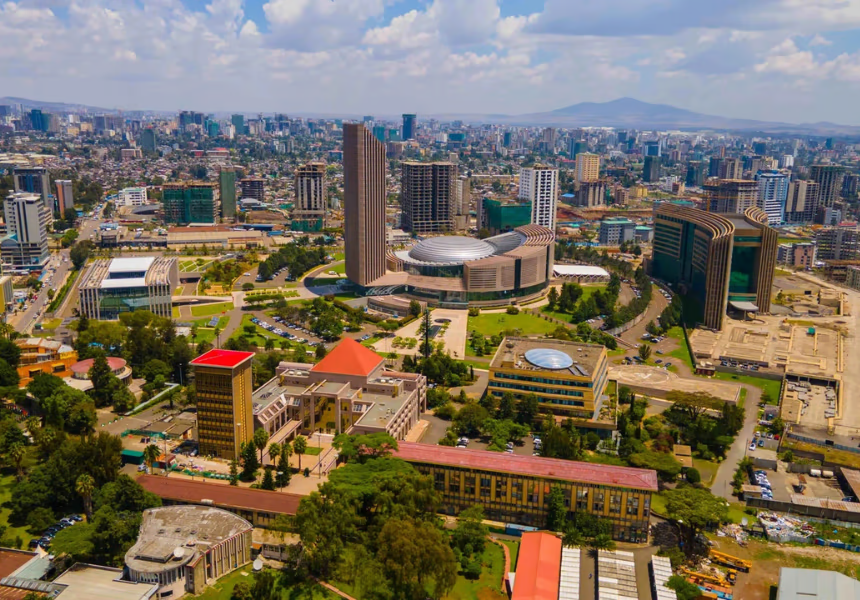
In the early hours of Monday, June 1, 2026, millions of Ethiopians will line up at more than 52,000 polling stations across the country to cast ballots in the country’s seventh general election. Regional and international observers are closely watching the vote, which is among Africa’s largest electoral exercises this year.

The vote comes at a pivotal moment for Ethiopia as the country undergoes major economic reforms and rapid digital expansion while continuing to navigate post-conflict tensions and security concerns in several regions.

According to the National Election Board of Ethiopia (NEBE), more than 50.5 million people have registered to vote at more than 52,000 polling stations nationwide. Women account for 46 percent of registered voters.

The poll also comes amid broader economic and technological shifts in Ethiopia, where recent government reforms have opened parts of the economy to foreign investment while the state-backed “Digital Ethiopia” initiative expands mobile money and digital financial services nationwide.

The Horn of Africa country continues navigating the aftermath of the 2020-2022 conflict in the country’s north amid ongoing security concerns in parts of the Amhara and Tigray regions.

NEBE says it deployed 187,000 election officials to manage polling operations. The federal government also declared June 1 a public holiday to facilitate voting.

Digital Voter Registration Introduced

This election cycle marks the first time Ethiopia has used a digital voter and candidate registration system.

NEBE said it introduced mobile and web-based voter and candidate registration platforms to modernize the registration process, reduce duplicate registrations and improve accessibility.

The board said more than 5.5 million voters were digitally registered during a hybrid registration exercise conducted between March 7 and April 22.

“By enabling citizens to register themselves or receive assistance using digital tools, the system helps minimize long queues, reduce registration errors and ease logistical challenges,” NEBE said in a statement.

The electoral board also said special arrangements were made to allow internally displaced people, university students and members of the national defense forces to vote away from their home constituencies.

NEBE Chairperson Melatwork Hailu clarified that the current registration figures do not yet include members of the national defense forces, university students or internally displaced persons.

Political Parties and Candidates

According to figures shared by Ethiopia’s ruling Prosperity Party, 47 political parties and more than 10,900 candidates are participating in the election.

Prime Minister Abiy Ahmed came to power in April 2018 following widespread anti-government protests that led to the resignation of his predecessor.

His Prosperity Party has governed since December 2019, when Abiy dissolved the former ruling coalition, the Ethiopian People’s Revolutionary Democratic Front (EPRDF), and merged most of its member parties into a single national party.

Ethiopia’s general election operates under a parliamentary system, meaning voters elect federal and regional legislative representatives rather than voting directly for the prime minister.

The party or coalition controlling a majority in the federal parliament ultimately forms the government and selects the country’s executive leadership.

Abiy Ahmed’s Prosperity Party remains the country’s dominant political force, holding a large parliamentary majority and governing most regional administrations.

The party concluded its nationwide campaign this week with rallies in several cities, including Addis Ababa, where party officials promoted infrastructure and urban development projects under the campaign slogan “Transforming Ethiopia into a Model Country.”

Opposition parties participating in the election include the Ethiopian Citizens for Social Justice party, the National Movement of Amhara, the Enat Party, the Freedom and Equality Party and the Oromo Federalist Congress.

NEBE said it organized candidate-symbol lotteries, televised debates and free media airtime allocations in coordination with the Ethiopian Media Authority.

According to the board, the airtime allocation covered radio stations, television broadcasters and newspapers in multiple languages.

Regional Observer Missions Deployed

Regional organizations, including the African Union (AU) and the Intergovernmental Authority on Development (IGAD), have deployed election observation missions.

The African Union Election Observation Mission is led by former Kenyan President Uhuru Kenyatta and includes 73 short-term observers from 37 African countries. The AU said 61 percent of the observers are women.

According to the AU, the delegation includes election experts, civil society representatives, media analysts and human rights specialists who will observe polling, counting and tabulation procedures.

IGAD’s observer mission is led by former Ugandan Vice President Speciosa Wandira Kazibwe and includes 26 observers drawn from member states.

IGAD said the mission will monitor voting procedures in several regional states, including Addis Ababa and Dire Dawa.

Both organizations said they plan to release preliminary findings on June 3.

Separately, NEBE Chairperson Melatwork Hailu said 169 civic organizations have been licensed to observe the seventh general election, with 141 of them receiving financial support.

Voting Suspended in Some Constituencies

NEBE announced that voting will not take place in 46 constituencies nationwide, including all 38 constituencies in the Tigray region and eight constituencies in the Amhara region.

Melatwork said the postponements were linked to security, administrative and political concerns.

In Tigray, the board cited unresolved issues related to security conditions and the political and legal status of regional actors following the northern conflict.

In Amhara, the affected constituencies are located in South and West Gondar, Ambassel and Dega Damot, according to Ethiopian Observer reporting citing NEBE officials.

The board said voting in the affected constituencies would be held at a later date, though no timetable has been announced.

Separately, residents of five disputed districts, including Humera, Adiremets, Korem Afla, Telemt and Alamata, will vote only for federal parliamentary representatives.

According to The Reporter, regional council elections in those districts will be delayed pending a House of Federation decision on territorial disputes between the Amhara and Tigray regional administrations.

Security Concerns Remain

Security concerns have remained a central issue throughout the campaign period.

NEBE said it held consultations in March with political parties, regional officials, security institutions and civil society groups regarding election-related security conditions.

The board said constituencies were categorized by varying levels of risk and that monitoring teams would be deployed to areas where political parties had raised concerns.

The election campaign has unfolded amid continued instability in some regions, including armed activity in parts of Amhara.

Some opposition parties have argued conditions are not yet suitable for fully competitive elections in all parts of the country.

Economic Stabilization and Digital Expansion

Ethiopia’s election comes amid major economic and financial reforms aimed at opening parts of the country’s economy to private and foreign investment.

Under the government’s Homegrown Economic Reform Agenda, authorities have introduced changes to the foreign exchange market and begun opening the banking sector to foreign competition and investment banking services.

The reforms have been backed by financing frameworks from the International Monetary Fund and the World Bank.

At the same time, the government’s “Digital Ethiopia” initiative and the National Digital Payments Strategy for 2026-2030 have accelerated the expansion of mobile money and digital financial services.

According to official figures, mobile money accounts have grown from 12.2 million in 2020 to roughly 139 million.

The reforms come as Ethiopia seeks to attract foreign investment while navigating continued political and security challenges in several regions.

Get the inside Story

Stay informed on the stories shaping Africa’s future. Get breaking news, in-depth analysis, opinions and exclusive insights from across the continent delivered to your inbox, free and unfiltered.


Get in touch for more:
Felix Tih
Editorial Director, Bantu Gazette
WhatsApp
LinkedIn
X (Twitter)
Instagram

Related Posts

Kenya President Announces Plan for Free Higher Education Starting in Sept. 2026
Policy & Governance

Kenya President Announces Plan for Free Higher Education Starting in Sept. 2026

August 3, 2026
Luanda Declaration Pushes African Leaders to Turn Blue Economy Plans into Action
Policy & Governance

Luanda Declaration Pushes African Leaders to Turn Blue Economy Plans into Action

July 26, 2026
West Africa Bloc Reiterates Commitment to Launch Single Currency in 2027
Policy & Governance

West Africa Bloc Reiterates Commitment to Launch Single Currency in 2027

July 25, 2026
Atlantic African States Adopt Cotonou Declaration to Boost Maritime Security and Green Trade
Policy & Governance

Atlantic African States Adopt Cotonou Declaration to Boost Maritime Security and Green Trade

July 15, 2026
Amazon Satellite Expansion, EU Investment Boost Kenya’s Digital Hub Ambitions
Policy & Governance

Kenya Enacts Sovereign Wealth Fund Law to Safeguard Resource Revenue

July 15, 2026
High-Level Training Strengthens African Diplomats’ Knowledge of Carbon Markets
Policy & Governance

High-Level Training Strengthens African Diplomats’ Knowledge of Carbon Markets

July 10, 2026

Most Recent

Ethiopia Intensifies Reforestation Drive with Launch of 8th Green Legacy Campaign
Development & Impact

Ethiopia Intensifies Reforestation Drive with Launch of 8th Green Legacy Campaign

by Felix Tih
August 3, 2026
0

The tree-planting drive has become a cornerstone of Ethiopia's environmental policy, linking ecosystem restoration with economic development goals.

Read moreDetails
Kenya President Announces Plan for Free Higher Education Starting in Sept. 2026

Kenya President Announces Plan for Free Higher Education Starting in Sept. 2026

August 3, 2026
Somalia Joins African Continental Free Trade Area, Gaining Access to $3.4 Trillion Market

Somalia Joins African Continental Free Trade Area, Gaining Access to $3.4 Trillion Market

August 1, 2026
Côte d’Ivoire Studies Botswana Mining Model to Strengthen Resource Governance

Botswana, Côte d’Ivoire Forge Historic Mining and Energy Partnership

July 31, 2026
‘Teranga’ by Mamy Mbaye Unveiled as Official Anthem of Dakar 2026 Youth Olympics

‘Teranga’ by Mamy Mbaye Unveiled as Official Anthem of Dakar 2026 Youth Olympics

July 31, 2026
Multilateral Fund Approves $22.3 Million for African Cooling and Ozone Projects

Multilateral Fund Approves $22.3 Million for African Cooling and Ozone Projects

August 1, 2026
Women Entrepreneurs Seen as Catalyst for Africa’s Growth

Women Entrepreneurs Seen as Catalyst for Africa’s Growth

July 31, 2026
Ethiopia Intensifies Reforestation Drive with Launch of 8th Green Legacy Campaign
Development & Impact

Ethiopia Intensifies Reforestation Drive with Launch of 8th Green Legacy Campaign

by Felix Tih
Reading Time: 2 mins read
August 3, 2026
0

The tree-planting drive has become a cornerstone of Ethiopia's environmental policy, linking ecosystem restoration with economic development goals.

Read moreDetails
Kenya President Announces Plan for Free Higher Education Starting in Sept. 2026
Policy & Governance

Kenya President Announces Plan for Free Higher Education Starting in Sept. 2026

by Waceke Nganga
Reading Time: 2 mins read
August 3, 2026
0

The overhaul comes as demand for higher education rises and public universities face nearly Sh100 billion in debt.

Read moreDetails
Somalia Joins African Continental Free Trade Area, Gaining Access to $3.4 Trillion Market
Business, Trade & Economy

Somalia Joins African Continental Free Trade Area, Gaining Access to $3.4 Trillion Market

by Amani Mwakalebela
Reading Time: 2 mins read
August 1, 2026
0

Horn of Africa country completes its accession to the African Continental Free Trade Area, opening access to a market of...

Read moreDetails

All Eyes on Ethiopia as Seventh General Election Approaches

African Union and IGAD observer missions are monitoring Ethiopia’s seventh general election as more than 50.5 million registered voters prepare to cast ballots on Monday

Ethiopia Clears Fourth Review as Economic Reforms Exceed Targets

Addis Ababa, Ethiopia

In the early hours of Monday, June 1, 2026, millions of Ethiopians will line up at more than 52,000 polling stations across the country to cast ballots in the country’s seventh general election. Regional and international observers are closely watching the vote, which is among Africa’s largest electoral exercises this year.

The vote comes at a pivotal moment for Ethiopia as the country undergoes major economic reforms and rapid digital expansion while continuing to navigate post-conflict tensions and security concerns in several regions.

According to the National Election Board of Ethiopia (NEBE), more than 50.5 million people have registered to vote at more than 52,000 polling stations nationwide. Women account for 46 percent of registered voters.

The poll also comes amid broader economic and technological shifts in Ethiopia, where recent government reforms have opened parts of the economy to foreign investment while the state-backed “Digital Ethiopia” initiative expands mobile money and digital financial services nationwide.

The Horn of Africa country continues navigating the aftermath of the 2020-2022 conflict in the country’s north amid ongoing security concerns in parts of the Amhara and Tigray regions.

NEBE says it deployed 187,000 election officials to manage polling operations. The federal government also declared June 1 a public holiday to facilitate voting.

Digital Voter Registration Introduced

This election cycle marks the first time Ethiopia has used a digital voter and candidate registration system.

NEBE said it introduced mobile and web-based voter and candidate registration platforms to modernize the registration process, reduce duplicate registrations and improve accessibility.

The board said more than 5.5 million voters were digitally registered during a hybrid registration exercise conducted between March 7 and April 22.

“By enabling citizens to register themselves or receive assistance using digital tools, the system helps minimize long queues, reduce registration errors and ease logistical challenges,” NEBE said in a statement.

The electoral board also said special arrangements were made to allow internally displaced people, university students and members of the national defense forces to vote away from their home constituencies.

NEBE Chairperson Melatwork Hailu clarified that the current registration figures do not yet include members of the national defense forces, university students or internally displaced persons.

Political Parties and Candidates

According to figures shared by Ethiopia’s ruling Prosperity Party, 47 political parties and more than 10,900 candidates are participating in the election.

Prime Minister Abiy Ahmed came to power in April 2018 following widespread anti-government protests that led to the resignation of his predecessor.

His Prosperity Party has governed since December 2019, when Abiy dissolved the former ruling coalition, the Ethiopian People’s Revolutionary Democratic Front (EPRDF), and merged most of its member parties into a single national party.

Ethiopia’s general election operates under a parliamentary system, meaning voters elect federal and regional legislative representatives rather than voting directly for the prime minister.

The party or coalition controlling a majority in the federal parliament ultimately forms the government and selects the country’s executive leadership.

Abiy Ahmed’s Prosperity Party remains the country’s dominant political force, holding a large parliamentary majority and governing most regional administrations.

The party concluded its nationwide campaign this week with rallies in several cities, including Addis Ababa, where party officials promoted infrastructure and urban development projects under the campaign slogan “Transforming Ethiopia into a Model Country.”

Opposition parties participating in the election include the Ethiopian Citizens for Social Justice party, the National Movement of Amhara, the Enat Party, the Freedom and Equality Party and the Oromo Federalist Congress.

NEBE said it organized candidate-symbol lotteries, televised debates and free media airtime allocations in coordination with the Ethiopian Media Authority.

According to the board, the airtime allocation covered radio stations, television broadcasters and newspapers in multiple languages.

Regional Observer Missions Deployed

Regional organizations, including the African Union (AU) and the Intergovernmental Authority on Development (IGAD), have deployed election observation missions.

The African Union Election Observation Mission is led by former Kenyan President Uhuru Kenyatta and includes 73 short-term observers from 37 African countries. The AU said 61 percent of the observers are women.

According to the AU, the delegation includes election experts, civil society representatives, media analysts and human rights specialists who will observe polling, counting and tabulation procedures.

IGAD’s observer mission is led by former Ugandan Vice President Speciosa Wandira Kazibwe and includes 26 observers drawn from member states.

IGAD said the mission will monitor voting procedures in several regional states, including Addis Ababa and Dire Dawa.

Both organizations said they plan to release preliminary findings on June 3.

Separately, NEBE Chairperson Melatwork Hailu said 169 civic organizations have been licensed to observe the seventh general election, with 141 of them receiving financial support.

Voting Suspended in Some Constituencies

NEBE announced that voting will not take place in 46 constituencies nationwide, including all 38 constituencies in the Tigray region and eight constituencies in the Amhara region.

Melatwork said the postponements were linked to security, administrative and political concerns.

In Tigray, the board cited unresolved issues related to security conditions and the political and legal status of regional actors following the northern conflict.

In Amhara, the affected constituencies are located in South and West Gondar, Ambassel and Dega Damot, according to Ethiopian Observer reporting citing NEBE officials.

The board said voting in the affected constituencies would be held at a later date, though no timetable has been announced.

Separately, residents of five disputed districts, including Humera, Adiremets, Korem Afla, Telemt and Alamata, will vote only for federal parliamentary representatives.

According to The Reporter, regional council elections in those districts will be delayed pending a House of Federation decision on territorial disputes between the Amhara and Tigray regional administrations.

Security Concerns Remain

Security concerns have remained a central issue throughout the campaign period.

NEBE said it held consultations in March with political parties, regional officials, security institutions and civil society groups regarding election-related security conditions.

The board said constituencies were categorized by varying levels of risk and that monitoring teams would be deployed to areas where political parties had raised concerns.

The election campaign has unfolded amid continued instability in some regions, including armed activity in parts of Amhara.

Some opposition parties have argued conditions are not yet suitable for fully competitive elections in all parts of the country.

Economic Stabilization and Digital Expansion

Ethiopia’s election comes amid major economic and financial reforms aimed at opening parts of the country’s economy to private and foreign investment.

Under the government’s Homegrown Economic Reform Agenda, authorities have introduced changes to the foreign exchange market and begun opening the banking sector to foreign competition and investment banking services.

The reforms have been backed by financing frameworks from the International Monetary Fund and the World Bank.

At the same time, the government’s “Digital Ethiopia” initiative and the National Digital Payments Strategy for 2026-2030 have accelerated the expansion of mobile money and digital financial services.

According to official figures, mobile money accounts have grown from 12.2 million in 2020 to roughly 139 million.

The reforms come as Ethiopia seeks to attract foreign investment while navigating continued political and security challenges in several regions.
All Eyes on Ethiopia as Seventh General Election Approaches

African Union and IGAD observer missions are monitoring Ethiopia’s seventh general election as more than 50.5 million registered voters prepare to cast ballots on Monday

Ethiopia Clears Fourth Review as Economic Reforms Exceed Targets

Addis Ababa, Ethiopia

Kalkidan Negashby Kalkidan Negash
May 29, 2026

In the early hours of Monday, June 1, 2026, millions of Ethiopians will line up at more than 52,000 polling stations across the country to cast ballots in the country’s seventh general election. Regional and international observers are closely watching the vote, which is among Africa’s largest electoral exercises this year.

The vote comes at a pivotal moment for Ethiopia as the country undergoes major economic reforms and rapid digital expansion while continuing to navigate post-conflict tensions and security concerns in several regions.

According to the National Election Board of Ethiopia (NEBE), more than 50.5 million people have registered to vote at more than 52,000 polling stations nationwide. Women account for 46 percent of registered voters.

The poll also comes amid broader economic and technological shifts in Ethiopia, where recent government reforms have opened parts of the economy to foreign investment while the state-backed “Digital Ethiopia” initiative expands mobile money and digital financial services nationwide.

The Horn of Africa country continues navigating the aftermath of the 2020-2022 conflict in the country’s north amid ongoing security concerns in parts of the Amhara and Tigray regions.

NEBE says it deployed 187,000 election officials to manage polling operations. The federal government also declared June 1 a public holiday to facilitate voting.

Digital Voter Registration Introduced

This election cycle marks the first time Ethiopia has used a digital voter and candidate registration system.

NEBE said it introduced mobile and web-based voter and candidate registration platforms to modernize the registration process, reduce duplicate registrations and improve accessibility.

The board said more than 5.5 million voters were digitally registered during a hybrid registration exercise conducted between March 7 and April 22.

“By enabling citizens to register themselves or receive assistance using digital tools, the system helps minimize long queues, reduce registration errors and ease logistical challenges,” NEBE said in a statement.

The electoral board also said special arrangements were made to allow internally displaced people, university students and members of the national defense forces to vote away from their home constituencies.

NEBE Chairperson Melatwork Hailu clarified that the current registration figures do not yet include members of the national defense forces, university students or internally displaced persons.

Political Parties and Candidates

According to figures shared by Ethiopia’s ruling Prosperity Party, 47 political parties and more than 10,900 candidates are participating in the election.

Prime Minister Abiy Ahmed came to power in April 2018 following widespread anti-government protests that led to the resignation of his predecessor.

His Prosperity Party has governed since December 2019, when Abiy dissolved the former ruling coalition, the Ethiopian People’s Revolutionary Democratic Front (EPRDF), and merged most of its member parties into a single national party.

Ethiopia’s general election operates under a parliamentary system, meaning voters elect federal and regional legislative representatives rather than voting directly for the prime minister.

The party or coalition controlling a majority in the federal parliament ultimately forms the government and selects the country’s executive leadership.

Abiy Ahmed’s Prosperity Party remains the country’s dominant political force, holding a large parliamentary majority and governing most regional administrations.

The party concluded its nationwide campaign this week with rallies in several cities, including Addis Ababa, where party officials promoted infrastructure and urban development projects under the campaign slogan “Transforming Ethiopia into a Model Country.”

Opposition parties participating in the election include the Ethiopian Citizens for Social Justice party, the National Movement of Amhara, the Enat Party, the Freedom and Equality Party and the Oromo Federalist Congress.

NEBE said it organized candidate-symbol lotteries, televised debates and free media airtime allocations in coordination with the Ethiopian Media Authority.

According to the board, the airtime allocation covered radio stations, television broadcasters and newspapers in multiple languages.

Regional Observer Missions Deployed

Regional organizations, including the African Union (AU) and the Intergovernmental Authority on Development (IGAD), have deployed election observation missions.

The African Union Election Observation Mission is led by former Kenyan President Uhuru Kenyatta and includes 73 short-term observers from 37 African countries. The AU said 61 percent of the observers are women.

According to the AU, the delegation includes election experts, civil society representatives, media analysts and human rights specialists who will observe polling, counting and tabulation procedures.

IGAD’s observer mission is led by former Ugandan Vice President Speciosa Wandira Kazibwe and includes 26 observers drawn from member states.

IGAD said the mission will monitor voting procedures in several regional states, including Addis Ababa and Dire Dawa.

Both organizations said they plan to release preliminary findings on June 3.

Separately, NEBE Chairperson Melatwork Hailu said 169 civic organizations have been licensed to observe the seventh general election, with 141 of them receiving financial support.

Voting Suspended in Some Constituencies

NEBE announced that voting will not take place in 46 constituencies nationwide, including all 38 constituencies in the Tigray region and eight constituencies in the Amhara region.

Melatwork said the postponements were linked to security, administrative and political concerns.

In Tigray, the board cited unresolved issues related to security conditions and the political and legal status of regional actors following the northern conflict.

In Amhara, the affected constituencies are located in South and West Gondar, Ambassel and Dega Damot, according to Ethiopian Observer reporting citing NEBE officials.

The board said voting in the affected constituencies would be held at a later date, though no timetable has been announced.

Separately, residents of five disputed districts, including Humera, Adiremets, Korem Afla, Telemt and Alamata, will vote only for federal parliamentary representatives.

According to The Reporter, regional council elections in those districts will be delayed pending a House of Federation decision on territorial disputes between the Amhara and Tigray regional administrations.

Security Concerns Remain

Security concerns have remained a central issue throughout the campaign period.

NEBE said it held consultations in March with political parties, regional officials, security institutions and civil society groups regarding election-related security conditions.

The board said constituencies were categorized by varying levels of risk and that monitoring teams would be deployed to areas where political parties had raised concerns.

The election campaign has unfolded amid continued instability in some regions, including armed activity in parts of Amhara.

Some opposition parties have argued conditions are not yet suitable for fully competitive elections in all parts of the country.

Economic Stabilization and Digital Expansion

Ethiopia’s election comes amid major economic and financial reforms aimed at opening parts of the country’s economy to private and foreign investment.

Under the government’s Homegrown Economic Reform Agenda, authorities have introduced changes to the foreign exchange market and begun opening the banking sector to foreign competition and investment banking services.

The reforms have been backed by financing frameworks from the International Monetary Fund and the World Bank.

At the same time, the government’s “Digital Ethiopia” initiative and the National Digital Payments Strategy for 2026-2030 have accelerated the expansion of mobile money and digital financial services.

According to official figures, mobile money accounts have grown from 12.2 million in 2020 to roughly 139 million.

The reforms come as Ethiopia seeks to attract foreign investment while navigating continued political and security challenges in several regions.
Get the inside Story

Stay informed on the stories shaping Africa’s future. Get breaking news, in-depth analysis, opinions and exclusive insights from across the continent delivered to your inbox, free and unfiltered.


Get in touch for more:
Felix Tih
Editorial Director, Bantu Gazette
WhatsApp
LinkedIn
X (Twitter)
Instagram

Related Posts

Kenya President Announces Plan for Free Higher Education Starting in Sept. 2026

Kenya President Announces Plan for Free Higher Education Starting in Sept. 2026

by Waceke Nganga
August 3, 2026
0

...

Luanda Declaration Pushes African Leaders to Turn Blue Economy Plans into Action

Luanda Declaration Pushes African Leaders to Turn Blue Economy Plans into Action

by Felix Tih
July 26, 2026
0

...

West Africa Bloc Reiterates Commitment to Launch Single Currency in 2027

West Africa Bloc Reiterates Commitment to Launch Single Currency in 2027

by Felix Tih
July 23, 2026
0

...

Atlantic African States Adopt Cotonou Declaration to Boost Maritime Security and Green Trade

Atlantic African States Adopt Cotonou Declaration to Boost Maritime Security and Green Trade

by Genoveva Ntutumu
July 14, 2026
0

...

Amazon Satellite Expansion, EU Investment Boost Kenya’s Digital Hub Ambitions

Kenya Enacts Sovereign Wealth Fund Law to Safeguard Resource Revenue

by Waceke Nganga
July 14, 2026
0

...

High-Level Training Strengthens African Diplomats’ Knowledge of Carbon Markets

High-Level Training Strengthens African Diplomats’ Knowledge of Carbon Markets

by Felix Tih
July 8, 2026
0

...

Ethiopia Intensifies Reforestation Drive with Launch of 8th Green Legacy Campaign
Development & Impact

Ethiopia Intensifies Reforestation Drive with Launch of 8th Green Legacy Campaign

by Felix Tih
Reading Time: 2 mins read
August 3, 2026
0

The tree-planting drive has become a cornerstone of Ethiopia's environmental policy, linking ecosystem restoration with economic development goals.

Read moreDetails
Kenya President Announces Plan for Free Higher Education Starting in Sept. 2026

Kenya President Announces Plan for Free Higher Education Starting in Sept. 2026

by Waceke Nganga
August 3, 2026
0

The overhaul comes as demand for higher education rises and public universities face nearly Sh100 billion in debt.

Somalia Joins African Continental Free Trade Area, Gaining Access to $3.4 Trillion Market

Somalia Joins African Continental Free Trade Area, Gaining Access to $3.4 Trillion Market

by Amani Mwakalebela
August 1, 2026
0

Horn of Africa country completes its accession to the African Continental Free Trade Area, opening access to a market of...

Côte d’Ivoire Studies Botswana Mining Model to Strengthen Resource Governance

Botswana, Côte d’Ivoire Forge Historic Mining and Energy Partnership

by Naledi Kgosi
July 31, 2026
0

Two African countries seal their first agreement on mining and energy cooperation, deepening plans for exploration, skills exchange and industrial...

‘Teranga’ by Mamy Mbaye Unveiled as Official Anthem of Dakar 2026 Youth Olympics

‘Teranga’ by Mamy Mbaye Unveiled as Official Anthem of Dakar 2026 Youth Olympics

by Felix Tih
July 31, 2026
0

Released to mark 100 days until Dakar 2026, Mamy Mbaye's anthem "Teranga" celebrates Senegalese hospitality and the spirit of the...

Next Post
Morocco Overtakes South Africa as Africa’s Leading Industrial Economy

Morocco Overtakes South Africa as Africa's Leading Industrial Economy

Madagascar Secures $68 Million for Economic and Governance Reforms

Madagascar Secures $68 Million for Economic and Governance Reforms

African Development Bank Governors Call for Faster Reform of Continent’s Financial Architecture

African Development Bank Governors Call for Faster Reform of Continent’s Financial Architecture

‘You are not alone’ WHO chief pledges solidarity with DR Congo communities battling Ebola

‘You are not alone’ WHO chief pledges solidarity with DR Congo communities battling Ebola

Bantu Gazette is a pioneering news platform that champions Africa's development, culture, and heritage. We spotlight the continent's successes, address its challenges, and provide insightful coverage of events that shape its future.

Bantu Gazette is a pioneering news platform that champions Africa's development, culture, and heritage. We spotlight the continent's successes, address its challenges, and provide insightful coverage of events that shape its future.

Our Platforms

  • Bantu Magazine
  • Bantu Brief
  • Black Frame Studio

Our Services

  • Bantu Agency
  • Advertise
  • Partnerships

Our Services

  • Editorial Director
  • Opportunities
  • Contact

Bantu Gazette is a pioneering news platform that champions Africa's development, culture, and heritage. We spotlight the continent's successes, address its challenges, and provide insightful coverage of events that shape its future.

Our Platforms

  • Bantu Magazine
  • Bantu Brief
  • Black Frame Studio

Our Services

  • Bantu Agency
  • Advertise
  • Partnerships

Our Services

  • Editorial Director
  • Opportunities
  • Contact
Bantu Gazette
  • Energy & Trade
  • Finance
  • Health
  • Politics & Economy
  • Technology
  • Environment
  • Feature
  • Opinion
  • Changemakers
  • Tourism & Culture
  • Magazine