


For a long time, external observers have generally framed Tanzania’s regional diplomatic role in East Africa as that of a marginal actor only capable of convening symbolic summits for photo opportunities.
In reality, the country has evolved from a ceremonial diplomatic convener in East Africa to a core regional diplomatic hub anchored in its hard economic power. The core underpinnings of this new status are not empty diplomatic rhetoric, but quantifiable economic appeal, institutional influence, and regional connectivity.
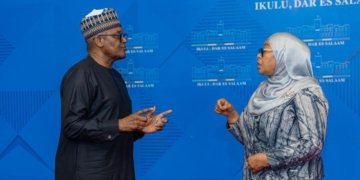
Between February and May 2026, Dar es Salaam hosted successive visits by Ugandan President Museveni, Rwandan President Kagame, and Kenyan President Ruto. A series of agreements signed during these visits spanning cross-border transportation, energy, trade facilitation, and industrial cooperation had a combined value of over 5 billion U.S. dollars.
IMF data shows that Tanzania recorded a 6.1% economic growth rate in 2026, with an inflation rate below 4%. Foreign direct investment inflows exceeded 1.8 billion U.S. dollars in 2025, ranking second among East African Community member states. The cargo throughput of the Port of Dar es Salaam rose from 14 million tons in 2021 to 24 million tons in 2025, while customs clearance time was cut from 30 days to fewer than 7 days.
The 2,561-kilometer Standard Gauge Railway project, with total financing exceeding 10 billion U.S. dollars, is currently under construction, with support from Standard Chartered Bank, the African Export-Import Bank, the Export-Import Bank of China, and multiple Gulf investors.
Once completed, it will link Tanzania with Rwanda, Burundi, Uganda, and the Democratic Republic of Congo. President Samia has positioned Tanzania as a stable middle power in the fragmented geopolitical landscape of East Africa.
Tanzania’s pursuit of a non-ideology-driven diplomacy of economic interdependence imposes high material costs on any form of regional confrontation. Institutional forecasts project that by 2030, the Central Corridor will handle over 40% of incoming cargo volume bound for the East African hinterland, a share that stood at less than 15% a decade prior.
The transformation of bilateral relations between Kenya and Tanzania serves as the most illustrative case to examine the restructuring of East Africa’s diplomatic landscape. Today, the two countries have become East Africa’s largest bilateral trade partners, with their 2025 bilateral trade volume reaching roughly 860 million U.S. dollars.
During Kenyan President Ruto’s visit to Dodoma, Tanzania’s capital, in May 2026, the two sides signed eight cooperation agreements covering areas including energy integration, cross-border transportation, customs harmonization, and fisheries cooperation.
They also jointly pledged to eliminate all remaining non-tariff barriers by May 30, 2026. In a speech delivered to Tanzania’s parliament, Ruto publicly acknowledged Tanzania as a core pillar of East Africa’s future integration.
Even though Kenya, as the region’s financial center, hosts the majority of multinational corporations’ regional headquarters, it still needs to rely on Tanzania’s energy corridors, transport infrastructure, and political cooperation to expand regional trade.
Tanzania’s core role is also reflected in its cooperation with Rwanda: the 2025 bilateral trade volume between Rwanda and Tanzania reached roughly 248 million U.S. dollars, and Rwanda’s investment in Tanzania exceeded 325 million U.S. dollars, spanning a wide range of sectors.
Critics have long argued that economic integration alone cannot sustain a country’s diplomatic leadership within its region. Tanzania, however, has defied this long-held assumption by combining commercial leverage with its institutional influence in East African regional organizations to establish itself as a core regional diplomatic hub.
Tanzania boasts a solid foundation for its regional standing: it hosts core institutions of the East African Community, participates deeply in regional peacekeeping operations, and has emerged as the preferred location for regional conflict mediation.
Its planned liquefied natural gas (LNG) project, with a total investment of 42 billion U.S. dollars, has significantly lifted its cross-regional geopolitical value. The project is expected to propel Tanzania into the ranks of Africa’s top LNG exporters, reshape the regional energy security landscape, and draw a range of stakeholders, including Gulf states, China, and the European Union, to lay out investments in East Africa’s emerging trade corridors.
In 2025 alone, Tanzania signed investment and infrastructure agreements worth more than 8 billion U.S. dollars, covering sectors including ports, railways, and aviation.
After President Samia took office in 2021, succeeding the late former President Magufuli, she reversed the previous administration’s challenges of diplomatic isolation and low investor confidence, restoring normal engagement with multilateral institutions and regional bodies, including the African Development Bank, the International Monetary Fund (IMF), and the World Bank.
In 2025, the country’s tourism revenue exceeded 4 billion U.S. dollars, its sovereign credit outlook improved, and Dar es Salaam officially became a core regional negotiation site in East Africa.
President Samia has launched a new regional leadership strategy centered on three core pillars: infrastructure diplomacy, economic interdependence, and strategic neutrality.
For the country to become the undisputed diplomatic center of East Africa, it must complete its infrastructure projects, maintain political stability, and translate its economic standing into institutional influence. Today, its core participation is indispensable to all major regional issues.