


KIGALI, Rwanda
Bill Gates spent a week retracing the wiring of Rwanda’s health system, from a syringe factory floor in Rwamagana to a lecture hall in Butaro.
Gates said Rwanda demonstrates how innovation can improve people’s lives when it is backed by strong public systems, highlighting the country’s work in health care, artificial intelligence and digital infrastructure during a weeklong visit.
Gates arrived in Rwanda on July 20 and visited the Kigali Genocide Memorial, where he laid a wreath and paid his respects to victims of the 1994 Genocide against the Tutsi.
The following day, President Paul Kagame met Gates, founder and chair of the Gates Foundation, to discuss strengthening the foundation’s longstanding partnership with Rwanda.
Their talks focused on health, agricultural transformation, artificial intelligence and digital public infrastructure in support of Rwanda’s development priorities.
The weeklong visit, hosted by the Rwanda Centre for the Fourth Industrial Revolution and the Ministry of ICT and Innovation, highlighted Rwanda’s efforts to strengthen public systems while expanding access to emerging technologies.
“My time in Rwanda reminded me how much progress can be made when innovation reaches the people who need it most,” Gates said.
Health Systems Built on Data
During the visit, Gates toured health facilities, a syringe manufacturing plant, a university and digital public infrastructure projects, each illustrating how Rwanda has built the systems needed to support AI in health care.
Among the key stops was the National Health Intelligence Center in Kigali, where real-time data from clinics, hospitals and community health workers helps the Ministry of Health guide coverage and resource decisions.
Gates said one of the week’s most striking experiences was following health data from facilities such as Mwulire Health Center through the national system, linking every level of care.
The center is central to Horizon 1000, a $50 million initiative launched by the Gates Foundation and OpenAI to bring AI-powered tools to 1,000 primary health clinics and surrounding communities by 2028. Rwanda is the program’s first partner country.
He said seeing projects already operating on the ground, rather than reviewing plans on paper, was among the highlights of the week.
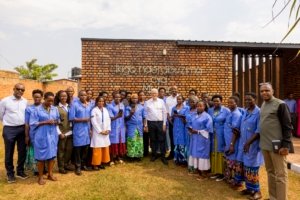
At Mwulire Health Center in Eastern Province, Gates met community health workers and toured a facility connected to the country’s digital health network.
He also visited TKMD’s syringe factory in Mwulire Industrial Park, which produces between 600,000 and 1 million auto-disable syringes a day and has supplied UNICEF orders to Ethiopia, Burundi, the Democratic Republic of Congo and Mozambique.
He said the factory showed how local manufacturing of essential medical supplies can reduce countries’ dependence on imports.
Building AI for African needs
At Carnegie Mellon University Africa and the University of Global Health Equity (UGHE) in Butaro, Gates met students, researchers and entrepreneurs developing AI tools for local challenges.
At UGHE, he joined First Lady Jeannette Kagame, Health Minister Dr. Sabin Nsanzimana and ICT and Innovation Minister Paula Ingabire.
UGHE, launched in 2015 with early funding from the Gates Foundation, was among the institutions Gates highlighted during the visit.
“If we let things take their normal course, AI, like all advanced tools, will be in the rich countries,” Gates said. “But that would be a great injustice.”
He said AI adapted to African contexts, including local languages and disease burdens, should be developed by institutions rooted on the continent. He said universities and research institutions across Africa should lead that work.
Gates also highlighted the Consortium of Medical Schools Africa, an Africa-led network that spans more than 190 medical schools across 37 countries and is working toward shared digital curricula and cross-border collaboration in health professions training.
“Those digital systems will be the foundation for the next generation, which will be powered by artificial intelligence,” Gates said. “Rwanda is at the forefront, working with the Gates Foundation and AI providers to explore how AI can strengthen the health system.”
Innovation beyond health care
He highlighted the Upanzi Network, a Rwandan-led initiative to build African capacity to develop, test and govern open-source digital public infrastructure, including digital identity, payment systems and cybersecurity.
He also visited One Acre Fund, which connects smallholder farmers to Rwanda’s Digital Farmer Registry and subsidy system, pairing government data with on-the-ground agricultural support.
Summarizing the week, the Gates Foundation said the visits stressed the importance of building stronger systems, expanding access and solving the problems communities face every day.
Many of the ideas shaping the future of African health, the foundation said, are being developed by health workers, researchers, entrepreneurs, governments and communities closest to the work.
The foundation also pointed to Rwanda’s progress over two decades, noting that the country’s under-five mortality rate has fallen from 59,000 deaths in 2000 to 16,000 today, a 73 percent reduction that it has cited as central to its partnership with the country.