
Bantu Gazette

Bantu Gazette
  • Policy & Governance
  • Development & Impact
  • Business, Trade & Economy
  • Energy
  • Changemakers
  • Culture & Identity
  • Perspectives
  • Magazine
Menu
  • Black Frame Studio
  • Magazine

Ghana Welcomes Planned Return of 2,000 Artifacts from the Netherlands, Germany

Restitution efforts are becoming a defining feature of evolving relations between African nations and European governments as calls for reparatory justice gain international support

Ghana Welcomes Planned Return of 2,000 Artifacts from the Netherlands, Germany

high level consultative conference on the next steps, accra ghana

Felix Tihby Felix Tih
June 22, 2026
Reading Time: 3 mins read

Ghana Welcomes Planned Return of 2,000 Artifacts from the Netherlands, Germany

Restitution efforts are becoming a defining feature of evolving relations between African nations and European governments as calls for reparatory justice gain international support

Ghana Welcomes Planned Return of 2,000 Artifacts from the Netherlands, Germany

high level consultative conference on the next steps, accra ghana

Ghana Welcomes Planned Return of 2,000 Artifacts from the Netherlands, Germany

high level consultative conference on the next steps, accra ghana

Felix Tihby Felix Tih
June 23, 2026
Reading Time: 3 mins read

ACCRA

Ghana has welcomed announcements by the Netherlands and Germany that they are prepared to advance the return of cultural artifacts linked to the country’s history, including about 2,000 objects identified in Dutch collections, in what officials describe as a significant step in efforts to address the legacies of slavery and colonialism.

The commitments were made during the High-Level Consultative Conference on the Next Steps to the Landmark U.N. Resolution on the Trafficking of Enslaved Africans, held in Accra from June 17 to June 19.

The gathering brought together African and Caribbean leaders, legal experts, government officials, and members of the African diaspora to discuss the implementation of U.N. General Assembly Resolution A/RES/80/250, adopted in March.

Ghana’s Foreign Affairs Minister Samuel Okudzeto Ablakwa said the government welcomed the Netherlands’ and Germany’s readiness to return looted artifacts and other items of cultural significance.

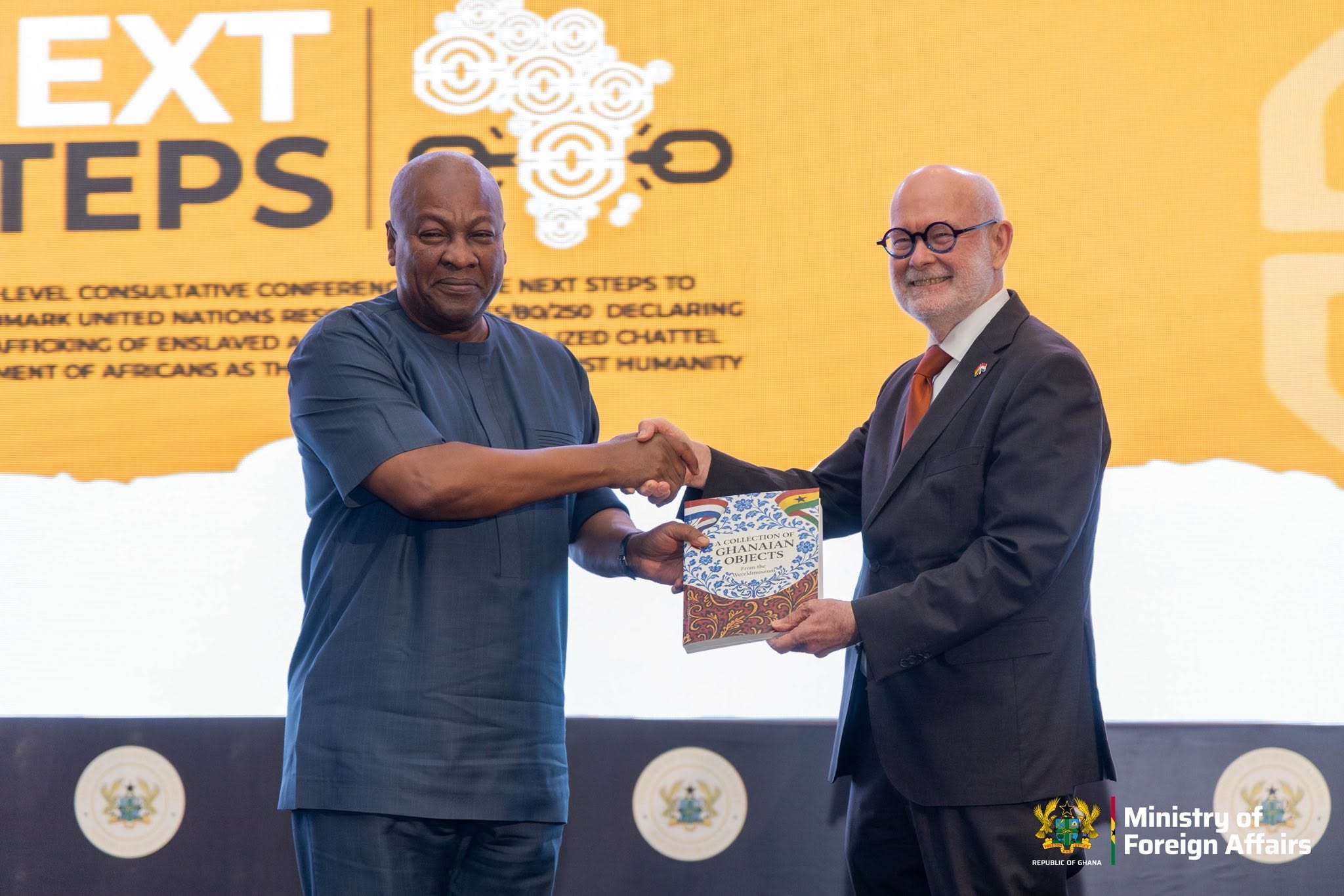
Ambassadors from both countries presented catalogs of objects under consideration for restitution to President John Dramani Mahama during a plenary session of the conference.
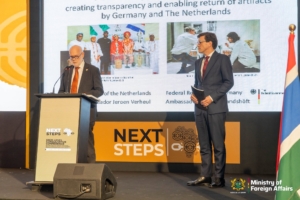
Dutch Ambassador Jeroen Verheul (L), German Ambassador Frederik Landshoeft (R)

Ablakwa also highlighted an apology from Denmark for its role in the transatlantic slave trade and a pledge to help preserve historic castles linked to that era.

He described the developments as evidence of a growing commitment among some European partners to support restitution, historical accountability and truth-telling.

Dutch Ambassador Jeroen Verheul said discussions were underway with Ghanaian authorities on the return of cultural heritage.

He presented a catalog containing approximately 2,000 objects from Dutch national ethnographic collections that may be linked to Ghana.

“The exact provenance of these objects is not yet fully known, but this catalog is a starting point for continuing this return process together,” Verheul said.

He said cooperation between Ghana and the Netherlands would be essential as research continues and decisions are made on future returns.

German Ambassador to Ghana Frederik Landshoeft said Berlin remains committed to confronting the legacy of its colonial past through dialogue with affected countries and communities.

He presented a catalog documenting provenance research into four objects from Pando in Ghana’s Volta Region, including two war drums and two war horns associated with the Dagadu rulers.

“They carry history, memory and authority,” Landshoeft said of the objects.

The research found that the items entered German possession during the colonial period in circumstances shaped by unequal power relations and colonial violence.

Understanding those histories matters, he said, because cultural artifacts are closely tied to the communities from which they originate.

The conference concluded with a declaration calling on countries involved in the Atlantic slave trade to offer full, formal and unconditional apologies as a foundation for reconciliation, trust-building and reparatory justice.

The gathering attracted leaders and representatives from more than 80 countries, including the presidents of Senegal, Namibia, Liberia and São Tomé and Príncipe.

Participants argued that recognition of the transatlantic slave trade as one of humanity’s gravest crimes should be accompanied by practical measures to address its lasting social, economic and cultural consequences.

The momentum behind restitution efforts extends beyond Ghana.

Nigeria secured the return of more than 1,100 Benin Bronzes from German state museums in 2022 and, after years of negotiations, received additional artifacts from London’s Horniman Museum in 2023.

Ethiopia this week formally received relics belonging to Emperor Tewodros II that were taken to Britain following the 1868 Maqdala campaign.

In Côte d’Ivoire, the sacred talking drum known as the Djidji Ayokwé returned from France in March, marking the first official restitution of a cultural artifact from France to the West African nation in more than a century.

Senegal, Mali and South Africa have also pursued repatriation claims in recent years, while the African Union has formally backed member states seeking the recovery of cultural heritage held abroad.

The announcements have generated discussion in Ghana about how returned artifacts should be preserved and displayed.

Prince Kojo Hilton, a Ghanaian visual artist and founder of Global Art Connect, welcomed the development and called for renewed efforts to complete Ghana’s National Museum project.

“We also must make it an effort to complete the National Museum building to be able to accommodate and exhibit these artifacts,” Hilton wrote in response to Ablakwa’s announcement.

The developments have also renewed broader conversations about how societies should remember the legacy of slavery and colonialism.

While supporters view restitution and preservation efforts as important tools for historical education and accountability, others argue that resources should be directed toward contemporary priorities such as education and public services.

Jacqueline Sutherland, commenting on social media following Ablakwa’s announcement, questioned the emphasis on preserving slave-era castles and related sites. “Why do you all want to preserve these castles? How does it help heal the years of pain and continued oppression of the people?” she wrote. “The money should be put to education and sanitation.”

The return of artifacts is increasingly viewed as part of a broader effort to acknowledge historical injustices and reshape relations between African countries and former colonial powers through dialogue, accountability and cultural cooperation.


Get the inside Story

Stay informed on the stories shaping Africa’s future. Get breaking news, in-depth analysis, opinions and exclusive insights from across the continent delivered to your inbox, free and unfiltered.


Get in touch for more:
Felix Tih
Editorial Director, Bantu Gazette
WhatsApp
LinkedIn
X (Twitter)
Instagram

Related Posts

Kolwezi Fashion Week Aligns Local Creativity with DR Congo’s Creative Economy Ambitions
Culture & Identity

Kolwezi Fashion Week Aligns Local Creativity with DR Congo’s Creative Economy Ambitions

July 17, 2026
Chinese Travel Interest in Cape Verde Surges After World Cup Breakthrough
Culture & Identity

Chinese Travel Interest in Cape Verde Surges After World Cup Breakthrough

July 9, 2026
Noir Fashion Week Returns to Nairobi as Kenya’s Textile Debate Continues
Culture & Identity

Noir Fashion Week Returns to Nairobi as Kenya’s Textile Debate Continues

July 13, 2026
Botswana Launches Nationwide Consultations to Modernize Tourism Sector
Culture & Identity

Botswana Launches Nationwide Consultations to Modernize Tourism Sector

June 20, 2026
Namibia President Calls for Preservation of Cultural Heritage
Culture & Identity

Namibia President Calls for Preservation of Cultural Heritage

June 3, 2026
Uganda Positions Tourism for Regional Growth Ahead of 2027 AFCON
Culture & Identity

Uganda Positions Tourism for Regional Growth Ahead of 2027 AFCON

May 26, 2026

Most Recent

1,700 Refugee and Host Community Youth Receive Digital Skills Training in Kenya
Development & Impact

1,700 Refugee and Host Community Youth Receive Digital Skills Training in Kenya

by Waceke Nganga
July 21, 2026
0

The initiative combines community-based training, Microsoft certifications and employment pathways to expand digital opportunities for young people in Kenya's two...

Read moreDetails
Mali’s $190 Million Power Project to Connect 10,000 Households

Mali’s $190 Million Power Project to Connect 10,000 Households

July 20, 2026
Mandela Day Marked with Nationwide Acts of Service and Renewed Focus on Dignity

Mandela Day Marked with Nationwide Acts of Service and Renewed Focus on Dignity

July 20, 2026
Beyond the Broken Promise of Education

Inclusive Education Seen as Foundation for Africa’s Sustainable Growth

July 17, 2026
Coding Our Own Future Ending digital dependency starts with mental sovereignty - Bantu Gazette

People, Not Technology, Remain Africa’s Biggest Digital Transformation Challenge

July 20, 2026
Chad Announces Visa-Free Entry for All Africans Beginning Jan. 1, 2027

Chad Announces Visa-Free Entry for All Africans Beginning Jan. 1, 2027

July 16, 2026
New Africa-Wide Chief Economists Network Targets Stronger Policymaking

New Africa-Wide Chief Economists Network Targets Stronger Policymaking

July 17, 2026
1,700 Refugee and Host Community Youth Receive Digital Skills Training in Kenya
Development & Impact

1,700 Refugee and Host Community Youth Receive Digital Skills Training in Kenya

by Waceke Nganga
Reading Time: 2 mins read
July 21, 2026
0

The initiative combines community-based training, Microsoft certifications and employment pathways to expand digital opportunities for young people in Kenya's two...

Read moreDetails
Mali’s $190 Million Power Project to Connect 10,000 Households
Energy

Mali’s $190 Million Power Project to Connect 10,000 Households

by Aissatou Fall
Reading Time: 2 mins read
July 20, 2026
0

African Development Bank-backed project will expand the capital's electricity network and improve power reliability for homes, businesses and industry.

Read moreDetails
Mandela Day Marked with Nationwide Acts of Service and Renewed Focus on Dignity
Uncategorized

Mandela Day Marked with Nationwide Acts of Service and Renewed Focus on Dignity

by Naledi Kgosi
Reading Time: 2 mins read
July 20, 2026
0

From new classrooms and children's books to food relief and water access, organizations across South Africa honored Nelson Mandela's legacy...

Read moreDetails

Ghana Welcomes Planned Return of 2,000 Artifacts from the Netherlands, Germany

Restitution efforts are becoming a defining feature of evolving relations between African nations and European governments as calls for reparatory justice gain international support

Ghana Welcomes Planned Return of 2,000 Artifacts from the Netherlands, Germany

high level consultative conference on the next steps, accra ghana

ACCRA

Ghana has welcomed announcements by the Netherlands and Germany that they are prepared to advance the return of cultural artifacts linked to the country’s history, including about 2,000 objects identified in Dutch collections, in what officials describe as a significant step in efforts to address the legacies of slavery and colonialism.

The commitments were made during the High-Level Consultative Conference on the Next Steps to the Landmark U.N. Resolution on the Trafficking of Enslaved Africans, held in Accra from June 17 to June 19.

The gathering brought together African and Caribbean leaders, legal experts, government officials, and members of the African diaspora to discuss the implementation of U.N. General Assembly Resolution A/RES/80/250, adopted in March.

Ghana’s Foreign Affairs Minister Samuel Okudzeto Ablakwa said the government welcomed the Netherlands’ and Germany’s readiness to return looted artifacts and other items of cultural significance.

Ambassadors from both countries presented catalogs of objects under consideration for restitution to President John Dramani Mahama during a plenary session of the conference.

Dutch Ambassador Jeroen Verheul (L), German Ambassador Frederik Landshoeft (R)

Ablakwa also highlighted an apology from Denmark for its role in the transatlantic slave trade and a pledge to help preserve historic castles linked to that era.

He described the developments as evidence of a growing commitment among some European partners to support restitution, historical accountability and truth-telling.

Dutch Ambassador Jeroen Verheul said discussions were underway with Ghanaian authorities on the return of cultural heritage.

He presented a catalog containing approximately 2,000 objects from Dutch national ethnographic collections that may be linked to Ghana.

“The exact provenance of these objects is not yet fully known, but this catalog is a starting point for continuing this return process together,” Verheul said.

He said cooperation between Ghana and the Netherlands would be essential as research continues and decisions are made on future returns.

German Ambassador to Ghana Frederik Landshoeft said Berlin remains committed to confronting the legacy of its colonial past through dialogue with affected countries and communities.

He presented a catalog documenting provenance research into four objects from Pando in Ghana’s Volta Region, including two war drums and two war horns associated with the Dagadu rulers.

“They carry history, memory and authority,” Landshoeft said of the objects.

The research found that the items entered German possession during the colonial period in circumstances shaped by unequal power relations and colonial violence.

Understanding those histories matters, he said, because cultural artifacts are closely tied to the communities from which they originate.

The conference concluded with a declaration calling on countries involved in the Atlantic slave trade to offer full, formal and unconditional apologies as a foundation for reconciliation, trust-building and reparatory justice.

The gathering attracted leaders and representatives from more than 80 countries, including the presidents of Senegal, Namibia, Liberia and São Tomé and Príncipe.

Participants argued that recognition of the transatlantic slave trade as one of humanity’s gravest crimes should be accompanied by practical measures to address its lasting social, economic and cultural consequences.

The momentum behind restitution efforts extends beyond Ghana.

Nigeria secured the return of more than 1,100 Benin Bronzes from German state museums in 2022 and, after years of negotiations, received additional artifacts from London’s Horniman Museum in 2023.

Ethiopia this week formally received relics belonging to Emperor Tewodros II that were taken to Britain following the 1868 Maqdala campaign.

In Côte d’Ivoire, the sacred talking drum known as the Djidji Ayokwé returned from France in March, marking the first official restitution of a cultural artifact from France to the West African nation in more than a century.

Senegal, Mali and South Africa have also pursued repatriation claims in recent years, while the African Union has formally backed member states seeking the recovery of cultural heritage held abroad.

The announcements have generated discussion in Ghana about how returned artifacts should be preserved and displayed.

Prince Kojo Hilton, a Ghanaian visual artist and founder of Global Art Connect, welcomed the development and called for renewed efforts to complete Ghana’s National Museum project.

“We also must make it an effort to complete the National Museum building to be able to accommodate and exhibit these artifacts,” Hilton wrote in response to Ablakwa’s announcement.

The developments have also renewed broader conversations about how societies should remember the legacy of slavery and colonialism.

While supporters view restitution and preservation efforts as important tools for historical education and accountability, others argue that resources should be directed toward contemporary priorities such as education and public services.

Jacqueline Sutherland, commenting on social media following Ablakwa’s announcement, questioned the emphasis on preserving slave-era castles and related sites. “Why do you all want to preserve these castles? How does it help heal the years of pain and continued oppression of the people?” she wrote. “The money should be put to education and sanitation.”

The return of artifacts is increasingly viewed as part of a broader effort to acknowledge historical injustices and reshape relations between African countries and former colonial powers through dialogue, accountability and cultural cooperation.

 

Ghana Welcomes Planned Return of 2,000 Artifacts from the Netherlands, Germany

Restitution efforts are becoming a defining feature of evolving relations between African nations and European governments as calls for reparatory justice gain international support

Ghana Welcomes Planned Return of 2,000 Artifacts from the Netherlands, Germany

high level consultative conference on the next steps, accra ghana

Felix Tihby Felix Tih
June 22, 2026

ACCRA

Ghana has welcomed announcements by the Netherlands and Germany that they are prepared to advance the return of cultural artifacts linked to the country’s history, including about 2,000 objects identified in Dutch collections, in what officials describe as a significant step in efforts to address the legacies of slavery and colonialism.

The commitments were made during the High-Level Consultative Conference on the Next Steps to the Landmark U.N. Resolution on the Trafficking of Enslaved Africans, held in Accra from June 17 to June 19.

The gathering brought together African and Caribbean leaders, legal experts, government officials, and members of the African diaspora to discuss the implementation of U.N. General Assembly Resolution A/RES/80/250, adopted in March.

Ghana’s Foreign Affairs Minister Samuel Okudzeto Ablakwa said the government welcomed the Netherlands’ and Germany’s readiness to return looted artifacts and other items of cultural significance.

Ambassadors from both countries presented catalogs of objects under consideration for restitution to President John Dramani Mahama during a plenary session of the conference.

Dutch Ambassador Jeroen Verheul (L), German Ambassador Frederik Landshoeft (R)

Ablakwa also highlighted an apology from Denmark for its role in the transatlantic slave trade and a pledge to help preserve historic castles linked to that era.

He described the developments as evidence of a growing commitment among some European partners to support restitution, historical accountability and truth-telling.

Dutch Ambassador Jeroen Verheul said discussions were underway with Ghanaian authorities on the return of cultural heritage.

He presented a catalog containing approximately 2,000 objects from Dutch national ethnographic collections that may be linked to Ghana.

“The exact provenance of these objects is not yet fully known, but this catalog is a starting point for continuing this return process together,” Verheul said.

He said cooperation between Ghana and the Netherlands would be essential as research continues and decisions are made on future returns.

German Ambassador to Ghana Frederik Landshoeft said Berlin remains committed to confronting the legacy of its colonial past through dialogue with affected countries and communities.

He presented a catalog documenting provenance research into four objects from Pando in Ghana’s Volta Region, including two war drums and two war horns associated with the Dagadu rulers.

“They carry history, memory and authority,” Landshoeft said of the objects.

The research found that the items entered German possession during the colonial period in circumstances shaped by unequal power relations and colonial violence.

Understanding those histories matters, he said, because cultural artifacts are closely tied to the communities from which they originate.

The conference concluded with a declaration calling on countries involved in the Atlantic slave trade to offer full, formal and unconditional apologies as a foundation for reconciliation, trust-building and reparatory justice.

The gathering attracted leaders and representatives from more than 80 countries, including the presidents of Senegal, Namibia, Liberia and São Tomé and Príncipe.

Participants argued that recognition of the transatlantic slave trade as one of humanity’s gravest crimes should be accompanied by practical measures to address its lasting social, economic and cultural consequences.

The momentum behind restitution efforts extends beyond Ghana.

Nigeria secured the return of more than 1,100 Benin Bronzes from German state museums in 2022 and, after years of negotiations, received additional artifacts from London’s Horniman Museum in 2023.

Ethiopia this week formally received relics belonging to Emperor Tewodros II that were taken to Britain following the 1868 Maqdala campaign.

In Côte d’Ivoire, the sacred talking drum known as the Djidji Ayokwé returned from France in March, marking the first official restitution of a cultural artifact from France to the West African nation in more than a century.

Senegal, Mali and South Africa have also pursued repatriation claims in recent years, while the African Union has formally backed member states seeking the recovery of cultural heritage held abroad.

The announcements have generated discussion in Ghana about how returned artifacts should be preserved and displayed.

Prince Kojo Hilton, a Ghanaian visual artist and founder of Global Art Connect, welcomed the development and called for renewed efforts to complete Ghana’s National Museum project.

“We also must make it an effort to complete the National Museum building to be able to accommodate and exhibit these artifacts,” Hilton wrote in response to Ablakwa’s announcement.

The developments have also renewed broader conversations about how societies should remember the legacy of slavery and colonialism.

While supporters view restitution and preservation efforts as important tools for historical education and accountability, others argue that resources should be directed toward contemporary priorities such as education and public services.

Jacqueline Sutherland, commenting on social media following Ablakwa’s announcement, questioned the emphasis on preserving slave-era castles and related sites. “Why do you all want to preserve these castles? How does it help heal the years of pain and continued oppression of the people?” she wrote. “The money should be put to education and sanitation.”

The return of artifacts is increasingly viewed as part of a broader effort to acknowledge historical injustices and reshape relations between African countries and former colonial powers through dialogue, accountability and cultural cooperation.
 

Get the inside Story

Stay informed on the stories shaping Africa’s future. Get breaking news, in-depth analysis, opinions and exclusive insights from across the continent delivered to your inbox, free and unfiltered.


Get in touch for more:
Felix Tih
Editorial Director, Bantu Gazette
WhatsApp
LinkedIn
X (Twitter)
Instagram

Related Posts

Kolwezi Fashion Week Aligns Local Creativity with DR Congo’s Creative Economy Ambitions

Kolwezi Fashion Week Aligns Local Creativity with DR Congo’s Creative Economy Ambitions

by Felix Tih
July 10, 2026
0

...

Chinese Travel Interest in Cape Verde Surges After World Cup Breakthrough

Chinese Travel Interest in Cape Verde Surges After World Cup Breakthrough

by Felix Tih
July 8, 2026
0

...

Noir Fashion Week Returns to Nairobi as Kenya’s Textile Debate Continues

Noir Fashion Week Returns to Nairobi as Kenya’s Textile Debate Continues

by Waceke Nganga
July 7, 2026
0

...

Botswana Launches Nationwide Consultations to Modernize Tourism Sector

Botswana Launches Nationwide Consultations to Modernize Tourism Sector

by Naledi Kgosi
June 18, 2026
0

...

Namibia President Calls for Preservation of Cultural Heritage

Namibia President Calls for Preservation of Cultural Heritage

by Naledi Kgosi
May 25, 2026
0

...

Uganda Positions Tourism for Regional Growth Ahead of 2027 AFCON

Uganda Positions Tourism for Regional Growth Ahead of 2027 AFCON

by Felix Tih
May 22, 2026
0

...

1,700 Refugee and Host Community Youth Receive Digital Skills Training in Kenya
Development & Impact

1,700 Refugee and Host Community Youth Receive Digital Skills Training in Kenya

by Waceke Nganga
Reading Time: 2 mins read
July 21, 2026
0

The initiative combines community-based training, Microsoft certifications and employment pathways to expand digital opportunities for young people in Kenya's two...

Read moreDetails
Mali’s $190 Million Power Project to Connect 10,000 Households

Mali’s $190 Million Power Project to Connect 10,000 Households

by Aissatou Fall
July 20, 2026
0

African Development Bank-backed project will expand the capital's electricity network and improve power reliability for homes, businesses and industry.

Mandela Day Marked with Nationwide Acts of Service and Renewed Focus on Dignity

Mandela Day Marked with Nationwide Acts of Service and Renewed Focus on Dignity

by Naledi Kgosi
July 18, 2026
0

From new classrooms and children's books to food relief and water access, organizations across South Africa honored Nelson Mandela's legacy...

Beyond the Broken Promise of Education

Inclusive Education Seen as Foundation for Africa’s Sustainable Growth

by Felix Tih
July 17, 2026
0

Quality, inclusive education is the cornerstone of Africa's sustainable future, with experts urging reforms rooted in Ubuntu and decolonization.

Coding Our Own Future Ending digital dependency starts with mental sovereignty - Bantu Gazette

People, Not Technology, Remain Africa’s Biggest Digital Transformation Challenge

by Felix Tih
July 17, 2026
0

Experts speaking during DigiBiz Africa's latest webinar said businesses often focus on software while overlooking the human behaviors that determine...

Next Post
Kenya’s President Ruto Takes Africa’s Agenda to G7 Summit in France

Kenya's President Ruto Takes Africa's Agenda to G7 Summit in France

Namibia, Tanzania Seek Stronger Economic Ties Built on Liberation-Era Trust

Namibia, Tanzania Seek Stronger Economic Ties Built on Liberation-Era Trust

Prosperity Party Clinches Parliamentary Majority in Ethiopia’s 7th General Election

Prosperity Party Clinches Parliamentary Majority in Ethiopia’s 7th General Election

Kenyan Fintech WapiPay Secures Canadian License in North American Push

Kenyan Fintech WapiPay Secures Canadian License in North American Push

Bantu Gazette is a pioneering news platform that champions Africa's development, culture, and heritage. We spotlight the continent's successes, address its challenges, and provide insightful coverage of events that shape its future.

Bantu Gazette is a pioneering news platform that champions Africa's development, culture, and heritage. We spotlight the continent's successes, address its challenges, and provide insightful coverage of events that shape its future.

Our Platforms

  • Bantu Magazine
  • Bantu Brief
  • Black Frame Studio

Our Services

  • Bantu Agency
  • Advertise
  • Partnerships

Our Services

  • Editorial Director
  • Opportunities
  • Contact

Bantu Gazette is a pioneering news platform that champions Africa's development, culture, and heritage. We spotlight the continent's successes, address its challenges, and provide insightful coverage of events that shape its future.

Our Platforms

  • Bantu Magazine
  • Bantu Brief
  • Black Frame Studio

Our Services

  • Bantu Agency
  • Advertise
  • Partnerships

Our Services

  • Editorial Director
  • Opportunities
  • Contact
Bantu Gazette
  • Energy & Trade
  • Finance
  • Health
  • Politics & Economy
  • Technology
  • Environment
  • Feature
  • Opinion
  • Changemakers
  • Tourism & Culture
  • Magazine