

Bantu Gazette

Bantu Gazette
  • Policy & Governance
  • Development & Impact
  • Business, Trade & Economy
  • Energy
  • Changemakers
  • Culture & Identity
  • Perspectives
  • Magazine
Menu
  • Black Frame Studio
  • Magazine

Nigeria Needs $1.3 Trillion for Industrial Transformation, Minister Says

Industry minister targets manufacturing growth and agricultural expansion to reduce $10 billion annual import dependency across sectors

Bantu Gazette

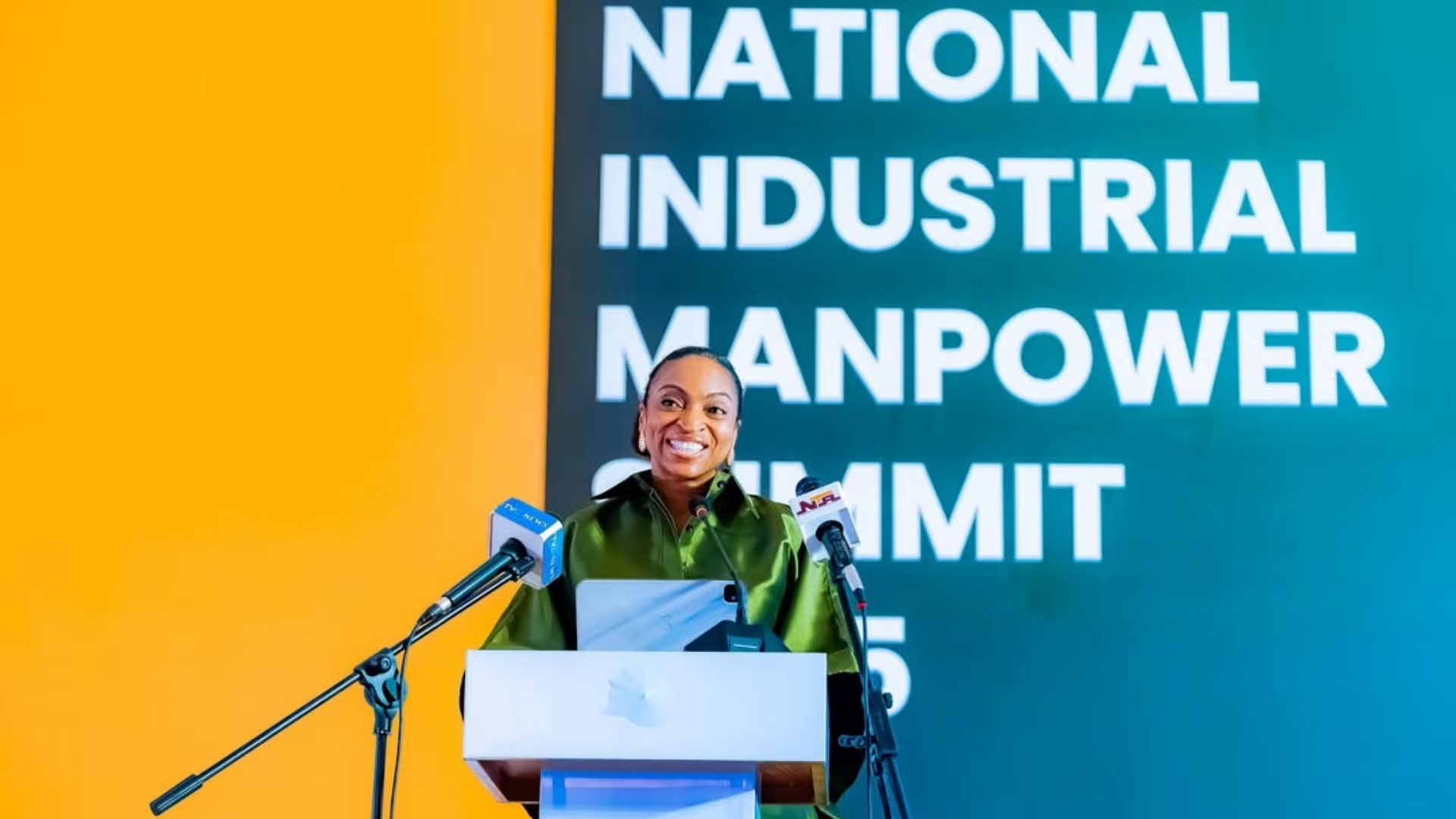
Dr Jumoke Oduwole, Nigeria’s Minister Federal Ministry of Industry, Trade and Investment. Credit: Ministry's social media

Cynthia N. Ganchokby Cynthia N. Ganchok
August 13, 2025
Reading Time: 2 mins read

Nigeria Needs $1.3 Trillion for Industrial Transformation, Minister Says

Industry minister targets manufacturing growth and agricultural expansion to reduce $10 billion annual import dependency across sectors

Bantu Gazette

Dr Jumoke Oduwole, Nigeria’s Minister Federal Ministry of Industry, Trade and Investment. Credit: Ministry's social media

Bantu Gazette

Dr Jumoke Oduwole, Nigeria’s Minister Federal Ministry of Industry, Trade and Investment. Credit: Ministry's social media

Cynthia N. Ganchokby Cynthia N. Ganchok
July 11, 2026
Reading Time: 2 mins read

Nigeria needs at least $1.3 trillion in annual financing to accelerate its industrial transformation and achieve economic sovereignty, the country’s industry minister said Tuesday.

Dr. Jumoke Oduwole, Minister of Industry, Trade and Investment, outlined the massive investment requirement during her keynote address at the National Industrial Manpower Summit in Abuja.

The funds would target critical infrastructure including energy systems, manufacturing facilities, housing, digital connectivity, and social sectors.

“The urgency is clear,” Oduwole said, noting that traditional aid flows are declining while concessional financing tightens across Africa.

The minister said the financing would come from domestic resources, capital markets, private investments, concessional finance, and foreign direct investment.

Oduwole presented a six-pillar strategy for Nigeria’s industrial transformation, anchored in President Bola Tinubu’s economic agenda. The strategy builds on Nigeria’s consumer market of over 220 million people, agricultural potential, critical mineral resources, rapid urbanization, regional market integration, and existing manufacturing base.

The manufacturing sector currently contributes 9.6% to Nigeria’s GDP and employs over 13 million people across food processing, cement production, textiles, pharmaceuticals, and automotive industries.

She said the sector could absorb Nigeria’s large youth population while reducing the country’s $10 billion annual import bill for manufactured goods.

Nigeria’s agricultural sector, which contributes 25% to GDP and employs a third of the workforce, represents another growth opportunity.

With Africa’s food and agriculture markets projected to reach $1 trillion by 2030, Nigeria aims to lead in agro-processing and value-added exports under the African Continental Free Trade Area.

The minister emphasized Nigeria’s strategic position in the  African Continental Free Trade Area (AfCFTA), which creates access to a market of 1.4 billion people across Africa.

She said this integration allows Nigerian industries to achieve economies of scale and positions the country as a preferred production destination for West Africa.

Oduwole also highlighted Nigeria’s critical mineral resources, including limestone, bitumen, gold, lithium, and rare earth elements.

Local refining and manufacturing of these materials could enable exports of finished components for electric vehicles, batteries, and high-tech manufacturing.

The three-day summit, themed “Manpower Development: The Bridge Between Potential and Productivity,” runs through August 14.

The event focuses on developing industrial skills and training programs to support Nigeria’s economic transformation goals.

Oduwole said she had visited the National Agency for Science and Engineering Infrastructure campus, where she observed integrated models for innovation, manufacturing, and skills development, including solar panel production, electric vehicle assembly, and agricultural mechanization tools.


Get the inside Story

Stay informed on the stories shaping Africa’s future. Get breaking news, in-depth analysis, opinions and exclusive insights from across the continent delivered to your inbox, free and unfiltered.


Get in touch for more:
Felix Tih
Editorial Director, Bantu Gazette
WhatsApp
LinkedIn
X (Twitter)
Instagram

Related Posts

$5 Billion Digital Corridor to Link African Markets, Payments
Business, Trade & Economy

$5 Billion Digital Corridor to Link African Markets, Payments

September 7, 2026
Ethiopia Reports More Than $14.4 Million in Exports Under African Free Trade Area
Business, Trade & Economy

Ethiopia Reports More Than $14.4 Million in Exports Under African Free Trade Area

September 3, 2026
South Africa Allocates $1.7 Billion to Road Agency for Network Expansion
Business, Trade & Economy

South Africa Says 3% Growth Can Change Its Jobs Equation. Can It Get There?

September 1, 2026
Rwanda Taps Japanese Yen Market for First Time in Loan Deal
Business, Trade & Economy

Rwanda Taps Japanese Yen Market for First Time in Loan Deal

September 3, 2026
Kenya Approves First Locally Domiciled Exchange Traded Fund
Business, Trade & Economy

Kenya Approves First Locally Domiciled Exchange Traded Fund

August 27, 2026
Ghana’s Bad-Loan Problem is Becoming a Financial-Stability Story
Business, Trade & Economy

Ghana’s Bad-Loan Problem is Becoming a Financial-Stability Story

August 24, 2026

Most Recent

Africa IP Day | One Market, Many Intellectual Property Systems. Can AfCFTA Bridge the Gap?
Development & Impact

Africa IP Day | One Market, Many Intellectual Property Systems. Can AfCFTA Bridge the Gap?

by Felix Tih
September 10, 2026
0

Africa’s innovators are crossing borders faster than IP protections can follow. Experts say AfCFTA could help build a more connected...

Read moreDetails
Africa Cut Maternal Mortality for Two Decades. Why Did Progress Start Slowing in 2016?

Africa Cut Maternal Mortality for Two Decades. Why Did Progress Start Slowing in 2016?

September 10, 2026
How the 2026 Transfer Window Changed the Market for African Footballers

How the 2026 Transfer Window Changed the Market for African Footballers

September 10, 2026
Youth-Led Thriller Secures International Distribution Deal After Uganda Film Festival Win

Youth-Led Thriller Secures International Distribution Deal After Uganda Film Festival Win

September 10, 2026
UN Adopts Togo-sponsored Resolution to Show Africa’s True Size on World Maps

UN Adopts Togo-sponsored Resolution to Show Africa’s True Size on World Maps

September 7, 2026
Beyond Technical Expertise, Africa’s Public-Sector Reformers Put Leadership to the Test

Beyond Technical Expertise, Africa’s Public-Sector Reformers Put Leadership to the Test

September 6, 2026
Kenya’s Wawira Njiru Awarded 2026 German Africa Prize for School Feeding Initiative

Kenya’s Wawira Njiru Awarded 2026 German Africa Prize for School Feeding Initiative

September 10, 2026
Africa IP Day | One Market, Many Intellectual Property Systems. Can AfCFTA Bridge the Gap?
Development & Impact

Africa IP Day | One Market, Many Intellectual Property Systems. Can AfCFTA Bridge the Gap?

by Felix Tih
Reading Time: 4 mins read
September 10, 2026
0

Africa’s innovators are crossing borders faster than IP protections can follow. Experts say AfCFTA could help build a more connected...

Read moreDetails
Africa Cut Maternal Mortality for Two Decades. Why Did Progress Start Slowing in 2016?
Development & Impact

Africa Cut Maternal Mortality for Two Decades. Why Did Progress Start Slowing in 2016?

by Felix Tih
Reading Time: 8 mins read
September 10, 2026
0

Africa CDC’s new assessment suggests the continent’s maternal mortality crisis cannot be explained mainly by recent aid cuts. The slowdown...

Read moreDetails
How the 2026 Transfer Window Changed the Market for African Footballers
Sports

How the 2026 Transfer Window Changed the Market for African Footballers

by Doyinsola Ibidunni
Reading Time: 3 mins read
September 10, 2026
0

From record fees to moves involving some of Africa’s brightest talents, the summer window showed how heavily European clubs are...

Read moreDetails

Nigeria Needs $1.3 Trillion for Industrial Transformation, Minister Says

Industry minister targets manufacturing growth and agricultural expansion to reduce $10 billion annual import dependency across sectors

Bantu Gazette

Dr Jumoke Oduwole, Nigeria’s Minister Federal Ministry of Industry, Trade and Investment. Credit: Ministry's social media

Nigeria needs at least $1.3 trillion in annual financing to accelerate its industrial transformation and achieve economic sovereignty, the country’s industry minister said Tuesday.

Dr. Jumoke Oduwole, Minister of Industry, Trade and Investment, outlined the massive investment requirement during her keynote address at the National Industrial Manpower Summit in Abuja.

The funds would target critical infrastructure including energy systems, manufacturing facilities, housing, digital connectivity, and social sectors.

“The urgency is clear,” Oduwole said, noting that traditional aid flows are declining while concessional financing tightens across Africa.

The minister said the financing would come from domestic resources, capital markets, private investments, concessional finance, and foreign direct investment.

Oduwole presented a six-pillar strategy for Nigeria’s industrial transformation, anchored in President Bola Tinubu’s economic agenda. The strategy builds on Nigeria’s consumer market of over 220 million people, agricultural potential, critical mineral resources, rapid urbanization, regional market integration, and existing manufacturing base.

The manufacturing sector currently contributes 9.6% to Nigeria’s GDP and employs over 13 million people across food processing, cement production, textiles, pharmaceuticals, and automotive industries.

She said the sector could absorb Nigeria’s large youth population while reducing the country’s $10 billion annual import bill for manufactured goods.

Nigeria’s agricultural sector, which contributes 25% to GDP and employs a third of the workforce, represents another growth opportunity.

With Africa’s food and agriculture markets projected to reach $1 trillion by 2030, Nigeria aims to lead in agro-processing and value-added exports under the African Continental Free Trade Area.

The minister emphasized Nigeria’s strategic position in the  African Continental Free Trade Area (AfCFTA), which creates access to a market of 1.4 billion people across Africa.

She said this integration allows Nigerian industries to achieve economies of scale and positions the country as a preferred production destination for West Africa.

Oduwole also highlighted Nigeria’s critical mineral resources, including limestone, bitumen, gold, lithium, and rare earth elements.

Local refining and manufacturing of these materials could enable exports of finished components for electric vehicles, batteries, and high-tech manufacturing.

The three-day summit, themed “Manpower Development: The Bridge Between Potential and Productivity,” runs through August 14.

The event focuses on developing industrial skills and training programs to support Nigeria’s economic transformation goals.

Oduwole said she had visited the National Agency for Science and Engineering Infrastructure campus, where she observed integrated models for innovation, manufacturing, and skills development, including solar panel production, electric vehicle assembly, and agricultural mechanization tools.

Nigeria Needs $1.3 Trillion for Industrial Transformation, Minister Says

Industry minister targets manufacturing growth and agricultural expansion to reduce $10 billion annual import dependency across sectors

Bantu Gazette

Dr Jumoke Oduwole, Nigeria’s Minister Federal Ministry of Industry, Trade and Investment. Credit: Ministry's social media

Cynthia N. Ganchokby Cynthia N. Ganchok
August 13, 2025

Nigeria needs at least $1.3 trillion in annual financing to accelerate its industrial transformation and achieve economic sovereignty, the country’s industry minister said Tuesday.

Dr. Jumoke Oduwole, Minister of Industry, Trade and Investment, outlined the massive investment requirement during her keynote address at the National Industrial Manpower Summit in Abuja.

The funds would target critical infrastructure including energy systems, manufacturing facilities, housing, digital connectivity, and social sectors.

“The urgency is clear,” Oduwole said, noting that traditional aid flows are declining while concessional financing tightens across Africa.

The minister said the financing would come from domestic resources, capital markets, private investments, concessional finance, and foreign direct investment.

Oduwole presented a six-pillar strategy for Nigeria’s industrial transformation, anchored in President Bola Tinubu’s economic agenda. The strategy builds on Nigeria’s consumer market of over 220 million people, agricultural potential, critical mineral resources, rapid urbanization, regional market integration, and existing manufacturing base.

The manufacturing sector currently contributes 9.6% to Nigeria’s GDP and employs over 13 million people across food processing, cement production, textiles, pharmaceuticals, and automotive industries.

She said the sector could absorb Nigeria’s large youth population while reducing the country’s $10 billion annual import bill for manufactured goods.

Nigeria’s agricultural sector, which contributes 25% to GDP and employs a third of the workforce, represents another growth opportunity.

With Africa’s food and agriculture markets projected to reach $1 trillion by 2030, Nigeria aims to lead in agro-processing and value-added exports under the African Continental Free Trade Area.

The minister emphasized Nigeria’s strategic position in the  African Continental Free Trade Area (AfCFTA), which creates access to a market of 1.4 billion people across Africa.

She said this integration allows Nigerian industries to achieve economies of scale and positions the country as a preferred production destination for West Africa.

Oduwole also highlighted Nigeria’s critical mineral resources, including limestone, bitumen, gold, lithium, and rare earth elements.

Local refining and manufacturing of these materials could enable exports of finished components for electric vehicles, batteries, and high-tech manufacturing.

The three-day summit, themed “Manpower Development: The Bridge Between Potential and Productivity,” runs through August 14.

The event focuses on developing industrial skills and training programs to support Nigeria’s economic transformation goals.

Oduwole said she had visited the National Agency for Science and Engineering Infrastructure campus, where she observed integrated models for innovation, manufacturing, and skills development, including solar panel production, electric vehicle assembly, and agricultural mechanization tools.

Get the inside Story

Stay informed on the stories shaping Africa’s future. Get breaking news, in-depth analysis, opinions and exclusive insights from across the continent delivered to your inbox, free and unfiltered.


Get in touch for more:
Felix Tih
Editorial Director, Bantu Gazette
WhatsApp
LinkedIn
X (Twitter)
Instagram

Related Posts

$5 Billion Digital Corridor to Link African Markets, Payments

$5 Billion Digital Corridor to Link African Markets, Payments

by Marina Bisse
September 1, 2026
0

...

Ethiopia Reports More Than $14.4 Million in Exports Under African Free Trade Area

Ethiopia Reports More Than $14.4 Million in Exports Under African Free Trade Area

by Kalkidan Negash
August 31, 2026
0

...

South Africa Allocates $1.7 Billion to Road Agency for Network Expansion

South Africa Says 3% Growth Can Change Its Jobs Equation. Can It Get There?

by Monica Brown
August 27, 2026
0

...

Rwanda Taps Japanese Yen Market for First Time in Loan Deal

Rwanda Taps Japanese Yen Market for First Time in Loan Deal

by Jane Mukami
August 27, 2026
0

...

Kenya Approves First Locally Domiciled Exchange Traded Fund

Kenya Approves First Locally Domiciled Exchange Traded Fund

by Waceke Nganga
August 25, 2026
0

...

Ghana’s Bad-Loan Problem is Becoming a Financial-Stability Story

Ghana’s Bad-Loan Problem is Becoming a Financial-Stability Story

by Felix Tih
August 24, 2026
0

...

Africa IP Day | One Market, Many Intellectual Property Systems. Can AfCFTA Bridge the Gap?
Development & Impact

Africa IP Day | One Market, Many Intellectual Property Systems. Can AfCFTA Bridge the Gap?

by Felix Tih
Reading Time: 4 mins read
September 10, 2026
0

Africa’s innovators are crossing borders faster than IP protections can follow. Experts say AfCFTA could help build a more connected...

Read moreDetails
Africa Cut Maternal Mortality for Two Decades. Why Did Progress Start Slowing in 2016?

Africa Cut Maternal Mortality for Two Decades. Why Did Progress Start Slowing in 2016?

by Felix Tih
September 10, 2026
0

Africa CDC’s new assessment suggests the continent’s maternal mortality crisis cannot be explained mainly by recent aid cuts. The slowdown...

How the 2026 Transfer Window Changed the Market for African Footballers

How the 2026 Transfer Window Changed the Market for African Footballers

by Doyinsola Ibidunni
September 10, 2026
0

From record fees to moves involving some of Africa’s brightest talents, the summer window showed how heavily European clubs are...

Youth-Led Thriller Secures International Distribution Deal After Uganda Film Festival Win

Youth-Led Thriller Secures International Distribution Deal After Uganda Film Festival Win

by Amani Mwakalebela
September 7, 2026
0

Award-winning “You May Kiss the Bride Goodbye” has signed with Okada Media, which is negotiating deals to take the youth-led...

UN Adopts Togo-sponsored Resolution to Show Africa’s True Size on World Maps

UN Adopts Togo-sponsored Resolution to Show Africa’s True Size on World Maps

by Felix Tih
September 4, 2026
0

The U.N. General Assembly adopted a Togo-led resolution promoting equal-area maps in schools, media and institutions to depict Africa and...

Next Post
Grand Magal de Touba Draws Millions to Senegal’s Self-Governing City

Grand Magal de Touba Draws Millions to Senegal's Self-Governing City

Africa50 Tops $1.4 Billion in Assets as Infrastructure Push Expands

Africa50 Tops $1.4 Billion in Assets as Infrastructure Push Expands

Gabon President Sets 10% Economic Growth Target for 5th Republic

Gabon President Sets 10% Economic Growth Target for 5th Republic

South Africa’s $40M Unity Dialogue Faces Political Boycotts

South Africa's $40M Unity Dialogue Faces Political Boycotts

Bantu Gazette is a pioneering news platform that champions Africa's development, culture, and heritage. We spotlight the continent's successes, address its challenges, and provide insightful coverage of events that shape its future.

Bantu Gazette is a pioneering news platform that champions Africa's development, culture, and heritage. We spotlight the continent's successes, address its challenges, and provide insightful coverage of events that shape its future.

Our Platforms

  • Bantu Magazine
  • Bantu Brief
  • Black Frame Studio

Our Services

  • Bantu Agency
  • Advertise
  • Partnerships

Our Services

  • Editorial Director
  • Opportunities
  • Contact

Bantu Gazette is a pioneering news platform that champions Africa's development, culture, and heritage. We spotlight the continent's successes, address its challenges, and provide insightful coverage of events that shape its future.

Our Platforms

  • Bantu Magazine
  • Bantu Brief
  • Black Frame Studio

Our Services

  • Bantu Agency
  • Advertise
  • Partnerships

Our Services

  • Editorial Director
  • Opportunities
  • Contact
Bantu Gazette
  • Energy & Trade
  • Finance
  • Health
  • Politics & Economy
  • Technology
  • Environment
  • Feature
  • Opinion
  • Changemakers
  • Tourism & Culture
  • Magazine