
Bantu Gazette

Bantu Gazette
  • Energy & Trade
  • Finance
  • Health
  • Politics & Economy
  • Technology
  • Environment
  • Feature
  • Opinion
  • Changemakers
  • Tourism & Culture
  • Magazine
Menu
  • Black Frame Studio
  • Magazine

South Africa’s $40M Unity Dialogue Faces Political Boycotts

Major parties boycott costly reconciliation initiative as critics question shift from citizen-led to government-controlled process

South Africa’s $40M Unity Dialogue Faces Political Boycotts

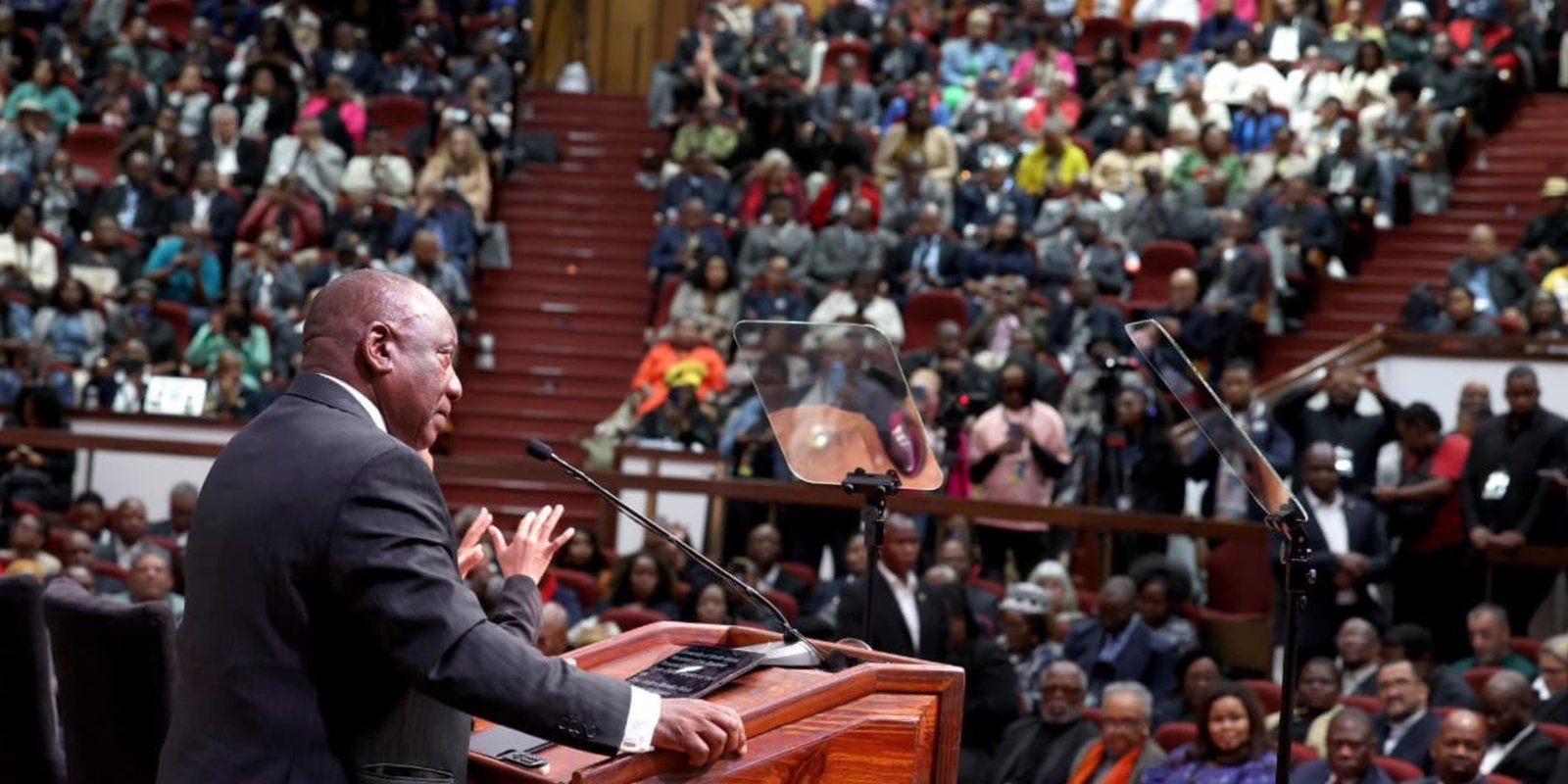
South Africa's President Cyril Ramaphosa speaking at the first National Convention

Refilwe Queenby Refilwe Queen
August 18, 2025
Reading Time: 2 mins read

South Africa’s $40M Unity Dialogue Faces Political Boycotts

Major parties boycott costly reconciliation initiative as critics question shift from citizen-led to government-controlled process

South Africa’s $40M Unity Dialogue Faces Political Boycotts

South Africa's President Cyril Ramaphosa speaking at the first National Convention

South Africa’s $40M Unity Dialogue Faces Political Boycotts

South Africa's President Cyril Ramaphosa speaking at the first National Convention

Refilwe Queenby Refilwe Queen
August 21, 2025
Reading Time: 2 mins read

South Africa’s President Cyril Ramaphosa’s National Dialogue initiative has drawn fierce criticism over its R700 million ($39.8 million) preliminary budget and suffered major political withdrawals, raising questions about the Government of National Unity’s flagship reconciliation effort.

The National Dialogue aims to create a new social compact to address South Africa’s economic hardship, unemployment, inequality and institutional crisis.

The initiative envisions nationwide consultations leading to concrete solutions for the country’s most pressing challenges, including poverty, crime, corruption, gender-based violence, slow land reform, poor governance, and social fragmentation.

The Democratic Alliance, a key Government of National partner, withdrew from the process in June after party leader John Steenhuisen dismissed it as a “talk shop” and “electioneering ploy.”

ActionSA and the uMkhonto weSizwe Party have also refused to participate, while several foundations established by former African National Congress leaders pulled out over concerns the process shifted from citizen-led to government-controlled.

The ANC, which has ruled South Africa since the end of apartheid in 1994, lost its parliamentary majority for the first time in the 2024 elections, forcing it into the current Government of National Unity.

The Presidency clarified that the R700 million ($39.8 million) figure represented a draft estimate from the preparatory task team, not an official allocation.

Officials said government would cover about 60% of costs, with private donors funding the remainder.

Ramaphosa has promised to keep expenses low, but the figure continues to fuel criticism about wasteful spending during South Africa’s cost-of-living crisis.

Launch Proceeds Despite Boycotts

The two-day national convention launched August 15-16 at the University of South Africa, drawing over 1,000 participants from more than 200 organizations.

Ramaphosa told attendees the dialogue would serve as a non-partisan platform where “no voice is too small and no perspective is too inconvenient to be heard.”

The president acknowledged the nation’s “profound challenges” including economic hardship, unemployment, inequality and institutional confidence crisis.

He called for solutions “bold enough to inspire, practical enough to implement” and described the process as launching “a million conversations.”

An Eminent Persons Group led by Professor Tinyiko Maluleke and Roelf Meyer, including rugby captain Siya Kolisi and humanitarian Dr. Imtiaz Sooliman, will guide the process through phases spanning local consultations to future national conventions.

Expert Criticism Mounts

Political economist Moeletsi Mbeki said the dialogue’s credibility has eroded because it became government-controlled rather than citizen-led as originally promised.

The continuing participant withdrawals indicate the process is “failing to live up to its initial promise,” Mbeki told Newzroom Afrika.

Civil society groups and academics question whether the high-profile approach can deliver results.

Critics from the Institute for Security Studies and Ilitha Labantu argue South Africa lacks political will and implementation capacity, not problem diagnosis.

They worry the dialogue will become another “tick-box exercise” failing to address gender-based violence and youth unemployment.

The Labour Party of South Africa filed an unsuccessful court application to halt the dialogue, calling it unconstitutional and fiscally irresponsible duplication of Parliament’s role.

Government Presses Forward

Despite the criticism and boycotts, officials say nationwide consultations will continue throughout the year.

The initiative’s success depends on its ability to move beyond political and financial controversies to engage communities at grassroots level.

For supporters, the dialogue represents South Africa’s final chance for unity. Critics view it as distraction from persistent government failures.

The first convention aimed to set agendas for thousands of public dialogues scheduled across the country over the next six to eight months.
 

Get the inside Story

Stay informed on the stories shaping Africa’s future. Get breaking news, in-depth analysis, opinions and exclusive insights from across the continent delivered to your inbox, free and unfiltered.


Related Posts

Dangote Commits $688 Million to Support Education in Nigeria
Politics & Economy

Dangote Commits $688 Million to Support Education in Nigeria

December 14, 2025
West Africa to Cut Air Travel Costs from 2026
Politics & Economy

West Africa to Cut Air Travel Costs from 2026

December 10, 2025
Ethiopia’s Amhara Peace Pact Reflects a Broader Shift
Politics & Economy

Africa Trade Gateway Positioned as Digital Backbone for Intra-African Trade

December 10, 2025
government of ghana and afdb sign grant agreement to support women and youth employment and social cohesion
Politics & Economy

Ghana Launches $71 million Program to Tackle Jobs Crisis

December 7, 2025
egypt moves to launch second tax facilitation package
Politics & Economy

Egypt Moves to Launch Second Tax Facilitation Package

December 7, 2025
east africa court ruling clears path for uganda tanzania pipeline
Politics & Economy

East Africa Court Ruling Clears Path for Uganda Tanzania Pipeline

December 4, 2025

Most Recent

Kenya Appoints Young Tree Activist as Conservation Envoy
Environment

Kenya Appoints Young Tree Activist as Conservation Envoy

by Jane Mukami
December 16, 2025
0

President William Ruto on Monday appointed 22-year-old Truphena Muthoni as an ambassador for Kenya’s 15 Billion Tree Planting Campaign, recognizing...

Read moreDetails
Dangote Commits $688 Million to Support Education in Nigeria

Dangote Commits $688 Million to Support Education in Nigeria

December 14, 2025
Diana Orembe Wins Africa’s Business Heroes 2025 Top Prize

Diana Orembe Wins Africa’s Business Heroes 2025 Top Prize

December 13, 2025
West Africa to Cut Air Travel Costs from 2026

West Africa to Cut Air Travel Costs from 2026

December 10, 2025
Namibia Secures $10 Million for Green Hydrogen Project

Namibia Secures $10 Million for Green Hydrogen Project

December 10, 2025
Senegal Approves Payment for African Energy Bank

Senegal Approves Payment for African Energy Bank

December 14, 2025
African Trade Bloc Expands Digital, Legal Tools to Boost Integration

African Trade Bloc Expands Digital, Legal Tools to Boost Integration

December 10, 2025
Kenya Appoints Young Tree Activist as Conservation Envoy
Environment

Kenya Appoints Young Tree Activist as Conservation Envoy

by Jane Mukami
Reading Time: 1 mins read
December 16, 2025
0

President William Ruto on Monday appointed 22-year-old Truphena Muthoni as an ambassador for Kenya’s 15 Billion Tree Planting Campaign, recognizing...

Read moreDetails
Dangote Commits $688 Million to Support Education in Nigeria
Politics & Economy

Dangote Commits $688 Million to Support Education in Nigeria

by Aissatou Fall
Reading Time: 1 mins read
December 14, 2025
0

Africa’s richest man, Aliko Dangote, has pledged ₦1 trillion ($688 million) to fund education across Nigeria over the next decade,...

Read moreDetails
Diana Orembe Wins Africa’s Business Heroes 2025 Top Prize
Finance

Diana Orembe Wins Africa’s Business Heroes 2025 Top Prize

by Jane Mukami
Reading Time: 1 mins read
December 13, 2025
0

Diana Orembe, co-founder of Tanzania-based biotech startup NovFeed, has won the 7th edition of the Africa’s Business Heroes (ABH) Prize...

Read moreDetails

South Africa’s $40M Unity Dialogue Faces Political Boycotts

Major parties boycott costly reconciliation initiative as critics question shift from citizen-led to government-controlled process

South Africa’s $40M Unity Dialogue Faces Political Boycotts

South Africa's President Cyril Ramaphosa speaking at the first National Convention

South Africa’s President Cyril Ramaphosa’s National Dialogue initiative has drawn fierce criticism over its R700 million ($39.8 million) preliminary budget and suffered major political withdrawals, raising questions about the Government of National Unity’s flagship reconciliation effort.

The National Dialogue aims to create a new social compact to address South Africa’s economic hardship, unemployment, inequality and institutional crisis.

The initiative envisions nationwide consultations leading to concrete solutions for the country’s most pressing challenges, including poverty, crime, corruption, gender-based violence, slow land reform, poor governance, and social fragmentation.

The Democratic Alliance, a key Government of National partner, withdrew from the process in June after party leader John Steenhuisen dismissed it as a “talk shop” and “electioneering ploy.”

ActionSA and the uMkhonto weSizwe Party have also refused to participate, while several foundations established by former African National Congress leaders pulled out over concerns the process shifted from citizen-led to government-controlled.

The ANC, which has ruled South Africa since the end of apartheid in 1994, lost its parliamentary majority for the first time in the 2024 elections, forcing it into the current Government of National Unity.

The Presidency clarified that the R700 million ($39.8 million) figure represented a draft estimate from the preparatory task team, not an official allocation.

Officials said government would cover about 60% of costs, with private donors funding the remainder.

Ramaphosa has promised to keep expenses low, but the figure continues to fuel criticism about wasteful spending during South Africa’s cost-of-living crisis.

Launch Proceeds Despite Boycotts

The two-day national convention launched August 15-16 at the University of South Africa, drawing over 1,000 participants from more than 200 organizations.

Ramaphosa told attendees the dialogue would serve as a non-partisan platform where “no voice is too small and no perspective is too inconvenient to be heard.”

The president acknowledged the nation’s “profound challenges” including economic hardship, unemployment, inequality and institutional confidence crisis.

He called for solutions “bold enough to inspire, practical enough to implement” and described the process as launching “a million conversations.”

An Eminent Persons Group led by Professor Tinyiko Maluleke and Roelf Meyer, including rugby captain Siya Kolisi and humanitarian Dr. Imtiaz Sooliman, will guide the process through phases spanning local consultations to future national conventions.

Expert Criticism Mounts

Political economist Moeletsi Mbeki said the dialogue’s credibility has eroded because it became government-controlled rather than citizen-led as originally promised.

The continuing participant withdrawals indicate the process is “failing to live up to its initial promise,” Mbeki told Newzroom Afrika.

Civil society groups and academics question whether the high-profile approach can deliver results.

Critics from the Institute for Security Studies and Ilitha Labantu argue South Africa lacks political will and implementation capacity, not problem diagnosis.

They worry the dialogue will become another “tick-box exercise” failing to address gender-based violence and youth unemployment.

The Labour Party of South Africa filed an unsuccessful court application to halt the dialogue, calling it unconstitutional and fiscally irresponsible duplication of Parliament’s role.

Government Presses Forward

Despite the criticism and boycotts, officials say nationwide consultations will continue throughout the year.

The initiative’s success depends on its ability to move beyond political and financial controversies to engage communities at grassroots level.

For supporters, the dialogue represents South Africa’s final chance for unity. Critics view it as distraction from persistent government failures.

The first convention aimed to set agendas for thousands of public dialogues scheduled across the country over the next six to eight months.
 

South Africa’s $40M Unity Dialogue Faces Political Boycotts

Major parties boycott costly reconciliation initiative as critics question shift from citizen-led to government-controlled process

South Africa’s $40M Unity Dialogue Faces Political Boycotts

South Africa's President Cyril Ramaphosa speaking at the first National Convention

Refilwe Queenby Refilwe Queen
August 18, 2025

South Africa’s President Cyril Ramaphosa’s National Dialogue initiative has drawn fierce criticism over its R700 million ($39.8 million) preliminary budget and suffered major political withdrawals, raising questions about the Government of National Unity’s flagship reconciliation effort.

The National Dialogue aims to create a new social compact to address South Africa’s economic hardship, unemployment, inequality and institutional crisis.

The initiative envisions nationwide consultations leading to concrete solutions for the country’s most pressing challenges, including poverty, crime, corruption, gender-based violence, slow land reform, poor governance, and social fragmentation.

The Democratic Alliance, a key Government of National partner, withdrew from the process in June after party leader John Steenhuisen dismissed it as a “talk shop” and “electioneering ploy.”

ActionSA and the uMkhonto weSizwe Party have also refused to participate, while several foundations established by former African National Congress leaders pulled out over concerns the process shifted from citizen-led to government-controlled.

The ANC, which has ruled South Africa since the end of apartheid in 1994, lost its parliamentary majority for the first time in the 2024 elections, forcing it into the current Government of National Unity.

The Presidency clarified that the R700 million ($39.8 million) figure represented a draft estimate from the preparatory task team, not an official allocation.

Officials said government would cover about 60% of costs, with private donors funding the remainder.

Ramaphosa has promised to keep expenses low, but the figure continues to fuel criticism about wasteful spending during South Africa’s cost-of-living crisis.

Launch Proceeds Despite Boycotts

The two-day national convention launched August 15-16 at the University of South Africa, drawing over 1,000 participants from more than 200 organizations.

Ramaphosa told attendees the dialogue would serve as a non-partisan platform where “no voice is too small and no perspective is too inconvenient to be heard.”

The president acknowledged the nation’s “profound challenges” including economic hardship, unemployment, inequality and institutional confidence crisis.

He called for solutions “bold enough to inspire, practical enough to implement” and described the process as launching “a million conversations.”

An Eminent Persons Group led by Professor Tinyiko Maluleke and Roelf Meyer, including rugby captain Siya Kolisi and humanitarian Dr. Imtiaz Sooliman, will guide the process through phases spanning local consultations to future national conventions.

Expert Criticism Mounts

Political economist Moeletsi Mbeki said the dialogue’s credibility has eroded because it became government-controlled rather than citizen-led as originally promised.

The continuing participant withdrawals indicate the process is “failing to live up to its initial promise,” Mbeki told Newzroom Afrika.

Civil society groups and academics question whether the high-profile approach can deliver results.

Critics from the Institute for Security Studies and Ilitha Labantu argue South Africa lacks political will and implementation capacity, not problem diagnosis.

They worry the dialogue will become another “tick-box exercise” failing to address gender-based violence and youth unemployment.

The Labour Party of South Africa filed an unsuccessful court application to halt the dialogue, calling it unconstitutional and fiscally irresponsible duplication of Parliament’s role.

Government Presses Forward

Despite the criticism and boycotts, officials say nationwide consultations will continue throughout the year.

The initiative’s success depends on its ability to move beyond political and financial controversies to engage communities at grassroots level.

For supporters, the dialogue represents South Africa’s final chance for unity. Critics view it as distraction from persistent government failures.

The first convention aimed to set agendas for thousands of public dialogues scheduled across the country over the next six to eight months.
 

Get the inside Story

Stay informed on the stories shaping Africa’s future. Get breaking news, in-depth analysis, opinions and exclusive insights from across the continent delivered to your inbox, free and unfiltered.


Related Posts

Dangote Commits $688 Million to Support Education in Nigeria

Dangote Commits $688 Million to Support Education in Nigeria

by Aissatou Fall
December 14, 2025
0

...

West Africa to Cut Air Travel Costs from 2026

West Africa to Cut Air Travel Costs from 2026

by Samira Benhadda
December 10, 2025
0

...

Ethiopia’s Amhara Peace Pact Reflects a Broader Shift

Africa Trade Gateway Positioned as Digital Backbone for Intra-African Trade

by Aissatou Fall
December 7, 2025
0

...

government of ghana and afdb sign grant agreement to support women and youth employment and social cohesion

Ghana Launches $71 million Program to Tackle Jobs Crisis

by Cynthia N. Ganchok
December 4, 2025
0

...

egypt moves to launch second tax facilitation package

Egypt Moves to Launch Second Tax Facilitation Package

by Samira Benhadda
December 1, 2025
0

...

east africa court ruling clears path for uganda tanzania pipeline

East Africa Court Ruling Clears Path for Uganda Tanzania Pipeline

by Jane Mukami
November 29, 2025
0

...

Kenya Appoints Young Tree Activist as Conservation Envoy
Environment

Kenya Appoints Young Tree Activist as Conservation Envoy

by Jane Mukami
Reading Time: 1 mins read
December 16, 2025
0

President William Ruto on Monday appointed 22-year-old Truphena Muthoni as an ambassador for Kenya’s 15 Billion Tree Planting Campaign, recognizing...

Read moreDetails
Dangote Commits $688 Million to Support Education in Nigeria

Dangote Commits $688 Million to Support Education in Nigeria

by Aissatou Fall
December 14, 2025
0

Africa’s richest man, Aliko Dangote, has pledged ₦1 trillion ($688 million) to fund education across Nigeria over the next decade,...

Diana Orembe Wins Africa’s Business Heroes 2025 Top Prize

Diana Orembe Wins Africa’s Business Heroes 2025 Top Prize

by Jane Mukami
December 13, 2025
0

Diana Orembe, co-founder of Tanzania-based biotech startup NovFeed, has won the 7th edition of the Africa’s Business Heroes (ABH) Prize...

West Africa to Cut Air Travel Costs from 2026

West Africa to Cut Air Travel Costs from 2026

by Samira Benhadda
December 10, 2025
0

The Economic Community of West African States (ECOWAS) has announced a major regional reform to reduce air travel costs across...

Namibia Secures $10 Million for Green Hydrogen Project

Namibia Secures $10 Million for Green Hydrogen Project

by Naledi Kgosi
December 10, 2025
0

The African Development Bank has approved a $10 million loan to support Namibia’s large-scale green hydrogen project, developed by Hyphen...

Next Post
500 Global, UN Launch 3 African Startup Programs in Nairobi

500 Global, UN Launch 3 African Startup Programs in Nairobi

‘We Can’t Be Spectators Anymore, Africa Must Lead’

'We Can’t Be Spectators Anymore, Africa Must Lead'

Ghana Battles to Save Cocoa Industry as Production Falls to 20-Year Low

Ghana Battles to Save Cocoa Industry as Production Falls to 20-Year Low

Bantu Gazette

Africa’s $1 Trillion Mobile Money Boom Faces Border Barriers

The editorial platform of Bantu Agency.

The editorial platform of Bantu Agency.

Our Platforms

  • Bantu Magazine
  • Bantu Brief
  • Black Frame Studio

Our Services

  • Bantu Agency
  • Advertise
  • Partnerships

Our Services

  • Editorial Director
  • Opportunities
  • Contact

The editorial platform of Bantu Agency.

Our Platforms

  • Bantu Magazine
  • Bantu Brief
  • Black Frame Studio

Our Services

  • Bantu Agency
  • Advertise
  • Partnerships

Our Services

  • Editorial Director
  • Opportunities
  • Contact
Bantu Gazette
  • Energy & Trade
  • Finance
  • Health
  • Politics & Economy
  • Technology
  • Environment
  • Feature
  • Opinion
  • Changemakers
  • Tourism & Culture
  • Magazine