

Bantu Gazette

Bantu Gazette
  • Energy & Trade
  • Finance
  • Health
  • Politics & Economy
  • Technology
  • Environment
  • Feature
  • Opinion
  • Changemakers
  • Tourism & Culture
  • Sports
  • Magazine
Menu
  • Black Frame Studio
  • Magazine

Ghana, Côte d’Ivoire Deepen Cocoa Price Coordination to Shield Farmers from Market Swings

Leaders say closer coordination on cocoa pricing and marketing will help deliver fairer incomes for farmers while boosting Africa's bargaining power in the global cocoa market

Ghana Battles to Save Cocoa Industry as Production Falls to 20-Year Low

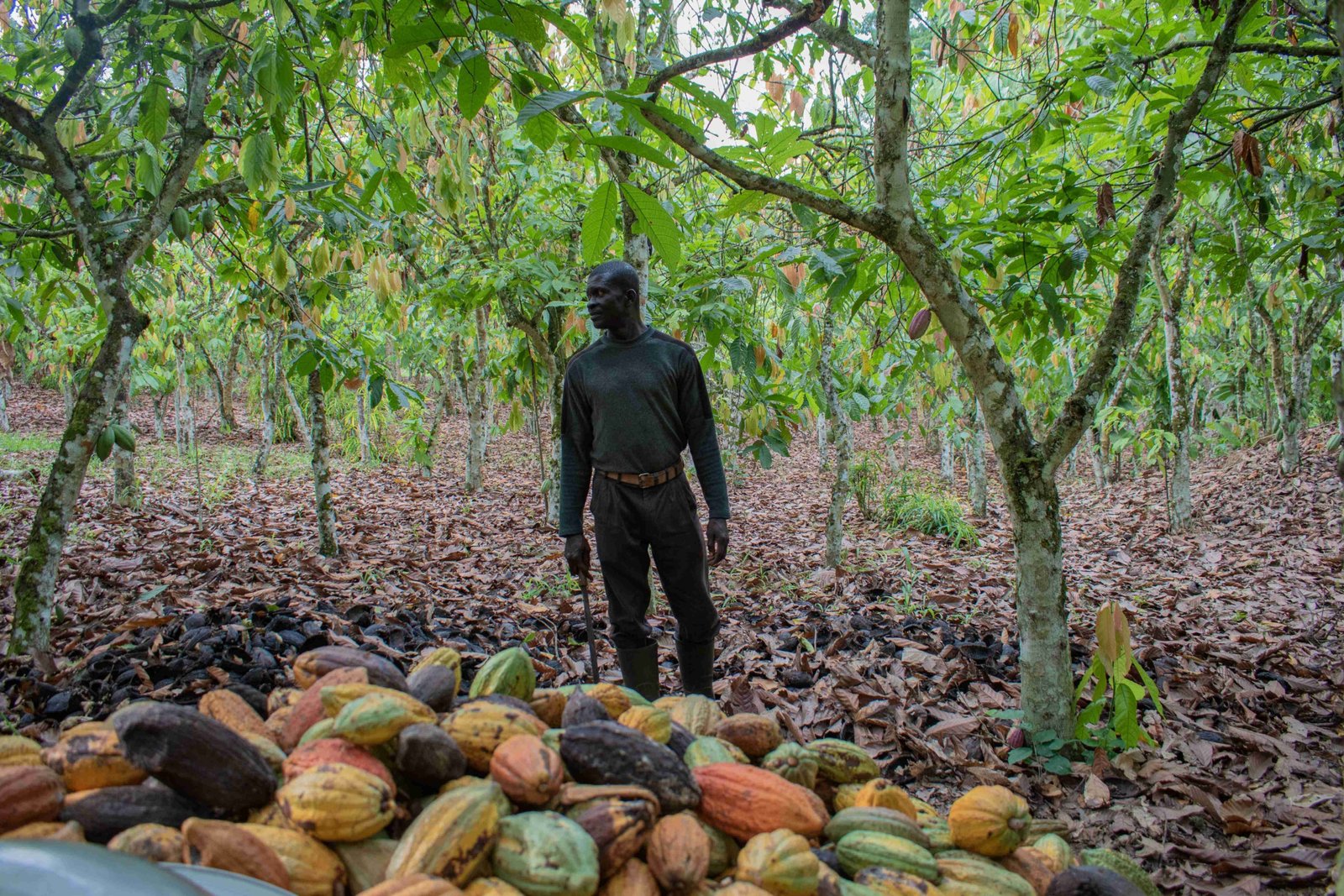
A man tends to his cocoa farm in the New Edubiase district of Ghana. Photo by Delali Adogla-Bessa

Felix Tihby Felix Tih
June 25, 2026
Reading Time: 3 mins read

Ghana, Côte d’Ivoire Deepen Cocoa Price Coordination to Shield Farmers from Market Swings

Leaders say closer coordination on cocoa pricing and marketing will help deliver fairer incomes for farmers while boosting Africa's bargaining power in the global cocoa market

Ghana Battles to Save Cocoa Industry as Production Falls to 20-Year Low

A man tends to his cocoa farm in the New Edubiase district of Ghana. Photo by Delali Adogla-Bessa

Ghana Battles to Save Cocoa Industry as Production Falls to 20-Year Low

A man tends to his cocoa farm in the New Edubiase district of Ghana. Photo by Delali Adogla-Bessa

Felix Tihby Felix Tih
June 25, 2026
Reading Time: 3 mins read

Ghana and Côte d’Ivoire are deepening coordination on cocoa pricing as the world’s two largest producers seek to cushion farmers against volatile global markets, climate pressures and supply disruptions.

The renewed commitment came at the Côte d’Ivoire-Ghana High-Level Summit on the Future of the Cocoa Economy, held in Abidjan on June 16, 2026, where President John Dramani Mahama and his Ivorian counterpart, President Alassane Ouattara, adopted a joint declaration to strengthen cooperation across the cocoa value chain.

The two West African neighbors, which together account for about 60% of global cocoa production, pledged to implement a common framework for determining producer prices and reinforce market intelligence to ensure farmers receive fair and predictable incomes.

At the center of the discussions was the need to safeguard cocoa producers from the unpredictable swings of the international commodities market.

Both leaders reaffirmed their commitment to the Living Income Differential (LID), a pricing mechanism introduced in 2019 that adds a premium to cocoa sales to improve farmers’ earnings.

The two countries hope to discourage cross-border smuggling driven by price differences by harmonizing producer prices and coordinating price announcements, while strengthening their collective influence in negotiations with international buyers.
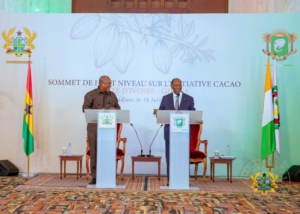
President John Dramani Mahama (L), President Alassane Ouattara (R)

Fair Compensation, Domestic Processing

For both governments, ensuring fair compensation for farmers is increasingly viewed as essential to the long-term sustainability of the cocoa sector.

Mahama and Ouattara stressed that cocoa farmers must remain at the heart of governance in the industry, noting that improving rural livelihoods is critical to maintaining production in a sector facing mounting challenges.

Beyond pricing, the summit highlighted several threats confronting cocoa production, including climate change, aging plantations, crop diseases, and environmental degradation.

The leaders expressed concern over the growing impact of illegal mining on agricultural lands and shared water bodies, describing it as a threat not only to the environment but also to cocoa production.

They agreed to pursue joint strategies to curb illegal mining activities, restore affected ecosystems and protect water resources that support farming communities.

Ghana and Côte d’Ivoire committed to strengthening collaboration between their national research institutions to combat Cocoa Swollen Shoot Virus Disease (CSSVD), one of the most destructive diseases affecting cocoa farms across the region.

The West African giants also reiterated their ambition to move beyond exporting raw cocoa beans by increasing domestic processing capacity and promoting the consumption of finished cocoa products within Africa.

The strategy is intended to enable producer countries to capture a larger share of the global cocoa-chocolate value chain, where Africa currently produces around 80% of the world’s cocoa beans but receives only a fraction of the industry’s total value.

Another notable outcome of the summit was the decision to open the Côte d’Ivoire-Ghana Cocoa Initiative to other African cocoa-producing nations.

Leaders believe a broader alliance could strengthen Africa’s collective bargaining power and improve coordination to address common challenges facing the industry.

Cocoa Production, Consumption and Trade

While Ghana and Côte d’Ivoire dominate global cocoa production, they capture only a small share of the wealth generated by the chocolate industry.

Together, they produce about 60% of the world’s cocoa, while Africa accounts for roughly 80% of global cocoa bean output. Most cocoa beans, however, are exported in raw or semi-processed form and transformed into chocolate in Europe and North America, where much of the value is created.

According to the World Bank, Côte d’Ivoire and Ghana have historically earned only a fraction of the value generated along the global cocoa-chocolate supply chain, with manufacturing, branding and retail concentrated in developed economies.

This imbalance has long limited the economic benefits accruing to producer countries despite their dominant role in supplying the raw material.

Against this backdrop, the two countries see closer cooperation to strengthen their negotiating position, reduce competition between themselves and pursue common policies that increase returns for farmers.

Their latest declaration also commits both governments to expanding domestic cocoa processing, promoting consumption of finished cocoa products within Africa and inviting other African producer countries to join the alliance.

Officials believe a broader coalition could give the continent greater influence over global cocoa trade and help secure a larger share of the industry’s value.

 

Get the inside Story

Stay informed on the stories shaping Africa’s future. Get breaking news, in-depth analysis, opinions and exclusive insights from across the continent delivered to your inbox, free and unfiltered.


Get in touch for more:
Felix Tih
Editorial Director, Bantu Gazette
WhatsApp
LinkedIn
X (Twitter)
Instagram

Related Posts

Intra-African Trade Holds the Key to Fertilizer Access Across the Continent
Agriculture & Trade

Intra-African Trade Holds the Key to Fertilizer Access Across the Continent

June 25, 2026
Côte d’Ivoire Calls for Building a Citizen-Friendly Public Service
Politics & Economy

Côte d’Ivoire Calls for Building a Citizen-Friendly Public Service

June 25, 2026
Prosperity Party Clinches Parliamentary Majority in Ethiopia’s 7th General Election
Politics & Economy

Prosperity Party Clinches Parliamentary Majority in Ethiopia’s 7th General Election

June 24, 2026
Namibia, Tanzania Seek Stronger Economic Ties Built on Liberation-Era Trust
Politics & Economy

Namibia, Tanzania Seek Stronger Economic Ties Built on Liberation-Era Trust

June 24, 2026
Kenya’s President Ruto Takes Africa’s Agenda to G7 Summit in France
Politics & Economy

Kenya’s President Ruto Takes Africa’s Agenda to G7 Summit in France

June 25, 2026
Africa’s Fertilizer Dependence is an Industrial Problem with Industrial Solutions
Agriculture & Trade

Africa’s Fertilizer Dependence is an Industrial Problem with Industrial Solutions

June 18, 2026

Most Recent

Ghana Battles to Save Cocoa Industry as Production Falls to 20-Year Low
Opinion

Ghana, Côte d’Ivoire Deepen Cocoa Price Coordination to Shield Farmers from Market Swings

by Felix Tih
June 25, 2026
0

Ghana and Côte d'Ivoire are deepening coordination on cocoa pricing as the world's two largest producers seek to cushion farmers...

Read moreDetails
Intra-African Trade Holds the Key to Fertilizer Access Across the Continent

Intra-African Trade Holds the Key to Fertilizer Access Across the Continent

June 25, 2026
Côte d’Ivoire Calls for Building a Citizen-Friendly Public Service

Côte d’Ivoire Calls for Building a Citizen-Friendly Public Service

June 25, 2026
Kenyan Fintech WapiPay Secures Canadian License in North American Push

Kenyan Fintech WapiPay Secures Canadian License in North American Push

June 22, 2026
Prosperity Party Clinches Parliamentary Majority in Ethiopia’s 7th General Election

Prosperity Party Clinches Parliamentary Majority in Ethiopia’s 7th General Election

June 24, 2026
Namibia, Tanzania Seek Stronger Economic Ties Built on Liberation-Era Trust

Namibia, Tanzania Seek Stronger Economic Ties Built on Liberation-Era Trust

June 24, 2026
Kenya’s President Ruto Takes Africa’s Agenda to G7 Summit in France

Kenya’s President Ruto Takes Africa’s Agenda to G7 Summit in France

June 25, 2026
Ghana Battles to Save Cocoa Industry as Production Falls to 20-Year Low
Opinion

Ghana, Côte d’Ivoire Deepen Cocoa Price Coordination to Shield Farmers from Market Swings

by Felix Tih
Reading Time: 3 mins read
June 25, 2026
0

Ghana and Côte d'Ivoire are deepening coordination on cocoa pricing as the world's two largest producers seek to cushion farmers...

Read moreDetails
Intra-African Trade Holds the Key to Fertilizer Access Across the Continent
Agriculture & Trade

Intra-African Trade Holds the Key to Fertilizer Access Across the Continent

by Monica Brown
Reading Time: 4 mins read
June 25, 2026
0

Africa's fertilizer strategy depends on regulatory alignment, efficient trade and integrated markets that connect production with farmers across the continent

Read moreDetails
Côte d’Ivoire Calls for Building a Citizen-Friendly Public Service
Politics & Economy

Côte d’Ivoire Calls for Building a Citizen-Friendly Public Service

by Aissatou Fall
Reading Time: 2 mins read
June 25, 2026
0

At the opening of the National Public Service Days, Côte d’Ivoire urged stronger citizen-focused governance through digitalization and service reforms

Read moreDetails

Ghana, Côte d’Ivoire Deepen Cocoa Price Coordination to Shield Farmers from Market Swings

Leaders say closer coordination on cocoa pricing and marketing will help deliver fairer incomes for farmers while boosting Africa's bargaining power in the global cocoa market

Ghana Battles to Save Cocoa Industry as Production Falls to 20-Year Low

A man tends to his cocoa farm in the New Edubiase district of Ghana. Photo by Delali Adogla-Bessa

Ghana and Côte d’Ivoire are deepening coordination on cocoa pricing as the world’s two largest producers seek to cushion farmers against volatile global markets, climate pressures and supply disruptions.

The renewed commitment came at the Côte d’Ivoire-Ghana High-Level Summit on the Future of the Cocoa Economy, held in Abidjan on June 16, 2026, where President John Dramani Mahama and his Ivorian counterpart, President Alassane Ouattara, adopted a joint declaration to strengthen cooperation across the cocoa value chain.

The two West African neighbors, which together account for about 60% of global cocoa production, pledged to implement a common framework for determining producer prices and reinforce market intelligence to ensure farmers receive fair and predictable incomes.

At the center of the discussions was the need to safeguard cocoa producers from the unpredictable swings of the international commodities market.

Both leaders reaffirmed their commitment to the Living Income Differential (LID), a pricing mechanism introduced in 2019 that adds a premium to cocoa sales to improve farmers’ earnings.

The two countries hope to discourage cross-border smuggling driven by price differences by harmonizing producer prices and coordinating price announcements, while strengthening their collective influence in negotiations with international buyers.

President John Dramani Mahama (L), President Alassane Ouattara (R)

Fair Compensation, Domestic Processing

For both governments, ensuring fair compensation for farmers is increasingly viewed as essential to the long-term sustainability of the cocoa sector.

Mahama and Ouattara stressed that cocoa farmers must remain at the heart of governance in the industry, noting that improving rural livelihoods is critical to maintaining production in a sector facing mounting challenges.

Beyond pricing, the summit highlighted several threats confronting cocoa production, including climate change, aging plantations, crop diseases, and environmental degradation.

The leaders expressed concern over the growing impact of illegal mining on agricultural lands and shared water bodies, describing it as a threat not only to the environment but also to cocoa production.

They agreed to pursue joint strategies to curb illegal mining activities, restore affected ecosystems and protect water resources that support farming communities.

Ghana and Côte d’Ivoire committed to strengthening collaboration between their national research institutions to combat Cocoa Swollen Shoot Virus Disease (CSSVD), one of the most destructive diseases affecting cocoa farms across the region.

The West African giants also reiterated their ambition to move beyond exporting raw cocoa beans by increasing domestic processing capacity and promoting the consumption of finished cocoa products within Africa.

The strategy is intended to enable producer countries to capture a larger share of the global cocoa-chocolate value chain, where Africa currently produces around 80% of the world’s cocoa beans but receives only a fraction of the industry’s total value.

Another notable outcome of the summit was the decision to open the Côte d’Ivoire-Ghana Cocoa Initiative to other African cocoa-producing nations.

Leaders believe a broader alliance could strengthen Africa’s collective bargaining power and improve coordination to address common challenges facing the industry.

Cocoa Production, Consumption and Trade

While Ghana and Côte d’Ivoire dominate global cocoa production, they capture only a small share of the wealth generated by the chocolate industry.

Together, they produce about 60% of the world’s cocoa, while Africa accounts for roughly 80% of global cocoa bean output. Most cocoa beans, however, are exported in raw or semi-processed form and transformed into chocolate in Europe and North America, where much of the value is created.

According to the World Bank, Côte d’Ivoire and Ghana have historically earned only a fraction of the value generated along the global cocoa-chocolate supply chain, with manufacturing, branding and retail concentrated in developed economies.

This imbalance has long limited the economic benefits accruing to producer countries despite their dominant role in supplying the raw material.

Against this backdrop, the two countries see closer cooperation to strengthen their negotiating position, reduce competition between themselves and pursue common policies that increase returns for farmers.

Their latest declaration also commits both governments to expanding domestic cocoa processing, promoting consumption of finished cocoa products within Africa and inviting other African producer countries to join the alliance.

Officials believe a broader coalition could give the continent greater influence over global cocoa trade and help secure a larger share of the industry’s value.

 

Ghana, Côte d’Ivoire Deepen Cocoa Price Coordination to Shield Farmers from Market Swings

Leaders say closer coordination on cocoa pricing and marketing will help deliver fairer incomes for farmers while boosting Africa's bargaining power in the global cocoa market

Ghana Battles to Save Cocoa Industry as Production Falls to 20-Year Low

A man tends to his cocoa farm in the New Edubiase district of Ghana. Photo by Delali Adogla-Bessa

Felix Tihby Felix Tih
June 25, 2026

Ghana and Côte d’Ivoire are deepening coordination on cocoa pricing as the world’s two largest producers seek to cushion farmers against volatile global markets, climate pressures and supply disruptions.

The renewed commitment came at the Côte d’Ivoire-Ghana High-Level Summit on the Future of the Cocoa Economy, held in Abidjan on June 16, 2026, where President John Dramani Mahama and his Ivorian counterpart, President Alassane Ouattara, adopted a joint declaration to strengthen cooperation across the cocoa value chain.

The two West African neighbors, which together account for about 60% of global cocoa production, pledged to implement a common framework for determining producer prices and reinforce market intelligence to ensure farmers receive fair and predictable incomes.

At the center of the discussions was the need to safeguard cocoa producers from the unpredictable swings of the international commodities market.

Both leaders reaffirmed their commitment to the Living Income Differential (LID), a pricing mechanism introduced in 2019 that adds a premium to cocoa sales to improve farmers’ earnings.

The two countries hope to discourage cross-border smuggling driven by price differences by harmonizing producer prices and coordinating price announcements, while strengthening their collective influence in negotiations with international buyers.

President John Dramani Mahama (L), President Alassane Ouattara (R)

Fair Compensation, Domestic Processing

For both governments, ensuring fair compensation for farmers is increasingly viewed as essential to the long-term sustainability of the cocoa sector.

Mahama and Ouattara stressed that cocoa farmers must remain at the heart of governance in the industry, noting that improving rural livelihoods is critical to maintaining production in a sector facing mounting challenges.

Beyond pricing, the summit highlighted several threats confronting cocoa production, including climate change, aging plantations, crop diseases, and environmental degradation.

The leaders expressed concern over the growing impact of illegal mining on agricultural lands and shared water bodies, describing it as a threat not only to the environment but also to cocoa production.

They agreed to pursue joint strategies to curb illegal mining activities, restore affected ecosystems and protect water resources that support farming communities.

Ghana and Côte d’Ivoire committed to strengthening collaboration between their national research institutions to combat Cocoa Swollen Shoot Virus Disease (CSSVD), one of the most destructive diseases affecting cocoa farms across the region.

The West African giants also reiterated their ambition to move beyond exporting raw cocoa beans by increasing domestic processing capacity and promoting the consumption of finished cocoa products within Africa.

The strategy is intended to enable producer countries to capture a larger share of the global cocoa-chocolate value chain, where Africa currently produces around 80% of the world’s cocoa beans but receives only a fraction of the industry’s total value.

Another notable outcome of the summit was the decision to open the Côte d’Ivoire-Ghana Cocoa Initiative to other African cocoa-producing nations.

Leaders believe a broader alliance could strengthen Africa’s collective bargaining power and improve coordination to address common challenges facing the industry.

Cocoa Production, Consumption and Trade

While Ghana and Côte d’Ivoire dominate global cocoa production, they capture only a small share of the wealth generated by the chocolate industry.

Together, they produce about 60% of the world’s cocoa, while Africa accounts for roughly 80% of global cocoa bean output. Most cocoa beans, however, are exported in raw or semi-processed form and transformed into chocolate in Europe and North America, where much of the value is created.

According to the World Bank, Côte d’Ivoire and Ghana have historically earned only a fraction of the value generated along the global cocoa-chocolate supply chain, with manufacturing, branding and retail concentrated in developed economies.

This imbalance has long limited the economic benefits accruing to producer countries despite their dominant role in supplying the raw material.

Against this backdrop, the two countries see closer cooperation to strengthen their negotiating position, reduce competition between themselves and pursue common policies that increase returns for farmers.

Their latest declaration also commits both governments to expanding domestic cocoa processing, promoting consumption of finished cocoa products within Africa and inviting other African producer countries to join the alliance.

Officials believe a broader coalition could give the continent greater influence over global cocoa trade and help secure a larger share of the industry’s value.

 

Get the inside Story

Stay informed on the stories shaping Africa’s future. Get breaking news, in-depth analysis, opinions and exclusive insights from across the continent delivered to your inbox, free and unfiltered.


Get in touch for more:
Felix Tih
Editorial Director, Bantu Gazette
WhatsApp
LinkedIn
X (Twitter)
Instagram

Related Posts

Intra-African Trade Holds the Key to Fertilizer Access Across the Continent

Intra-African Trade Holds the Key to Fertilizer Access Across the Continent

by Monica Brown
June 25, 2026
0

...

Côte d’Ivoire Calls for Building a Citizen-Friendly Public Service

Côte d’Ivoire Calls for Building a Citizen-Friendly Public Service

by Aissatou Fall
June 24, 2026
0

...

Prosperity Party Clinches Parliamentary Majority in Ethiopia’s 7th General Election

Prosperity Party Clinches Parliamentary Majority in Ethiopia’s 7th General Election

by Kalkidan Negash
June 22, 2026
0

...

Namibia, Tanzania Seek Stronger Economic Ties Built on Liberation-Era Trust

Namibia, Tanzania Seek Stronger Economic Ties Built on Liberation-Era Trust

by Naledi Kgosi
June 22, 2026
0

...

Kenya’s President Ruto Takes Africa’s Agenda to G7 Summit in France

Kenya’s President Ruto Takes Africa’s Agenda to G7 Summit in France

by Waceke Nganga
June 22, 2026
0

...

Africa’s Fertilizer Dependence is an Industrial Problem with Industrial Solutions

Africa’s Fertilizer Dependence is an Industrial Problem with Industrial Solutions

by Monica Brown
June 15, 2026
0

...

Ghana Battles to Save Cocoa Industry as Production Falls to 20-Year Low
Opinion

Ghana, Côte d’Ivoire Deepen Cocoa Price Coordination to Shield Farmers from Market Swings

by Felix Tih
Reading Time: 3 mins read
June 25, 2026
0

Ghana and Côte d'Ivoire are deepening coordination on cocoa pricing as the world's two largest producers seek to cushion farmers...

Read moreDetails
Intra-African Trade Holds the Key to Fertilizer Access Across the Continent

Intra-African Trade Holds the Key to Fertilizer Access Across the Continent

by Monica Brown
June 25, 2026
0

Africa's fertilizer strategy depends on regulatory alignment, efficient trade and integrated markets that connect production with farmers across the continent

Côte d’Ivoire Calls for Building a Citizen-Friendly Public Service

Côte d’Ivoire Calls for Building a Citizen-Friendly Public Service

by Aissatou Fall
June 24, 2026
0

At the opening of the National Public Service Days, Côte d’Ivoire urged stronger citizen-focused governance through digitalization and service reforms

Kenyan Fintech WapiPay Secures Canadian License in North American Push

Kenyan Fintech WapiPay Secures Canadian License in North American Push

by Waceke Nganga
June 22, 2026
0

NAIROBI WapiPay, a fintech company founded in Nairobi, Kenya, has expanded into North America after receiving a Money Services Business...

Prosperity Party Clinches Parliamentary Majority in Ethiopia’s 7th General Election

Prosperity Party Clinches Parliamentary Majority in Ethiopia’s 7th General Election

by Kalkidan Negash
June 22, 2026
0

ADDIS ABABA Ethiopia’s ruling Prosperity Party (PP) secured another parliamentary majority after winning 438 seats in the House of Peoples’...

Bantu Gazette is a pioneering news platform that champions Africa's development, culture, and heritage. We spotlight the continent's successes, address its challenges, and provide insightful coverage of events that shape its future.

Bantu Gazette is a pioneering news platform that champions Africa's development, culture, and heritage. We spotlight the continent's successes, address its challenges, and provide insightful coverage of events that shape its future.

Our Platforms

  • Bantu Magazine
  • Bantu Brief
  • Black Frame Studio

Our Services

  • Bantu Agency
  • Advertise
  • Partnerships

Our Services

  • Editorial Director
  • Opportunities
  • Contact

Bantu Gazette is a pioneering news platform that champions Africa's development, culture, and heritage. We spotlight the continent's successes, address its challenges, and provide insightful coverage of events that shape its future.

Our Platforms

  • Bantu Magazine
  • Bantu Brief
  • Black Frame Studio

Our Services

  • Bantu Agency
  • Advertise
  • Partnerships

Our Services

  • Editorial Director
  • Opportunities
  • Contact
Bantu Gazette
  • Energy & Trade
  • Finance
  • Health
  • Politics & Economy
  • Technology
  • Environment
  • Feature
  • Opinion
  • Changemakers
  • Tourism & Culture
  • Magazine