
Bantu Gazette

Bantu Gazette
  • Energy & Trade
  • Finance
  • Health
  • Politics & Economy
  • Technology
  • Environment
  • Feature
  • Opinion
  • Changemakers
  • Tourism & Culture
  • Sports
  • Magazine
Menu
  • Black Frame Studio
  • Magazine

Refugee activists at COP29 call for funding and support to withstand climate threats

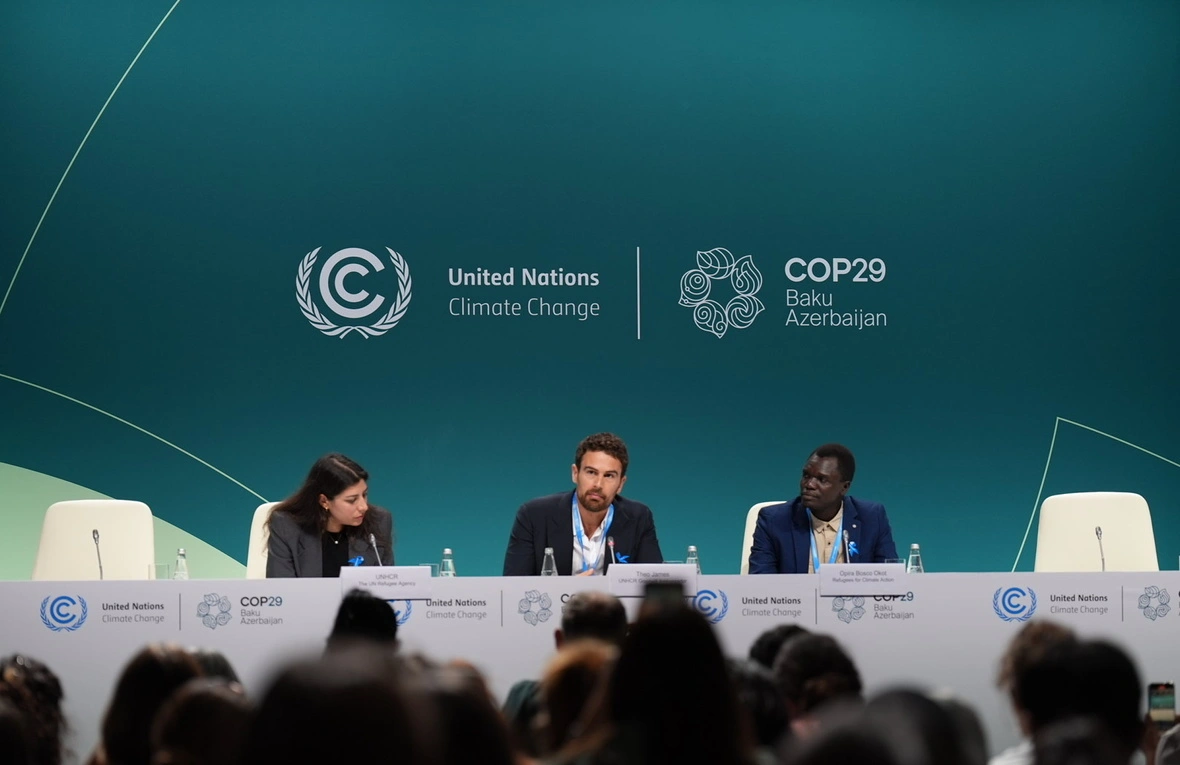
Actor and UNHCR Goodwill Ambassador Theo James (centre) and refugee climate activist Opira Bosco Okot (right) at the launch of the "Refugees for Climate Action" network at COP29 on Thursday.

Actor and UNHCR Goodwill Ambassador Theo James (centre) and refugee climate activist Opira Bosco Okot (right) at the launch of the "Refugees for Climate Action" network at COP29 on Thursday.

Bantu Gazetteby Bantu Gazette
November 21, 2024
Reading Time: 5 mins read

Refugee activists at COP29 call for funding and support to withstand climate threats

Actor and UNHCR Goodwill Ambassador Theo James (centre) and refugee climate activist Opira Bosco Okot (right) at the launch of the "Refugees for Climate Action" network at COP29 on Thursday.

Actor and UNHCR Goodwill Ambassador Theo James (centre) and refugee climate activist Opira Bosco Okot (right) at the launch of the "Refugees for Climate Action" network at COP29 on Thursday.

Actor and UNHCR Goodwill Ambassador Theo James (centre) and refugee climate activist Opira Bosco Okot (right) at the launch of the "Refugees for Climate Action" network at COP29 on Thursday.

Actor and UNHCR Goodwill Ambassador Theo James (centre) and refugee climate activist Opira Bosco Okot (right) at the launch of the "Refugees for Climate Action" network at COP29 on Thursday.

Bantu Gazetteby Bantu Gazette
November 21, 2024
Reading Time: 5 mins read

Forcibly displaced people attending the global climate summit in Azerbaijan have been calling on decision makers to address gaps in climate finance.

Refugees and other forcibly displaced people living on the frontlines of the global climate crisis had a clear message for leaders and delegates attending the COP29 summit in Azerbaijan this week: as the climate crisis makes their lives ever more precarious, they need more funding and support to survive and adapt.

“No matter how hard we try to build the lives we want for ourselves, the fight gets harder with each passing day because of climate change,” said Grace Dorong, a former refugee from South Sudan and founder of the NGO, Root of Generations. 

She listed the multiple hazards her country is facing, including drought and flooding, as well as the conflict in neighbouring Sudan that has driven nearly 850,000 refugees and returnees across the border. She described their plight now “as moving from a frying pan into a fire.”

“Refugees have no escape,” she added. “You flee in one direction; you are met with danger. You flee in another direction; you are met with another danger. The climate crisis is drastically impacting our lives.”

Dorong was addressing delegates at the launch on Tuesday of a new report by UNHCR, the UN Refugee Agency, that explores the complex links between the climate crisis, conflict and forced displacement. Written in collaboration with 13 expert organizations, research institutions and refugee-led groups, it finds that three out of every four of the 123 million people displaced by conflict are also struggling to withstand the devastating and growing effects of climate change. This is because the majority of displaced people are hosted in areas of the world that are highly exposed to climate hazards.

Climate activist and former refugee Grace Dorong at COP29 in Baku, Azerbaijan. © UNHCR:Melik Benkritly

As climate shocks become more extreme, displaced people are increasingly being forced to move again and again, with little hope of being able to return home, as more parts of the world become uninhabitable.

“We see on the ground the human impact on the most vulnerable people of what is being discussed here at COP29,” said UN High Commissioner for Refugees, Filippo Grandi, who also spoke at the report launch. “For people like Grace, this is not theoretical; this is an everyday reality that dramatically impacts their lives.”

Gaps in climate finance

Despite being among those most affected by the impacts of climate change, refugees and host communities in fragile and conflict-affected countries are not being reached by climate financing that could help them adapt. The report notes that 90 per cent of climate finance is going to middle-income, high-emitting countries while only 2 per cent goes to extremely fragile countries.

“This represents a profound injustice,” said Grandi. “It is extremely important that development actors take more risks, making sure that climate action includes the most fragile parts of the world.”

COP29
UN High Commissioner for Refugees Filippo Grandi at COP29 alongside refugee climate activists Opira Bosco Okot (left), and Grace Dorong.

In a positive step towards improving flows of climate finance to displaced communities, UNHCR signed a Memorandum of Understanding (MoU) this week with the Green Climate Fund (GCF), the world’s largest climate fund. The MoU aims to pair UNHCR’s knowledge and expertise working in fragile- and conflict-affected settings with the GCF’s goal of scaling up the delivery of climate finance to developing countries.

On the sidelines of this week’s talks, UNHCR held a joint event with the International Organization for Migration (IOM) about the importance of including refugees and migrants in climate finance decision-making. Opira Bosco Okot, a 28-year-old South Sudanese refugee and climate activist, pointed out that refugee-led organizations are capable of bringing transformative climate responses to their communities, but they need support with capacity building and adaptation.

“There’s been limited climate financing that has reached displaced communities,” he said, adding that of the very few refugee-led organizations that were receiving funding, it was restricted and short-term, affecting their sustainability.

New network of refugee activists

Okot is part of a new coalition of climate-activist refugees and displaced people from across the globe who are joining forces as part of a new coalition – the Refugees for Climate Action – which launched at COP29 on Thursday.

Convened by UNHCR, the group will provide a platform for the urgent messages its members have to share about how the climate crisis is making life even more precarious for those forced to flee. Besides Okot, the network’s eight members include Mohamed Anowar, a young Rohingya refugee from Myanmar living in Bangladesh; Ermano Prévoir, a Haitian refugee and passionate environmental advocate living in Brazil; Eman Al-Hamali, who leads a group of internally displaced women in Yemen running a solar microgrid plant; and Jeanne Muhimundu, a Rwandan climate and environmental activist living in a refugee camp in Zimbabwe.

At the launch on Thursday, Okot was joined by actor and UNHCR Goodwill Ambassador Theo James.

Last month, James travelled with UNHCR to Mauritania, an arid country that has experienced intense climate shocks in recent years, including seasonal floods, crippling droughts and extreme heat. He met refugees who had fled conflict in Mali in recent years and are hosted in Mbera camp in the southeastern Hodh Chargui region.

“They told me about how life is becoming untenable in the desert,” James said at the launch. “They have escaped war, only to fight another battle with the impacts of climate change. They are facing a food crisis, a water crisis, a shelter crisis, and ultimately, a survival crisis.”

Okot and James urged delegates at COP29 to ensure that refugees are included in climate discussions and in climate financing.  

“We stand committed to advocating for the voices that often go unheard and overlooked,” said Okot. “We are standing up for our planet, claiming our place at the table, not just to speak, but to advocate for climate justice.”

By Laura Padoan in Baku, Azerbaijan

Additional reporting by Kristy Siegfried

SOURCE: UNHCR
Get the inside Story

Stay informed on the stories shaping Africa’s future. Get breaking news, in-depth analysis, opinions and exclusive insights from across the continent delivered to your inbox, free and unfiltered.


Get in touch for more:
Felix Tih
Editorial Director, Bantu Gazette
WhatsApp
LinkedIn
X (Twitter)
Instagram

Related Posts

COP29
Environment

Kenya Secures Funds to Protect Reefs, Grow Coastal Economy

January 9, 2026
COP29
Environment

Kenya Appoints Young Tree Activist as Conservation Envoy

December 16, 2025
COP29
Environment

Ethiopia to Host COP 32 After Securing African Support in Belém

November 14, 2025
COP29
Environment

South Africa Adds 130,000 Construction Jobs in Sector Rebound

November 14, 2025
COP29
Environment

Rwanda Kicks Off National Tree-Planting Season

October 25, 2025
COP29
Environment

Nigeria’s Lagos Unveils €410M Waterways Project

October 22, 2025

Most Recent

COP29
Energy & Trade

Rwanda Coffee Export Earnings Reach Record $150 Million in 2025

by Jane Mukami
January 16, 2026
0

Rwanda’s coffee industry posted its strongest year on record in 2025, with export revenues reaching nearly $150 million, according to...

Read moreDetails
COP29

Africa Cup of Nations in Morocco Sets Record With 90% Revenue Increase

January 16, 2026
COP29

Morocco’s Long-Term Planning Shapes Africa Cup of Nations 2025

January 16, 2026
COP29

West Africa Records First Social Bond Listing on Luxembourg Green Exchange

January 15, 2026
COP29

Italian Journalists Admire Morocco’s World-Class Stadiums

January 14, 2026
COP29

Africa’s Growth Future Lies in Value-Added Trade, WTO Chief Says

January 14, 2026
COP29

Nigeria, UAE Agree to Eliminate Tariffs on Over 7,000 Products

January 13, 2026
COP29
COP29
Energy & Trade

Rwanda Coffee Export Earnings Reach Record $150 Million in 2025

by Jane Mukami
Reading Time: 1 min read
January 16, 2026
0

Rwanda’s coffee industry posted its strongest year on record in 2025, with export revenues reaching nearly $150 million, according to...

Read moreDetails
COP29
Sports

Africa Cup of Nations in Morocco Sets Record With 90% Revenue Increase

by Elise Ntebah
Reading Time: 1 min read
January 16, 2026
0

The TotalEnergies Africa Cup of Nations Morocco 2025 has delivered the largest commercial return in the history of the tournament,...

Read moreDetails
COP29
Sports

Morocco’s Long-Term Planning Shapes Africa Cup of Nations 2025

by Felix Tih
Reading Time: 2 mins read
January 16, 2026
0

Morocco began planning the infrastructure and operational framework for the 2025 Africa Cup of Nations more than four years before...

Read moreDetails

Refugee activists at COP29 call for funding and support to withstand climate threats

Actor and UNHCR Goodwill Ambassador Theo James (centre) and refugee climate activist Opira Bosco Okot (right) at the launch of the "Refugees for Climate Action" network at COP29 on Thursday.

Actor and UNHCR Goodwill Ambassador Theo James (centre) and refugee climate activist Opira Bosco Okot (right) at the launch of the "Refugees for Climate Action" network at COP29 on Thursday.

Forcibly displaced people attending the global climate summit in Azerbaijan have been calling on decision makers to address gaps in climate finance.

Refugees and other forcibly displaced people living on the frontlines of the global climate crisis had a clear message for leaders and delegates attending the COP29 summit in Azerbaijan this week: as the climate crisis makes their lives ever more precarious, they need more funding and support to survive and adapt.

“No matter how hard we try to build the lives we want for ourselves, the fight gets harder with each passing day because of climate change,” said Grace Dorong, a former refugee from South Sudan and founder of the NGO, Root of Generations. 

She listed the multiple hazards her country is facing, including drought and flooding, as well as the conflict in neighbouring Sudan that has driven nearly 850,000 refugees and returnees across the border. She described their plight now “as moving from a frying pan into a fire.”

“Refugees have no escape,” she added. “You flee in one direction; you are met with danger. You flee in another direction; you are met with another danger. The climate crisis is drastically impacting our lives.”

Dorong was addressing delegates at the launch on Tuesday of a new report by UNHCR, the UN Refugee Agency, that explores the complex links between the climate crisis, conflict and forced displacement. Written in collaboration with 13 expert organizations, research institutions and refugee-led groups, it finds that three out of every four of the 123 million people displaced by conflict are also struggling to withstand the devastating and growing effects of climate change. This is because the majority of displaced people are hosted in areas of the world that are highly exposed to climate hazards.

Climate activist and former refugee Grace Dorong at COP29 in Baku, Azerbaijan. © UNHCR:Melik Benkritly

As climate shocks become more extreme, displaced people are increasingly being forced to move again and again, with little hope of being able to return home, as more parts of the world become uninhabitable.

“We see on the ground the human impact on the most vulnerable people of what is being discussed here at COP29,” said UN High Commissioner for Refugees, Filippo Grandi, who also spoke at the report launch. “For people like Grace, this is not theoretical; this is an everyday reality that dramatically impacts their lives.”

Gaps in climate finance

Despite being among those most affected by the impacts of climate change, refugees and host communities in fragile and conflict-affected countries are not being reached by climate financing that could help them adapt. The report notes that 90 per cent of climate finance is going to middle-income, high-emitting countries while only 2 per cent goes to extremely fragile countries.

“This represents a profound injustice,” said Grandi. “It is extremely important that development actors take more risks, making sure that climate action includes the most fragile parts of the world.”

COP29
UN High Commissioner for Refugees Filippo Grandi at COP29 alongside refugee climate activists Opira Bosco Okot (left), and Grace Dorong.

In a positive step towards improving flows of climate finance to displaced communities, UNHCR signed a Memorandum of Understanding (MoU) this week with the Green Climate Fund (GCF), the world’s largest climate fund. The MoU aims to pair UNHCR’s knowledge and expertise working in fragile- and conflict-affected settings with the GCF’s goal of scaling up the delivery of climate finance to developing countries.

On the sidelines of this week’s talks, UNHCR held a joint event with the International Organization for Migration (IOM) about the importance of including refugees and migrants in climate finance decision-making. Opira Bosco Okot, a 28-year-old South Sudanese refugee and climate activist, pointed out that refugee-led organizations are capable of bringing transformative climate responses to their communities, but they need support with capacity building and adaptation.

“There’s been limited climate financing that has reached displaced communities,” he said, adding that of the very few refugee-led organizations that were receiving funding, it was restricted and short-term, affecting their sustainability.

New network of refugee activists

Okot is part of a new coalition of climate-activist refugees and displaced people from across the globe who are joining forces as part of a new coalition – the Refugees for Climate Action – which launched at COP29 on Thursday.

Convened by UNHCR, the group will provide a platform for the urgent messages its members have to share about how the climate crisis is making life even more precarious for those forced to flee. Besides Okot, the network’s eight members include Mohamed Anowar, a young Rohingya refugee from Myanmar living in Bangladesh; Ermano Prévoir, a Haitian refugee and passionate environmental advocate living in Brazil; Eman Al-Hamali, who leads a group of internally displaced women in Yemen running a solar microgrid plant; and Jeanne Muhimundu, a Rwandan climate and environmental activist living in a refugee camp in Zimbabwe.

At the launch on Thursday, Okot was joined by actor and UNHCR Goodwill Ambassador Theo James.

Last month, James travelled with UNHCR to Mauritania, an arid country that has experienced intense climate shocks in recent years, including seasonal floods, crippling droughts and extreme heat. He met refugees who had fled conflict in Mali in recent years and are hosted in Mbera camp in the southeastern Hodh Chargui region.

“They told me about how life is becoming untenable in the desert,” James said at the launch. “They have escaped war, only to fight another battle with the impacts of climate change. They are facing a food crisis, a water crisis, a shelter crisis, and ultimately, a survival crisis.”

Okot and James urged delegates at COP29 to ensure that refugees are included in climate discussions and in climate financing.  

“We stand committed to advocating for the voices that often go unheard and overlooked,” said Okot. “We are standing up for our planet, claiming our place at the table, not just to speak, but to advocate for climate justice.”

By Laura Padoan in Baku, Azerbaijan

Additional reporting by Kristy Siegfried

SOURCE: UNHCR
Refugee activists at COP29 call for funding and support to withstand climate threats

Actor and UNHCR Goodwill Ambassador Theo James (centre) and refugee climate activist Opira Bosco Okot (right) at the launch of the "Refugees for Climate Action" network at COP29 on Thursday.

Actor and UNHCR Goodwill Ambassador Theo James (centre) and refugee climate activist Opira Bosco Okot (right) at the launch of the "Refugees for Climate Action" network at COP29 on Thursday.

Bantu Gazetteby Bantu Gazette
November 21, 2024

Forcibly displaced people attending the global climate summit in Azerbaijan have been calling on decision makers to address gaps in climate finance.

Refugees and other forcibly displaced people living on the frontlines of the global climate crisis had a clear message for leaders and delegates attending the COP29 summit in Azerbaijan this week: as the climate crisis makes their lives ever more precarious, they need more funding and support to survive and adapt.

“No matter how hard we try to build the lives we want for ourselves, the fight gets harder with each passing day because of climate change,” said Grace Dorong, a former refugee from South Sudan and founder of the NGO, Root of Generations. 

She listed the multiple hazards her country is facing, including drought and flooding, as well as the conflict in neighbouring Sudan that has driven nearly 850,000 refugees and returnees across the border. She described their plight now “as moving from a frying pan into a fire.”

“Refugees have no escape,” she added. “You flee in one direction; you are met with danger. You flee in another direction; you are met with another danger. The climate crisis is drastically impacting our lives.”

Dorong was addressing delegates at the launch on Tuesday of a new report by UNHCR, the UN Refugee Agency, that explores the complex links between the climate crisis, conflict and forced displacement. Written in collaboration with 13 expert organizations, research institutions and refugee-led groups, it finds that three out of every four of the 123 million people displaced by conflict are also struggling to withstand the devastating and growing effects of climate change. This is because the majority of displaced people are hosted in areas of the world that are highly exposed to climate hazards.

Climate activist and former refugee Grace Dorong at COP29 in Baku, Azerbaijan. © UNHCR:Melik Benkritly

As climate shocks become more extreme, displaced people are increasingly being forced to move again and again, with little hope of being able to return home, as more parts of the world become uninhabitable.

“We see on the ground the human impact on the most vulnerable people of what is being discussed here at COP29,” said UN High Commissioner for Refugees, Filippo Grandi, who also spoke at the report launch. “For people like Grace, this is not theoretical; this is an everyday reality that dramatically impacts their lives.”

Gaps in climate finance

Despite being among those most affected by the impacts of climate change, refugees and host communities in fragile and conflict-affected countries are not being reached by climate financing that could help them adapt. The report notes that 90 per cent of climate finance is going to middle-income, high-emitting countries while only 2 per cent goes to extremely fragile countries.

“This represents a profound injustice,” said Grandi. “It is extremely important that development actors take more risks, making sure that climate action includes the most fragile parts of the world.”

COP29
UN High Commissioner for Refugees Filippo Grandi at COP29 alongside refugee climate activists Opira Bosco Okot (left), and Grace Dorong.

In a positive step towards improving flows of climate finance to displaced communities, UNHCR signed a Memorandum of Understanding (MoU) this week with the Green Climate Fund (GCF), the world’s largest climate fund. The MoU aims to pair UNHCR’s knowledge and expertise working in fragile- and conflict-affected settings with the GCF’s goal of scaling up the delivery of climate finance to developing countries.

On the sidelines of this week’s talks, UNHCR held a joint event with the International Organization for Migration (IOM) about the importance of including refugees and migrants in climate finance decision-making. Opira Bosco Okot, a 28-year-old South Sudanese refugee and climate activist, pointed out that refugee-led organizations are capable of bringing transformative climate responses to their communities, but they need support with capacity building and adaptation.

“There’s been limited climate financing that has reached displaced communities,” he said, adding that of the very few refugee-led organizations that were receiving funding, it was restricted and short-term, affecting their sustainability.

New network of refugee activists

Okot is part of a new coalition of climate-activist refugees and displaced people from across the globe who are joining forces as part of a new coalition – the Refugees for Climate Action – which launched at COP29 on Thursday.

Convened by UNHCR, the group will provide a platform for the urgent messages its members have to share about how the climate crisis is making life even more precarious for those forced to flee. Besides Okot, the network’s eight members include Mohamed Anowar, a young Rohingya refugee from Myanmar living in Bangladesh; Ermano Prévoir, a Haitian refugee and passionate environmental advocate living in Brazil; Eman Al-Hamali, who leads a group of internally displaced women in Yemen running a solar microgrid plant; and Jeanne Muhimundu, a Rwandan climate and environmental activist living in a refugee camp in Zimbabwe.

At the launch on Thursday, Okot was joined by actor and UNHCR Goodwill Ambassador Theo James.

Last month, James travelled with UNHCR to Mauritania, an arid country that has experienced intense climate shocks in recent years, including seasonal floods, crippling droughts and extreme heat. He met refugees who had fled conflict in Mali in recent years and are hosted in Mbera camp in the southeastern Hodh Chargui region.

“They told me about how life is becoming untenable in the desert,” James said at the launch. “They have escaped war, only to fight another battle with the impacts of climate change. They are facing a food crisis, a water crisis, a shelter crisis, and ultimately, a survival crisis.”

Okot and James urged delegates at COP29 to ensure that refugees are included in climate discussions and in climate financing.  

“We stand committed to advocating for the voices that often go unheard and overlooked,” said Okot. “We are standing up for our planet, claiming our place at the table, not just to speak, but to advocate for climate justice.”

By Laura Padoan in Baku, Azerbaijan

Additional reporting by Kristy Siegfried

SOURCE: UNHCR
Get the inside Story

Stay informed on the stories shaping Africa’s future. Get breaking news, in-depth analysis, opinions and exclusive insights from across the continent delivered to your inbox, free and unfiltered.


Get in touch for more:
Felix Tih
Editorial Director, Bantu Gazette
WhatsApp
LinkedIn
X (Twitter)
Instagram

Related Posts

COP29

Kenya Secures Funds to Protect Reefs, Grow Coastal Economy

by Jane Mukami
January 9, 2026
0

...

COP29

Kenya Appoints Young Tree Activist as Conservation Envoy

by Jane Mukami
December 16, 2025
0

...

COP29

Ethiopia to Host COP 32 After Securing African Support in Belém

by Maraki Desta
November 14, 2025
0

...

COP29

South Africa Adds 130,000 Construction Jobs in Sector Rebound

by Naledi Kgosi
November 13, 2025
0

...

COP29

Rwanda Kicks Off National Tree-Planting Season

by Jane Mukami
October 25, 2025
0

...

COP29

Nigeria’s Lagos Unveils €410M Waterways Project

by Cynthia N. Ganchok
October 19, 2025
0

...

COP29
Energy & Trade

Rwanda Coffee Export Earnings Reach Record $150 Million in 2025

by Jane Mukami
Reading Time: 1 min read
January 16, 2026
0

Rwanda’s coffee industry posted its strongest year on record in 2025, with export revenues reaching nearly $150 million, according to...

Read moreDetails
COP29

Africa Cup of Nations in Morocco Sets Record With 90% Revenue Increase

by Elise Ntebah
January 16, 2026
0

The TotalEnergies Africa Cup of Nations Morocco 2025 has delivered the largest commercial return in the history of the tournament,...

COP29

Morocco’s Long-Term Planning Shapes Africa Cup of Nations 2025

by Felix Tih
January 16, 2026
0

Morocco began planning the infrastructure and operational framework for the 2025 Africa Cup of Nations more than four years before...

COP29

West Africa Records First Social Bond Listing on Luxembourg Green Exchange

by Aissatou Fall
January 15, 2026
0

The West African Economic and Monetary Union (UEMOA) reached a milestone in sustainable finance as its regional mortgage refinancing institution...

COP29

Italian Journalists Admire Morocco’s World-Class Stadiums

by Nora Tabe
January 14, 2026
0

Italian journalists have expressed strong admiration for the level of organization and infrastructure provided by Morocco during the Africa Cup...

Next Post
Stepping Up Response to Curb Infectious Diseases in Nigeria

Stepping Up Response to Curb Infectious Diseases in Nigeria

Hunger Crisis Deepens in the Democratic Republic of Congo

Urgent Call for Action to Combat Antimicrobial Resistance in Africa

Ethiopian PM Welcomes Major Gold Mining Investment in Gambela

Bantu Gazette is a pioneering news platform that champions Africa's development, culture, and heritage. We spotlight the continent's successes, address its challenges, and provide insightful coverage of events that shape its future.

Bantu Gazette is a pioneering news platform that champions Africa's development, culture, and heritage. We spotlight the continent's successes, address its challenges, and provide insightful coverage of events that shape its future.

Our Platforms

  • Bantu Magazine
  • Bantu Brief
  • Black Frame Studio

Our Services

  • Bantu Agency
  • Advertise
  • Partnerships

Our Services

  • Editorial Director
  • Opportunities
  • Contact

Bantu Gazette is a pioneering news platform that champions Africa's development, culture, and heritage. We spotlight the continent's successes, address its challenges, and provide insightful coverage of events that shape its future.

Our Platforms

  • Bantu Magazine
  • Bantu Brief
  • Black Frame Studio

Our Services

  • Bantu Agency
  • Advertise
  • Partnerships

Our Services

  • Editorial Director
  • Opportunities
  • Contact
Bantu Gazette
  • Energy & Trade
  • Finance
  • Health
  • Politics & Economy
  • Technology
  • Environment
  • Feature
  • Opinion
  • Changemakers
  • Tourism & Culture
  • Magazine