
Bantu Gazette

Bantu Gazette
  • Energy & Trade
  • Finance
  • Health
  • Politics & Economy
  • Technology
  • Environment
  • Feature
  • Opinion
  • Changemakers
  • Tourism & Culture
  • Sports
  • Magazine
Menu
  • Black Frame Studio
  • Magazine

Prof. Mamadou Diouf Calls for Africa to Reclaim It’s History, Erase Colonial Narratives

Bantu Gazetteby Bantu Gazette
December 2, 2024
Reading Time: 4 mins read

Prof. Mamadou Diouf Calls for Africa to Reclaim It’s History, Erase Colonial Narratives

Bantu Gazetteby Bantu Gazette
December 2, 2024
Reading Time: 4 mins read

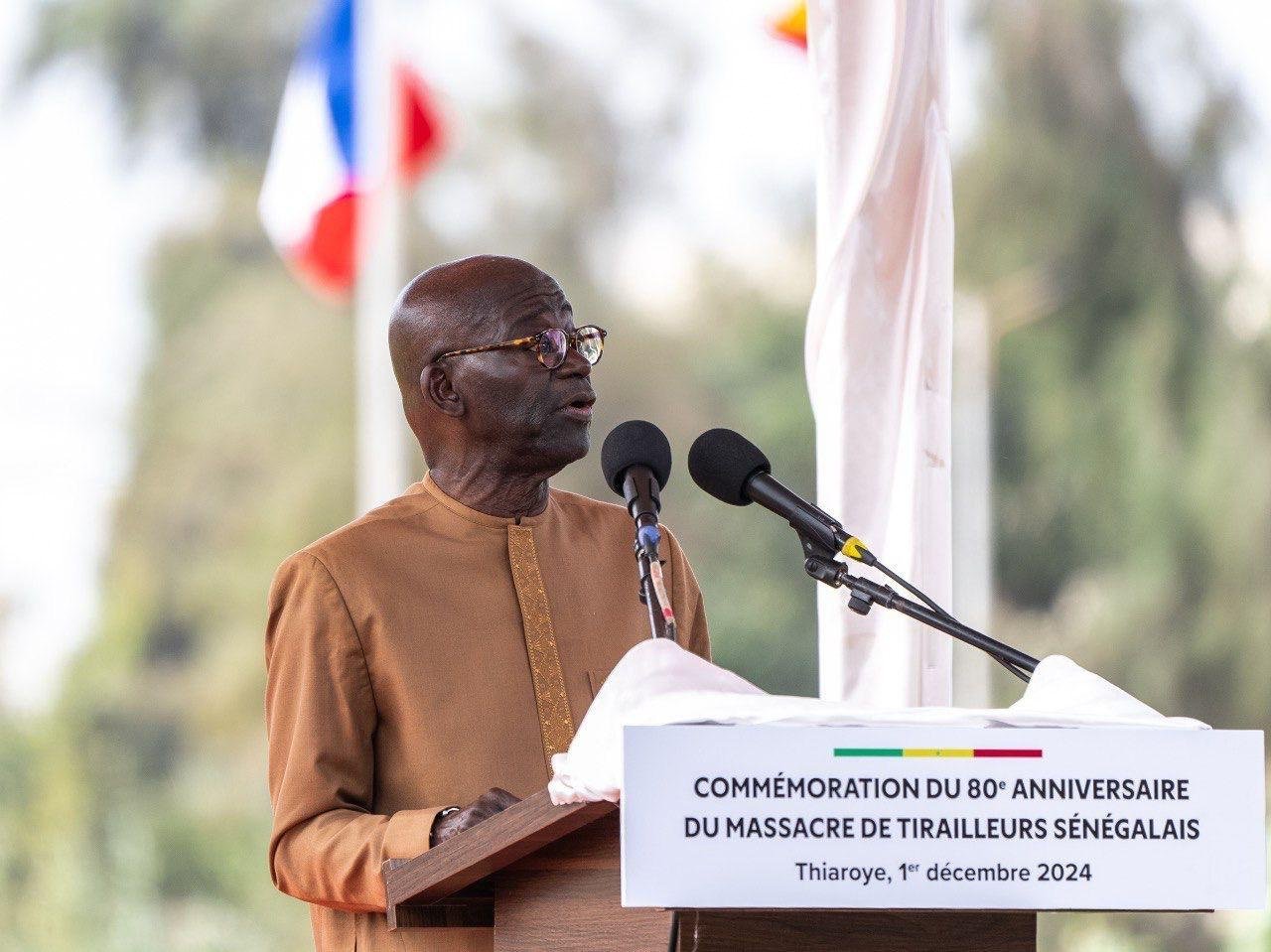
DAKAR, Senegal (BG) – The 80th anniversary of the Thiaroye massacre was marked by a poignant ceremony under the coordination of Professor Mamadou Diouf, President of the Committee for the Commemoration of the massacre, who emphasized the enduring significance of this tragic event.

On Dec. 1, 1944, hundreds of Senegalese Tirailleurs were killed at dawn by French colonial troops. The soldiers who had fought valiantly for France during World War II, were demanding the wages and benefits promised for their service, only to face brutal repression instead.

Diouf is the Leitner Family Professor of African Studies and the Director of Columbia University’s Institute for African Studies. He holds a Ph.D. from the University of Paris-Sorbonne.

In his address on Sunday during the commemoration, the Senegalese Historian invoked the symbolism of Thiaroye, emphasizing that the men who died there were not only soldiers but also martyrs for Africa, embodying the Pan-African spirit.

He noted, “Thiaroye is, for us Senegalese, the occasion, as dramatic as it is majestic, to grant the victims of the massacre the status of ‘martyrs for Africa’ and for the Pan-African spirit.”

The soldiers came from all across French colonial territories in Africa, reflecting the diversity of African peoples and their common struggle against colonial oppression.

The massacre, as Diouf explained, occurred amidst the celebration of liberation in Europe.

It revealed a stark paradox—while Europe celebrated freedom, African soldiers who fought for that freedom were met with violence when they demanded their due.

“The Thiaroye massacre brutally shattered the dreams of emancipation nurtured by the propaganda of France’s liberators,” the historian said.

He further emphasized the systematic cover-up that followed the massacre, as French colonial authorities falsified records and manipulated information to downplay the true scale of the tragedy. “The French authorities did everything to hide ‘the carnage and slaughter,’” Diouf remarked.

A Call to Reclaim the Narrative

He called for a reclamation of the narrative around Thiaroye, stating that it is time for Africa to tell its own story.

“Taking the initiative in producing the narrative about this moment in our history is to return the event to Africa, erasing colonial territorialization, and allowing a memorial representation commanded by Africans, beyond French fields of honor.”

The call to action was aimed at ensuring that the tragedy of Thiaroye becomes part of Africa’s collective consciousness, not just as a colonial atrocity but as a moment of Pan-African unity and resistance.

The commemoration was also seen as a rupture from past approaches, where previous regimes maintained a complicit silence regarding the massacre. Under the leadership of President Bassirou Diomaye Faye and Prime Minister Ousmane Sonko, the government has sought to break the silence.

President Faye reaffirmed the importance of historical truth and justice. “This commemoration is more than just remembering a tragic event; it is a collective oath to honor the dignity of those who fought and fell for the values of freedom, justice, and humanity,” Faye said.

The establishment of the Committee for the Commemoration was a significant step toward recognizing the historical injustice and ensuring that the voices of the victims are finally heard.

Building a Pan-African Legacy

The ceremony also highlighted the cultural and educational aspects of remembering Thiaroye.

The Senegalese historian emphasized the importance of incorporating the lessons of Thiaroye into civic, cultural, and artistic programs to serve the Pan-African community.

This is part of an ongoing effort to transform the memory of Thiaroye into a “shared history that nourishes a pedagogy to build the foundations of African integration.”

According to him, the tragedy is a national memory for Senegal and a collective memory for all African nations that suffered under colonial rule.

The Thiaroye massacre was a grim reminder of the costs of colonial arrogance and the struggle for African dignity.

The commemorative ceremony was a powerful testament to the resilience of the Pan-African spirit and a commitment to ensuring that the sacrifices of the Tirailleurs are never forgotten.

Diouf, an African History Scholar and Advocate for Justice

As he concluded, the legacy of Thiaroye must live on, not only as a tragic reminder of the past but also as an inspiration for the future—a future where unity, justice, and recognition for African sacrifices are central to the continent’s path forward.

Diouf was born in Rufisque, a city in the Dakar region of western Senegal, in 1951.

Before joining the faculty at Columbia University, he was the Charles D. Moody Jr. Collegiate Professor of History and African American Studies at the University of Michigan, from 2000 to 2007. Before that, he was Head of the Research, Information, and Documentation Department of the Council for the Development of Social Science Research in Africa (CODESRIA) and faculty member of the History Department of Cheikh Anta Diop University in Dakar, Senegal.

His research interests include urban, political, social and intellectual history in colonial and postcolonial Africa.

Diouf is a member of the editorial board of several professional journals including the Journal of African History (Cambridge), Psychopathologie Africaine(Dakar), la vie des idées.fr (Paris), Public Culture, and a co-editor (with Peter Geschiere) of the book series, Histoires du Sud/Histories of the South published by Karthala, Paris and New National Histories in Africa published by Palgrave MacMillan.

Get the inside Story

Stay informed on the stories shaping Africa’s future. Get breaking news, in-depth analysis, opinions and exclusive insights from across the continent delivered to your inbox, free and unfiltered.


Get in touch for more:
Felix Tih
Editorial Director, Bantu Gazette
WhatsApp
LinkedIn
X (Twitter)
Instagram

Related Posts

World-Class Port Operator Pledges $600 Million Investment in Nigeria
Politics & Economy

World-Class Port Operator Pledges $600 Million Investment in Nigeria

May 17, 2026
Ethiopia Export Earnings Surge to $8.7 Billion in Ten Months
Politics & Economy

Ethiopia Export Earnings Surge to $8.7 Billion in Ten Months

May 17, 2026
South Africa Allocates $1.7 Billion to Road Agency for Network Expansion
Politics & Economy

South Africa Allocates $1.7 Billion to Road Agency for Network Expansion

May 13, 2026
Kenya, Tanzania Agree to Scrap Non-Tariff Barriers to Boost Trade
Politics & Economy

Kenya, Tanzania Agree to Scrap Non-Tariff Barriers to Boost Trade

May 9, 2026
Damang Mine Delivers First 110 Kilograms of Gold to Ghana’s National Reserves
Politics & Economy

Damang Mine Delivers First 110 Kilograms of Gold to Ghana’s National Reserves

May 8, 2026
African Governments Adopt Declaration Calling for Urgent Action on Sustainable Development
Politics & Economy

African Governments Adopt Declaration Calling for Urgent Action on Sustainable Development

May 9, 2026

Most Recent

AI Expansion Targets Health and Education Systems in Rwanda
Technology

West Africa Bloc Turns to Artificial Intelligence for Digital Skills, Innovation

by Aissatou Fall
May 18, 2026
0

LOMÉ, Togo The Economic Community of West African States (ECOWAS) urged policymakers to prioritize digital skills and artificial intelligence alongside...

Read moreDetails
World-Class Port Operator Pledges $600 Million Investment in Nigeria

World-Class Port Operator Pledges $600 Million Investment in Nigeria

May 17, 2026
‘Never Miss an Opportunity to Tell Your Story’

‘Never Miss an Opportunity to Tell Your Story’

May 17, 2026
Rwanda Highlights Skills Development in Creative Economy Strategy

Rwanda Highlights Skills Development in Creative Economy Strategy

May 16, 2026
Ethiopia Export Earnings Surge to $8.7 Billion in Ten Months

Ethiopia Export Earnings Surge to $8.7 Billion in Ten Months

May 17, 2026
Liberia to Build its 1st Electrical Manufacturing Plant in $26M Deal with Kenyan Firm

Liberia to Build its 1st Electrical Manufacturing Plant in $26M Deal with Kenyan Firm

May 17, 2026
South Africa Allocates $1.7 Billion to Road Agency for Network Expansion

South Africa Allocates $1.7 Billion to Road Agency for Network Expansion

May 13, 2026
AI Expansion Targets Health and Education Systems in Rwanda
Technology

West Africa Bloc Turns to Artificial Intelligence for Digital Skills, Innovation

by Aissatou Fall
Reading Time: 1 min read
May 18, 2026
0

LOMÉ, Togo The Economic Community of West African States (ECOWAS) urged policymakers to prioritize digital skills and artificial intelligence alongside...

Read moreDetails
World-Class Port Operator Pledges $600 Million Investment in Nigeria
Politics & Economy

World-Class Port Operator Pledges $600 Million Investment in Nigeria

by Marina Bisse
Reading Time: 2 mins read
May 17, 2026
0

Investment to support Apapa port modernization following talks at Africa CEO Forum in Kigali

Read moreDetails
‘Never Miss an Opportunity to Tell Your Story’
Tourism & Culture

‘Never Miss an Opportunity to Tell Your Story’

by Bukelwa Maphanga
Reading Time: 5 mins read
May 17, 2026
0

Togolese author and Pan-Africanist Farouk Mintoiba uses literature, language and community leadership to reshape narratives about Africa

Read moreDetails

Prof. Mamadou Diouf Calls for Africa to Reclaim It’s History, Erase Colonial Narratives

DAKAR, Senegal (BG) – The 80th anniversary of the Thiaroye massacre was marked by a poignant ceremony under the coordination of Professor Mamadou Diouf, President of the Committee for the Commemoration of the massacre, who emphasized the enduring significance of this tragic event.

On Dec. 1, 1944, hundreds of Senegalese Tirailleurs were killed at dawn by French colonial troops. The soldiers who had fought valiantly for France during World War II, were demanding the wages and benefits promised for their service, only to face brutal repression instead.

Diouf is the Leitner Family Professor of African Studies and the Director of Columbia University’s Institute for African Studies. He holds a Ph.D. from the University of Paris-Sorbonne.

In his address on Sunday during the commemoration, the Senegalese Historian invoked the symbolism of Thiaroye, emphasizing that the men who died there were not only soldiers but also martyrs for Africa, embodying the Pan-African spirit.

He noted, “Thiaroye is, for us Senegalese, the occasion, as dramatic as it is majestic, to grant the victims of the massacre the status of ‘martyrs for Africa’ and for the Pan-African spirit.”

The soldiers came from all across French colonial territories in Africa, reflecting the diversity of African peoples and their common struggle against colonial oppression.

The massacre, as Diouf explained, occurred amidst the celebration of liberation in Europe.

It revealed a stark paradox—while Europe celebrated freedom, African soldiers who fought for that freedom were met with violence when they demanded their due.

“The Thiaroye massacre brutally shattered the dreams of emancipation nurtured by the propaganda of France’s liberators,” the historian said.

He further emphasized the systematic cover-up that followed the massacre, as French colonial authorities falsified records and manipulated information to downplay the true scale of the tragedy. “The French authorities did everything to hide ‘the carnage and slaughter,’” Diouf remarked.

A Call to Reclaim the Narrative

He called for a reclamation of the narrative around Thiaroye, stating that it is time for Africa to tell its own story.

“Taking the initiative in producing the narrative about this moment in our history is to return the event to Africa, erasing colonial territorialization, and allowing a memorial representation commanded by Africans, beyond French fields of honor.”

The call to action was aimed at ensuring that the tragedy of Thiaroye becomes part of Africa’s collective consciousness, not just as a colonial atrocity but as a moment of Pan-African unity and resistance.

The commemoration was also seen as a rupture from past approaches, where previous regimes maintained a complicit silence regarding the massacre. Under the leadership of President Bassirou Diomaye Faye and Prime Minister Ousmane Sonko, the government has sought to break the silence.

President Faye reaffirmed the importance of historical truth and justice. “This commemoration is more than just remembering a tragic event; it is a collective oath to honor the dignity of those who fought and fell for the values of freedom, justice, and humanity,” Faye said.

The establishment of the Committee for the Commemoration was a significant step toward recognizing the historical injustice and ensuring that the voices of the victims are finally heard.

Building a Pan-African Legacy

The ceremony also highlighted the cultural and educational aspects of remembering Thiaroye.

The Senegalese historian emphasized the importance of incorporating the lessons of Thiaroye into civic, cultural, and artistic programs to serve the Pan-African community.

This is part of an ongoing effort to transform the memory of Thiaroye into a “shared history that nourishes a pedagogy to build the foundations of African integration.”

According to him, the tragedy is a national memory for Senegal and a collective memory for all African nations that suffered under colonial rule.

The Thiaroye massacre was a grim reminder of the costs of colonial arrogance and the struggle for African dignity.

The commemorative ceremony was a powerful testament to the resilience of the Pan-African spirit and a commitment to ensuring that the sacrifices of the Tirailleurs are never forgotten.

Diouf, an African History Scholar and Advocate for Justice

As he concluded, the legacy of Thiaroye must live on, not only as a tragic reminder of the past but also as an inspiration for the future—a future where unity, justice, and recognition for African sacrifices are central to the continent’s path forward.

Diouf was born in Rufisque, a city in the Dakar region of western Senegal, in 1951.

Before joining the faculty at Columbia University, he was the Charles D. Moody Jr. Collegiate Professor of History and African American Studies at the University of Michigan, from 2000 to 2007. Before that, he was Head of the Research, Information, and Documentation Department of the Council for the Development of Social Science Research in Africa (CODESRIA) and faculty member of the History Department of Cheikh Anta Diop University in Dakar, Senegal.

His research interests include urban, political, social and intellectual history in colonial and postcolonial Africa.

Diouf is a member of the editorial board of several professional journals including the Journal of African History (Cambridge), Psychopathologie Africaine(Dakar), la vie des idées.fr (Paris), Public Culture, and a co-editor (with Peter Geschiere) of the book series, Histoires du Sud/Histories of the South published by Karthala, Paris and New National Histories in Africa published by Palgrave MacMillan.
Prof. Mamadou Diouf Calls for Africa to Reclaim It’s History, Erase Colonial Narratives

Bantu Gazetteby Bantu Gazette
December 2, 2024

DAKAR, Senegal (BG) – The 80th anniversary of the Thiaroye massacre was marked by a poignant ceremony under the coordination of Professor Mamadou Diouf, President of the Committee for the Commemoration of the massacre, who emphasized the enduring significance of this tragic event.

On Dec. 1, 1944, hundreds of Senegalese Tirailleurs were killed at dawn by French colonial troops. The soldiers who had fought valiantly for France during World War II, were demanding the wages and benefits promised for their service, only to face brutal repression instead.

Diouf is the Leitner Family Professor of African Studies and the Director of Columbia University’s Institute for African Studies. He holds a Ph.D. from the University of Paris-Sorbonne.

In his address on Sunday during the commemoration, the Senegalese Historian invoked the symbolism of Thiaroye, emphasizing that the men who died there were not only soldiers but also martyrs for Africa, embodying the Pan-African spirit.

He noted, “Thiaroye is, for us Senegalese, the occasion, as dramatic as it is majestic, to grant the victims of the massacre the status of ‘martyrs for Africa’ and for the Pan-African spirit.”

The soldiers came from all across French colonial territories in Africa, reflecting the diversity of African peoples and their common struggle against colonial oppression.

The massacre, as Diouf explained, occurred amidst the celebration of liberation in Europe.

It revealed a stark paradox—while Europe celebrated freedom, African soldiers who fought for that freedom were met with violence when they demanded their due.

“The Thiaroye massacre brutally shattered the dreams of emancipation nurtured by the propaganda of France’s liberators,” the historian said.

He further emphasized the systematic cover-up that followed the massacre, as French colonial authorities falsified records and manipulated information to downplay the true scale of the tragedy. “The French authorities did everything to hide ‘the carnage and slaughter,’” Diouf remarked.

A Call to Reclaim the Narrative

He called for a reclamation of the narrative around Thiaroye, stating that it is time for Africa to tell its own story.

“Taking the initiative in producing the narrative about this moment in our history is to return the event to Africa, erasing colonial territorialization, and allowing a memorial representation commanded by Africans, beyond French fields of honor.”

The call to action was aimed at ensuring that the tragedy of Thiaroye becomes part of Africa’s collective consciousness, not just as a colonial atrocity but as a moment of Pan-African unity and resistance.

The commemoration was also seen as a rupture from past approaches, where previous regimes maintained a complicit silence regarding the massacre. Under the leadership of President Bassirou Diomaye Faye and Prime Minister Ousmane Sonko, the government has sought to break the silence.

President Faye reaffirmed the importance of historical truth and justice. “This commemoration is more than just remembering a tragic event; it is a collective oath to honor the dignity of those who fought and fell for the values of freedom, justice, and humanity,” Faye said.

The establishment of the Committee for the Commemoration was a significant step toward recognizing the historical injustice and ensuring that the voices of the victims are finally heard.

Building a Pan-African Legacy

The ceremony also highlighted the cultural and educational aspects of remembering Thiaroye.

The Senegalese historian emphasized the importance of incorporating the lessons of Thiaroye into civic, cultural, and artistic programs to serve the Pan-African community.

This is part of an ongoing effort to transform the memory of Thiaroye into a “shared history that nourishes a pedagogy to build the foundations of African integration.”

According to him, the tragedy is a national memory for Senegal and a collective memory for all African nations that suffered under colonial rule.

The Thiaroye massacre was a grim reminder of the costs of colonial arrogance and the struggle for African dignity.

The commemorative ceremony was a powerful testament to the resilience of the Pan-African spirit and a commitment to ensuring that the sacrifices of the Tirailleurs are never forgotten.

Diouf, an African History Scholar and Advocate for Justice

As he concluded, the legacy of Thiaroye must live on, not only as a tragic reminder of the past but also as an inspiration for the future—a future where unity, justice, and recognition for African sacrifices are central to the continent’s path forward.

Diouf was born in Rufisque, a city in the Dakar region of western Senegal, in 1951.

Before joining the faculty at Columbia University, he was the Charles D. Moody Jr. Collegiate Professor of History and African American Studies at the University of Michigan, from 2000 to 2007. Before that, he was Head of the Research, Information, and Documentation Department of the Council for the Development of Social Science Research in Africa (CODESRIA) and faculty member of the History Department of Cheikh Anta Diop University in Dakar, Senegal.

His research interests include urban, political, social and intellectual history in colonial and postcolonial Africa.

Diouf is a member of the editorial board of several professional journals including the Journal of African History (Cambridge), Psychopathologie Africaine(Dakar), la vie des idées.fr (Paris), Public Culture, and a co-editor (with Peter Geschiere) of the book series, Histoires du Sud/Histories of the South published by Karthala, Paris and New National Histories in Africa published by Palgrave MacMillan.
Get the inside Story

Stay informed on the stories shaping Africa’s future. Get breaking news, in-depth analysis, opinions and exclusive insights from across the continent delivered to your inbox, free and unfiltered.


Get in touch for more:
Felix Tih
Editorial Director, Bantu Gazette
WhatsApp
LinkedIn
X (Twitter)
Instagram

Related Posts

World-Class Port Operator Pledges $600 Million Investment in Nigeria

World-Class Port Operator Pledges $600 Million Investment in Nigeria

by Marina Bisse
May 17, 2026
0

...

Ethiopia Export Earnings Surge to $8.7 Billion in Ten Months

Ethiopia Export Earnings Surge to $8.7 Billion in Ten Months

by Kalkidan Negash
May 15, 2026
0

...

South Africa Allocates $1.7 Billion to Road Agency for Network Expansion

South Africa Allocates $1.7 Billion to Road Agency for Network Expansion

by Naledi Kgosi
May 13, 2026
0

...

Kenya, Tanzania Agree to Scrap Non-Tariff Barriers to Boost Trade

Kenya, Tanzania Agree to Scrap Non-Tariff Barriers to Boost Trade

by Jane Mukami
May 9, 2026
0

...

Damang Mine Delivers First 110 Kilograms of Gold to Ghana’s National Reserves

Damang Mine Delivers First 110 Kilograms of Gold to Ghana’s National Reserves

by Aissatou Fall
May 8, 2026
0

...

African Governments Adopt Declaration Calling for Urgent Action on Sustainable Development

African Governments Adopt Declaration Calling for Urgent Action on Sustainable Development

by Felix Tih
May 7, 2026
0

...

AI Expansion Targets Health and Education Systems in Rwanda
Technology

West Africa Bloc Turns to Artificial Intelligence for Digital Skills, Innovation

by Aissatou Fall
Reading Time: 1 min read
May 18, 2026
0

LOMÉ, Togo The Economic Community of West African States (ECOWAS) urged policymakers to prioritize digital skills and artificial intelligence alongside...

Read moreDetails
World-Class Port Operator Pledges $600 Million Investment in Nigeria

World-Class Port Operator Pledges $600 Million Investment in Nigeria

by Marina Bisse
May 17, 2026
0

Investment to support Apapa port modernization following talks at Africa CEO Forum in Kigali

‘Never Miss an Opportunity to Tell Your Story’

‘Never Miss an Opportunity to Tell Your Story’

by Bukelwa Maphanga
May 16, 2026
0

Togolese author and Pan-Africanist Farouk Mintoiba uses literature, language and community leadership to reshape narratives about Africa

Rwanda Highlights Skills Development in Creative Economy Strategy

Rwanda Highlights Skills Development in Creative Economy Strategy

by Jane Mukami
May 15, 2026
0

KIGALI Rwanda is investing in skills development as part of its strategy to expand the creative economy, with officials calling...

Ethiopia Export Earnings Surge to $8.7 Billion in Ten Months

Ethiopia Export Earnings Surge to $8.7 Billion in Ten Months

by Kalkidan Negash
May 15, 2026
0

Ethiopia’s export revenues rose 43% to $8.71 billion in the first ten months of the current fiscal year, beating the...

Next Post

African Energy Chamber Urges Ivory Coast to Push Forward with Oil, Gas Investment

New Report Urges IMF Reforms to Empower Low and Middle-Income Nations

President Cyril Ramaphosa Launches South Africa’s G20 Presidency

Namibia on Track to Become Southern Africa's Energy Hub

Bantu Gazette is a pioneering news platform that champions Africa's development, culture, and heritage. We spotlight the continent's successes, address its challenges, and provide insightful coverage of events that shape its future.

Bantu Gazette is a pioneering news platform that champions Africa's development, culture, and heritage. We spotlight the continent's successes, address its challenges, and provide insightful coverage of events that shape its future.

Our Platforms

  • Bantu Magazine
  • Bantu Brief
  • Black Frame Studio

Our Services

  • Bantu Agency
  • Advertise
  • Partnerships

Our Services

  • Editorial Director
  • Opportunities
  • Contact

Bantu Gazette is a pioneering news platform that champions Africa's development, culture, and heritage. We spotlight the continent's successes, address its challenges, and provide insightful coverage of events that shape its future.

Our Platforms

  • Bantu Magazine
  • Bantu Brief
  • Black Frame Studio

Our Services

  • Bantu Agency
  • Advertise
  • Partnerships

Our Services

  • Editorial Director
  • Opportunities
  • Contact
Bantu Gazette
  • Energy & Trade
  • Finance
  • Health
  • Politics & Economy
  • Technology
  • Environment
  • Feature
  • Opinion
  • Changemakers
  • Tourism & Culture
  • Magazine