
Bantu Gazette

Bantu Gazette
  • Energy & Trade
  • Finance
  • Health
  • Politics & Economy
  • Technology
  • Environment
  • Feature
  • Opinion
  • Changemakers
  • Tourism & Culture
  • Magazine
Menu
  • Black Frame Studio
  • Magazine

The Berlin Conference: The Carving Up of Africa Without Africans

Bantu Gazetteby Bantu Gazette
February 26, 2025
Reading Time: 4 mins read

The Berlin Conference: The Carving Up of Africa Without Africans

Bantu Gazetteby Bantu Gazette
February 26, 2025
Reading Time: 4 mins read

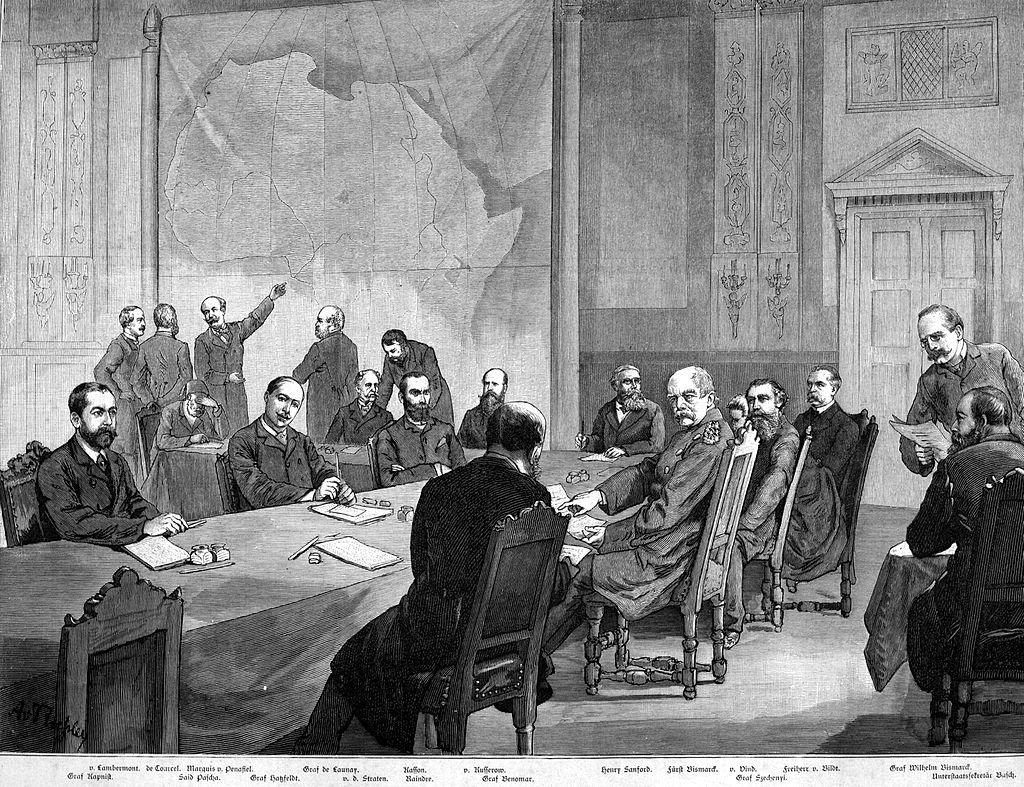
YAOUNDE, Cameroon (BG) — In the winter of 1884, leaders from Europe’s most powerful nations gathered in Berlin to determine the fate of a continent none of them belonged to.

Over three months, from Nov. 15, 1884, to Feb. 26, 1885, these Western powers meticulously divided Africa among themselves, establishing the colonial borders that would shape the continent’s future—without a single African representative present.

The conference concluded with the signing of the General Act of Berlin.

The Motives Behind the Conference

The Berlin Conference was orchestrated by German Chancellor Otto von Bismarck, who sought to prevent conflicts among European nations competing for African territory.

By the late 19th century, European imperial powers had intensified their expansionist ambitions, eager to exploit Africa’s vast natural resources, strategic trade routes and labor force.

The conference formalized what was already a frenzied land grab, ensuring that territorial claims were recognized under international law, thus avoiding direct European military conflicts over Africa.

The main participants included Britain, France, Germany, Portugal, Belgium, Spain, Italy and the Netherlands—each driven by economic, political and nationalist interests.

The United States was invited but played no significant role, and, crucially, no African nation or leader was consulted.

The Division of a Continent

The systematic partitioning of Africa followed, with European powers drawing arbitrary borders that paid little regard to existing ethnic, cultural or political structures.

By 1900, nearly 90% of Africa had fallen under European control. The British dominated vast territories, including Egypt, Sudan, South Africa and Nigeria.

France took over Algeria, Tunisia and large portions of West Africa. Belgium, under King Leopold II, claimed the Congo, leading to one of the most brutal colonial regimes in history.

Germany established control over several territories, including German East Africa (now Tanzania, Rwanda and Burundi), German Southwest Africa (now Namibia), Kamerun (now Cameroon) and Togoland (now Togo and part of Ghana).

Although Germany was a latecomer to the scramble for Africa, it quickly became one of the continent’s dominant colonial powers before losing its territories after World War I.

Lasting Consequences

The Berlin Conference set the stage for decades of colonial rule, fundamentally altering Africa’s social, political and economic landscape.

The artificial borders disregarded historical tribal territories, leading to current conflicts.

Exploiting Africa’s natural resources enriched European economies while leaving African nations impoverished.

Colonial rule suppressed indigenous governance, replacing it with foreign administrations that sowed the seeds of authoritarian rule post-independence.

Though the colonial era officially ended in the mid-20th century, the scars of the Berlin Conference remain deeply embedded in Africa’s geopolitical and economic realities.

The arbitrary borders established then continue to fuel territorial disputes and ethnic conflicts, while the economic structures imposed by European powers have had lasting repercussions on Africa’s development.

At a symposium marking the 140th anniversary of the Berlin Conference in January 2024, Togolese diplomat and Minister of Foreign Affairs Prof. Robert Dussey addressed the ongoing consequences of Africa’s partition, stating:

“In Berlin, Africa was both present and absent. It was present as a prize to be divided, with conditions set for its partition, yet absent from the decision-making process. Africa was at the heart of the conference without being a participant.”

He further criticized the enduring impact of colonialism, saying:

“The colonial past is a past that refuses to pass, because Africa still holds a vivid memory of it… Some former colonial powers still view Africa as their sphere of influence, and this is unacceptable for our generation of Africans today.”

A Lesson From History

The Berlin Conference stands as a stark reminder of the consequences of imperialism and the dangers of foreign interference in sovereign territories.

It also serves as a lesson in the importance of self-determination—something Africa was denied in 1884.

As the continent continues to navigate its post-colonial challenges, the legacy of the Berlin Conference remains a defining chapter in the story of Africa.

More than a century later, Africa is still reckoning with the decisions made in Berlin.

The world must recognize this history not as a distant past but as an ever-present reality influencing Africa’s political and economic struggles today.

Africans were once absent from the table where their fate was decided, but today, the real question is not about what was taken—it is about how we reclaim our agency, transform our challenges into opportunities, and shape our own future on our own terms.

Get the inside Story

Stay informed on the stories shaping Africa’s future. Get breaking news, in-depth analysis, opinions and exclusive insights from across the continent delivered to your inbox, free and unfiltered.


Related Posts

Dangote Commits $688 Million to Support Education in Nigeria
Politics & Economy

Dangote Commits $688 Million to Support Education in Nigeria

December 14, 2025
West Africa to Cut Air Travel Costs from 2026
Politics & Economy

West Africa to Cut Air Travel Costs from 2026

December 10, 2025
Ethiopia’s Amhara Peace Pact Reflects a Broader Shift
Politics & Economy

Africa Trade Gateway Positioned as Digital Backbone for Intra-African Trade

December 10, 2025
government of ghana and afdb sign grant agreement to support women and youth employment and social cohesion
Politics & Economy

Ghana Launches $71 million Program to Tackle Jobs Crisis

December 7, 2025
egypt moves to launch second tax facilitation package
Politics & Economy

Egypt Moves to Launch Second Tax Facilitation Package

December 7, 2025
east africa court ruling clears path for uganda tanzania pipeline
Politics & Economy

East Africa Court Ruling Clears Path for Uganda Tanzania Pipeline

December 4, 2025

Most Recent

Kenya Appoints Young Tree Activist as Conservation Envoy
Environment

Kenya Appoints Young Tree Activist as Conservation Envoy

by Jane Mukami
December 16, 2025
0

President William Ruto on Monday appointed 22-year-old Truphena Muthoni as an ambassador for Kenya’s 15 Billion Tree Planting Campaign, recognizing...

Read moreDetails
Dangote Commits $688 Million to Support Education in Nigeria

Dangote Commits $688 Million to Support Education in Nigeria

December 14, 2025
Diana Orembe Wins Africa’s Business Heroes 2025 Top Prize

Diana Orembe Wins Africa’s Business Heroes 2025 Top Prize

December 13, 2025
West Africa to Cut Air Travel Costs from 2026

West Africa to Cut Air Travel Costs from 2026

December 10, 2025
Namibia Secures $10 Million for Green Hydrogen Project

Namibia Secures $10 Million for Green Hydrogen Project

December 10, 2025
Senegal Approves Payment for African Energy Bank

Senegal Approves Payment for African Energy Bank

December 14, 2025
African Trade Bloc Expands Digital, Legal Tools to Boost Integration

African Trade Bloc Expands Digital, Legal Tools to Boost Integration

December 10, 2025
Kenya Appoints Young Tree Activist as Conservation Envoy
Environment

Kenya Appoints Young Tree Activist as Conservation Envoy

by Jane Mukami
Reading Time: 1 mins read
December 16, 2025
0

President William Ruto on Monday appointed 22-year-old Truphena Muthoni as an ambassador for Kenya’s 15 Billion Tree Planting Campaign, recognizing...

Read moreDetails
Dangote Commits $688 Million to Support Education in Nigeria
Politics & Economy

Dangote Commits $688 Million to Support Education in Nigeria

by Aissatou Fall
Reading Time: 1 mins read
December 14, 2025
0

Africa’s richest man, Aliko Dangote, has pledged ₦1 trillion ($688 million) to fund education across Nigeria over the next decade,...

Read moreDetails
Diana Orembe Wins Africa’s Business Heroes 2025 Top Prize
Finance

Diana Orembe Wins Africa’s Business Heroes 2025 Top Prize

by Jane Mukami
Reading Time: 1 mins read
December 13, 2025
0

Diana Orembe, co-founder of Tanzania-based biotech startup NovFeed, has won the 7th edition of the Africa’s Business Heroes (ABH) Prize...

Read moreDetails

The Berlin Conference: The Carving Up of Africa Without Africans

YAOUNDE, Cameroon (BG) — In the winter of 1884, leaders from Europe’s most powerful nations gathered in Berlin to determine the fate of a continent none of them belonged to.

Over three months, from Nov. 15, 1884, to Feb. 26, 1885, these Western powers meticulously divided Africa among themselves, establishing the colonial borders that would shape the continent’s future—without a single African representative present.

The conference concluded with the signing of the General Act of Berlin.

The Motives Behind the Conference

The Berlin Conference was orchestrated by German Chancellor Otto von Bismarck, who sought to prevent conflicts among European nations competing for African territory.

By the late 19th century, European imperial powers had intensified their expansionist ambitions, eager to exploit Africa’s vast natural resources, strategic trade routes and labor force.

The conference formalized what was already a frenzied land grab, ensuring that territorial claims were recognized under international law, thus avoiding direct European military conflicts over Africa.

The main participants included Britain, France, Germany, Portugal, Belgium, Spain, Italy and the Netherlands—each driven by economic, political and nationalist interests.

The United States was invited but played no significant role, and, crucially, no African nation or leader was consulted.

The Division of a Continent

The systematic partitioning of Africa followed, with European powers drawing arbitrary borders that paid little regard to existing ethnic, cultural or political structures.

By 1900, nearly 90% of Africa had fallen under European control. The British dominated vast territories, including Egypt, Sudan, South Africa and Nigeria.

France took over Algeria, Tunisia and large portions of West Africa. Belgium, under King Leopold II, claimed the Congo, leading to one of the most brutal colonial regimes in history.

Germany established control over several territories, including German East Africa (now Tanzania, Rwanda and Burundi), German Southwest Africa (now Namibia), Kamerun (now Cameroon) and Togoland (now Togo and part of Ghana).

Although Germany was a latecomer to the scramble for Africa, it quickly became one of the continent’s dominant colonial powers before losing its territories after World War I.

Lasting Consequences

The Berlin Conference set the stage for decades of colonial rule, fundamentally altering Africa’s social, political and economic landscape.

The artificial borders disregarded historical tribal territories, leading to current conflicts.

Exploiting Africa’s natural resources enriched European economies while leaving African nations impoverished.

Colonial rule suppressed indigenous governance, replacing it with foreign administrations that sowed the seeds of authoritarian rule post-independence.

Though the colonial era officially ended in the mid-20th century, the scars of the Berlin Conference remain deeply embedded in Africa’s geopolitical and economic realities.

The arbitrary borders established then continue to fuel territorial disputes and ethnic conflicts, while the economic structures imposed by European powers have had lasting repercussions on Africa’s development.

At a symposium marking the 140th anniversary of the Berlin Conference in January 2024, Togolese diplomat and Minister of Foreign Affairs Prof. Robert Dussey addressed the ongoing consequences of Africa’s partition, stating:

“In Berlin, Africa was both present and absent. It was present as a prize to be divided, with conditions set for its partition, yet absent from the decision-making process. Africa was at the heart of the conference without being a participant.”

He further criticized the enduring impact of colonialism, saying:

“The colonial past is a past that refuses to pass, because Africa still holds a vivid memory of it… Some former colonial powers still view Africa as their sphere of influence, and this is unacceptable for our generation of Africans today.”

A Lesson From History

The Berlin Conference stands as a stark reminder of the consequences of imperialism and the dangers of foreign interference in sovereign territories.

It also serves as a lesson in the importance of self-determination—something Africa was denied in 1884.

As the continent continues to navigate its post-colonial challenges, the legacy of the Berlin Conference remains a defining chapter in the story of Africa.

More than a century later, Africa is still reckoning with the decisions made in Berlin.

The world must recognize this history not as a distant past but as an ever-present reality influencing Africa’s political and economic struggles today.

Africans were once absent from the table where their fate was decided, but today, the real question is not about what was taken—it is about how we reclaim our agency, transform our challenges into opportunities, and shape our own future on our own terms.

The Berlin Conference: The Carving Up of Africa Without Africans

Bantu Gazetteby Bantu Gazette
February 26, 2025

YAOUNDE, Cameroon (BG) — In the winter of 1884, leaders from Europe’s most powerful nations gathered in Berlin to determine the fate of a continent none of them belonged to.

Over three months, from Nov. 15, 1884, to Feb. 26, 1885, these Western powers meticulously divided Africa among themselves, establishing the colonial borders that would shape the continent’s future—without a single African representative present.

The conference concluded with the signing of the General Act of Berlin.

The Motives Behind the Conference

The Berlin Conference was orchestrated by German Chancellor Otto von Bismarck, who sought to prevent conflicts among European nations competing for African territory.

By the late 19th century, European imperial powers had intensified their expansionist ambitions, eager to exploit Africa’s vast natural resources, strategic trade routes and labor force.

The conference formalized what was already a frenzied land grab, ensuring that territorial claims were recognized under international law, thus avoiding direct European military conflicts over Africa.

The main participants included Britain, France, Germany, Portugal, Belgium, Spain, Italy and the Netherlands—each driven by economic, political and nationalist interests.

The United States was invited but played no significant role, and, crucially, no African nation or leader was consulted.

The Division of a Continent

The systematic partitioning of Africa followed, with European powers drawing arbitrary borders that paid little regard to existing ethnic, cultural or political structures.

By 1900, nearly 90% of Africa had fallen under European control. The British dominated vast territories, including Egypt, Sudan, South Africa and Nigeria.

France took over Algeria, Tunisia and large portions of West Africa. Belgium, under King Leopold II, claimed the Congo, leading to one of the most brutal colonial regimes in history.

Germany established control over several territories, including German East Africa (now Tanzania, Rwanda and Burundi), German Southwest Africa (now Namibia), Kamerun (now Cameroon) and Togoland (now Togo and part of Ghana).

Although Germany was a latecomer to the scramble for Africa, it quickly became one of the continent’s dominant colonial powers before losing its territories after World War I.

Lasting Consequences

The Berlin Conference set the stage for decades of colonial rule, fundamentally altering Africa’s social, political and economic landscape.

The artificial borders disregarded historical tribal territories, leading to current conflicts.

Exploiting Africa’s natural resources enriched European economies while leaving African nations impoverished.

Colonial rule suppressed indigenous governance, replacing it with foreign administrations that sowed the seeds of authoritarian rule post-independence.

Though the colonial era officially ended in the mid-20th century, the scars of the Berlin Conference remain deeply embedded in Africa’s geopolitical and economic realities.

The arbitrary borders established then continue to fuel territorial disputes and ethnic conflicts, while the economic structures imposed by European powers have had lasting repercussions on Africa’s development.

At a symposium marking the 140th anniversary of the Berlin Conference in January 2024, Togolese diplomat and Minister of Foreign Affairs Prof. Robert Dussey addressed the ongoing consequences of Africa’s partition, stating:

“In Berlin, Africa was both present and absent. It was present as a prize to be divided, with conditions set for its partition, yet absent from the decision-making process. Africa was at the heart of the conference without being a participant.”

He further criticized the enduring impact of colonialism, saying:

“The colonial past is a past that refuses to pass, because Africa still holds a vivid memory of it… Some former colonial powers still view Africa as their sphere of influence, and this is unacceptable for our generation of Africans today.”

A Lesson From History

The Berlin Conference stands as a stark reminder of the consequences of imperialism and the dangers of foreign interference in sovereign territories.

It also serves as a lesson in the importance of self-determination—something Africa was denied in 1884.

As the continent continues to navigate its post-colonial challenges, the legacy of the Berlin Conference remains a defining chapter in the story of Africa.

More than a century later, Africa is still reckoning with the decisions made in Berlin.

The world must recognize this history not as a distant past but as an ever-present reality influencing Africa’s political and economic struggles today.

Africans were once absent from the table where their fate was decided, but today, the real question is not about what was taken—it is about how we reclaim our agency, transform our challenges into opportunities, and shape our own future on our own terms.

Get the inside Story

Stay informed on the stories shaping Africa’s future. Get breaking news, in-depth analysis, opinions and exclusive insights from across the continent delivered to your inbox, free and unfiltered.


Related Posts

Dangote Commits $688 Million to Support Education in Nigeria

Dangote Commits $688 Million to Support Education in Nigeria

by Aissatou Fall
December 14, 2025
0

...

West Africa to Cut Air Travel Costs from 2026

West Africa to Cut Air Travel Costs from 2026

by Samira Benhadda
December 10, 2025
0

...

Ethiopia’s Amhara Peace Pact Reflects a Broader Shift

Africa Trade Gateway Positioned as Digital Backbone for Intra-African Trade

by Aissatou Fall
December 7, 2025
0

...

government of ghana and afdb sign grant agreement to support women and youth employment and social cohesion

Ghana Launches $71 million Program to Tackle Jobs Crisis

by Cynthia N. Ganchok
December 4, 2025
0

...

egypt moves to launch second tax facilitation package

Egypt Moves to Launch Second Tax Facilitation Package

by Samira Benhadda
December 1, 2025
0

...

east africa court ruling clears path for uganda tanzania pipeline

East Africa Court Ruling Clears Path for Uganda Tanzania Pipeline

by Jane Mukami
November 29, 2025
0

...

Kenya Appoints Young Tree Activist as Conservation Envoy
Environment

Kenya Appoints Young Tree Activist as Conservation Envoy

by Jane Mukami
Reading Time: 1 mins read
December 16, 2025
0

President William Ruto on Monday appointed 22-year-old Truphena Muthoni as an ambassador for Kenya’s 15 Billion Tree Planting Campaign, recognizing...

Read moreDetails
Dangote Commits $688 Million to Support Education in Nigeria

Dangote Commits $688 Million to Support Education in Nigeria

by Aissatou Fall
December 14, 2025
0

Africa’s richest man, Aliko Dangote, has pledged ₦1 trillion ($688 million) to fund education across Nigeria over the next decade,...

Diana Orembe Wins Africa’s Business Heroes 2025 Top Prize

Diana Orembe Wins Africa’s Business Heroes 2025 Top Prize

by Jane Mukami
December 13, 2025
0

Diana Orembe, co-founder of Tanzania-based biotech startup NovFeed, has won the 7th edition of the Africa’s Business Heroes (ABH) Prize...

West Africa to Cut Air Travel Costs from 2026

West Africa to Cut Air Travel Costs from 2026

by Samira Benhadda
December 10, 2025
0

The Economic Community of West African States (ECOWAS) has announced a major regional reform to reduce air travel costs across...

Namibia Secures $10 Million for Green Hydrogen Project

Namibia Secures $10 Million for Green Hydrogen Project

by Naledi Kgosi
December 10, 2025
0

The African Development Bank has approved a $10 million loan to support Namibia’s large-scale green hydrogen project, developed by Hyphen...

Next Post

Maroc : une feuille de route pour créer 1,45 million d’emplois d’ici 2030

Ugandan MPs Urge School Infrastructure Upgrades to Support New Curriculum

La Côte d’Ivoire appelle à inverser la tendance du changement climatique

Call for Investment and Economic Growth at Cameroon Economic Meetings

The editorial platform of Bantu Agency.

The editorial platform of Bantu Agency.

Our Platforms

  • Bantu Magazine
  • Bantu Brief
  • Black Frame Studio

Our Services

  • Bantu Agency
  • Advertise
  • Partnerships

Our Services

  • Editorial Director
  • Opportunities
  • Contact

The editorial platform of Bantu Agency.

Our Platforms

  • Bantu Magazine
  • Bantu Brief
  • Black Frame Studio

Our Services

  • Bantu Agency
  • Advertise
  • Partnerships

Our Services

  • Editorial Director
  • Opportunities
  • Contact
Bantu Gazette
  • Energy & Trade
  • Finance
  • Health
  • Politics & Economy
  • Technology
  • Environment
  • Feature
  • Opinion
  • Changemakers
  • Tourism & Culture
  • Magazine